You’d Be Amazed How Many People Want Big Oil Charged With Homicide
Heather Souvaine Horn The New Republic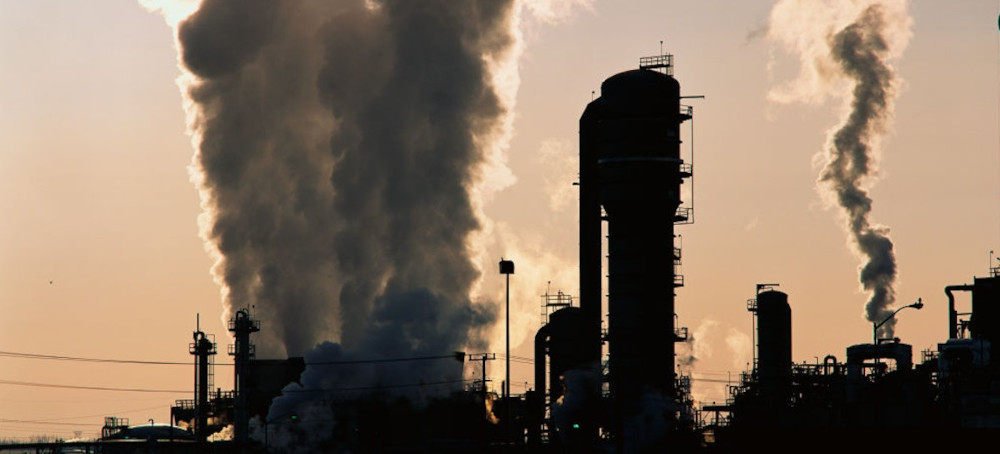 Smokestacks at a petroleum processing plant. (photo: Getty)
A new poll shows overwhelming support for holding oil and gas companies accountable via the courts.
These are striking numbers. As I wrote in this newsletter last month, all too often pollsters ask people vague questions about whether people support “steps” to address climate change, without specifying what those steps are. That didn’t happen with this poll, which was conducted by the progressive think tank Data for Progress and consumer rights advocacy group Public Citizen. This was the exact question: “Do you think that oil and gas companies should be held legally accountable for their contributions to climate change, including their impacts on extreme weather events and public health?” In addition to the aforementioned political divides, women said “yes” more often than men, young people more often than old people, and Black or Latino people more often than white people—but that still adds up to a striking degree of support for accountability for fossil fuel companies.
Nor did the poll stop there. It also asked whether people supported not just civil lawsuits but criminal prosecutions for “reckless or negligent homicide.” This is a relatively new idea, and a somewhat edgy one for a lot of people. But 49 percent of respondents said they supported this too, compared to only 39 percent who said they’d oppose.
The New Republic has been covering legal approaches to climate accountability for years now: both the civil suits and more recent approaches. Public Citizen’s Aaron Regunberg and David Arkush made the case for criminal prosecutions, and specifically homicide charges, in March. “In criminal law, homicide means causing a death with a culpable mental state,” they reasoned. “If someone substantially contributes to or accelerates a death, that counts as ‘causing’ it. If they did so intentionally, knowingly, or recklessly, that counts as ‘culpable mental state.’ So the basic questions in a climate homicide trial are as follows: Did fossil fuel companies substantially contribute to or accelerate deaths, and did they do so at least recklessly, if not knowingly or intentionally?”
Criminal charges can do things that civil lawsuits can’t. “In today’s thinking,” Regunberg and Arkush wrote, “tort law—the law of civil wrongs—seeks economically efficient outcomes: The question is about whether one party should give another some money. Criminal law, by contrast, is concerned with society’s fundamental values—with morality.” And that’s reflected in the effects of these types of law: “Where tort law prices misconduct, criminal law prohibits it.”
Regunberg and law professor Donald Braman subsequently proposed another novel legal approach: civil asset forfeiture. That’s a tool that’s typically used by cops to confiscate property they suspect of being used for committing crimes—a system that disproportionately penalizes poor people and minorities, and in which it’s often very hard to recover the seized assets even if no crime is ever proven. But it was originally intended, Regunberg and Braman wrote, to be used against “large-scale criminal enterprises.” Since legal experts are now arguing that fossil fuel companies’ activities “could fall under the category of criminal violations such as reckless endangerment, criminal mischief, conspiracy and racketeering, and homicide,” Regunberg and Braman wrote, it stands to reason that the “pipelines, refining plants, and oil reserves” that are “recklessly endangering entire communities” could be confiscated by the police.
And then there’s Kate Aronoff’s latest. Given that fossil fuel companies have manufactured and promoted plastics for decades—even misleading the public about plastics recycling—there really ought to be a way, she argued, to hold them accountable at the international level for microplastics, which have now been found not only in “food, water, blood, and placenta” but also in human testicles. “In a recent book,” she wrote, “Spanish economist and environmental adviser David Lizoain makes the case for bringing fossil fuel executives in front of the International Criminal Court, and understanding rising temperatures—and the resulting mass deaths—as climate genocide.”
The international legal system is, on the whole, much more favorable to companies than it is to their potential victims, Kate argued. And that’s arguably true in the domestic arena as well. Which brings us back to the recent poll: If this many people favor legal accountability, perhaps that may be about to change.