Within Days, Trump Will Decide on Ground War
Prof Robert Pape Escalation Trap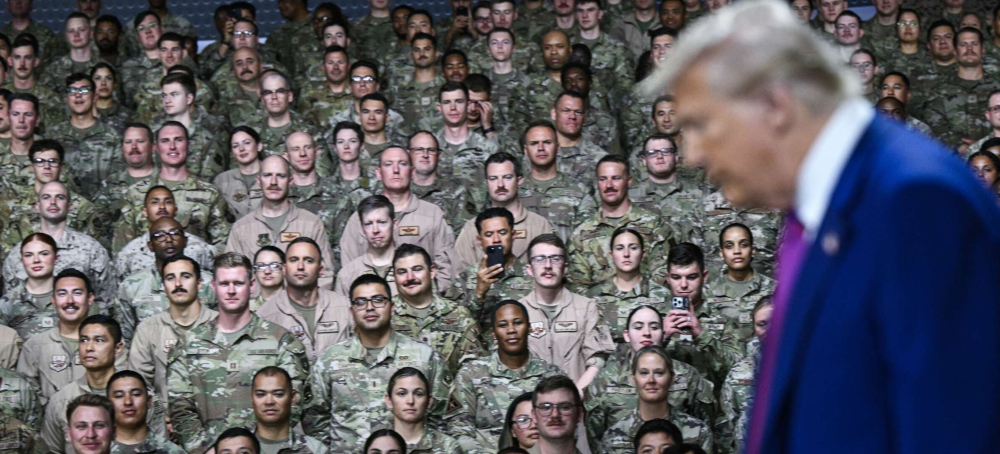 Watch the Signals That Actually Matter—Before It’s Obvious to Everyone Else. (photo: Getty)
ALSO SEE: Escalation Trap, Prof Robert Pape on Substack
Watch the Signals That Actually Matter—Before It’s Obvious to Everyone Else
The headlines suggest uncertainty: shifting statements, mixed signals, constant speculation about what comes next. It creates the impression that the trajectory of the war depends on what leaders decide in the moment.
But that is not how wars like this unfold
By the time a decision appears in public, the underlying conditions that make it possible—or necessary—have already taken shape. The real drivers are not the words. They are the movements beneath them.
The Decision Already Taking Shape
The expected arrival of additional U.S. Marines in the region between April 7 and April 10 is not just reinforcement. It is a structural signal.
Deployments of this kind change the logic of the war before any formal decision is made. They expand operational options, but more importantly, they narrow political flexibility. Once forces are positioned to secure critical infrastructure—especially around the Strait of Hormuz—the mission begins to shift from coercion to control.
This is the threshold.
What begins as a limited effort to restore deterrence becomes a requirement to maintain stability. What is framed as temporary becomes embedded. And once that shift occurs, the question facing policymakers is no longer whether to escalate, but how far escalation must go to achieve the objective.
By the time a ground war decision is announced, much of the logic behind it has already been set in motion.
Within days, these deployments will translate into visible actions. When they do, most observers will see escalation. They will miss what stage of the war it represents.
Why the Deployments Already Matter
The deployments are not just shaping U.S. options. They are already reshaping the region.
The core issue is control over energy flows through the Strait of Hormuz, through which roughly a fifth of global oil supply moves and on which Gulf economies depend for a substantial share of state revenue. Iran’s ability to disrupt or condition access to that flow is not just a military lever—it is a political one.
As Iran’s leverage grows, regional states are beginning to adjust.
Three distinct patterns are emerging.
First, Iraq is moving to distance itself from U.S. military operations while quietly ensuring its own economic lifelines. That means hedging—maintaining formal ties with Washington while exploring arrangements that reduce vulnerability to disruption in the Strait.
Second, states like Qatar and Oman are positioning themselves as neutral intermediaries. Their objective is not alignment, but insulation—preserving flexibility by avoiding full commitment to either side while keeping channels open.
Third, Saudi Arabia and the United Arab Emirates face the most acute dilemma. They are the most exposed to long-term instability in energy flows and the most threatened by the political implications of Iranian dominance over the Strait. For them, the risk is not just economic. It is internal: sustained vulnerability could translate into domestic pressure and questions about regime security.
This is the key shift now occurring in Iran’s favor.
The war is no longer simply a U.S.–Iran confrontation. It is becoming a system-wide stress test that is fragmenting regional alignment in real time.
The Hidden Logic of the Escalation Trap
This is where most analysis gets the dynamic wrong.
There is an assumption that rising costs—higher oil prices, market instability, regional pressure—will push toward restraint. But in conflicts like this, rising costs often produce the opposite effect.
They increase the incentive to resolve the underlying source of instability.
If energy flows remain insecure, and if regional partners begin to hedge or fragment, the pressure on the United States is not simply to manage the situation. It is to restore control over it. That is what makes ground operations more likely, not less.
The escalation trap is not driven by aggression alone.
It is driven by the interaction of strategic failure and systemic political pressure. When limited measures fail to stabilize the system, the demand for more decisive action grows.
And by the time that demand becomes visible, the pathway toward escalation is already constrained.
Live Briefing, April 4 at 5pm ET: Dynamics Before They Become Obvious
Over the next several days, these dynamics will move from underlying structure to visible reality.
The arrival of U.S. forces, the response of regional states, and the continued instability in energy flows will begin to reveal what kind of war this is becoming.
Most people will see these developments as isolated events. They are not. They are connected—and they point in a specific direction.
On April 4 at 5pm ET, I’m hosting a live briefing where I will map the escalation stages now underway, explain what the current deployments signal, and identify the specific indicators to watch over the next 7–10 days.
This is the window when the structure becomes visible—and when interpretation matters most.