Wisconsin Supreme Court Strikes Down 1849 Abortion Ban
Kate Zernike The New York Times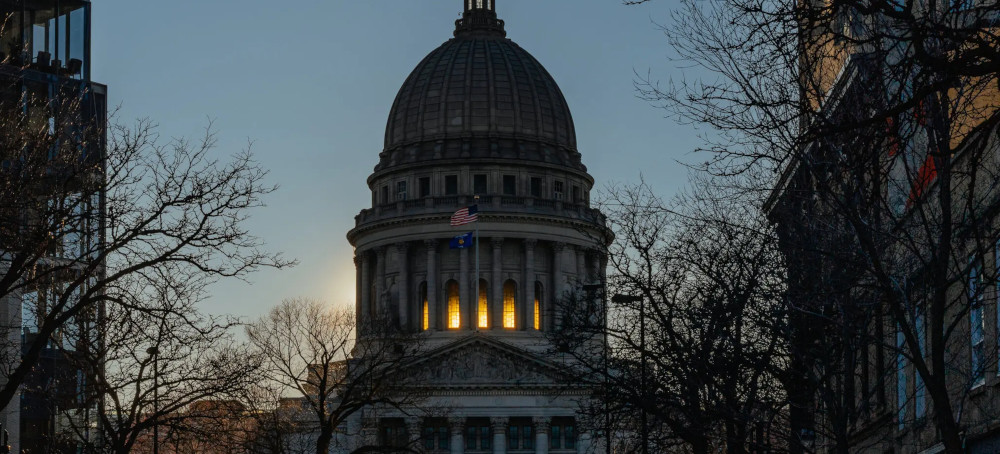 After Roe v. Wade was overturned, Gov. Tony Evers and Attorney General Josh Kaul of Wisconsin sued to invalidate the state’s ban. (photo: Jamie Kelter Davis/The New York Times)
ALSO SEE: Wisconsin Supreme Court’s Liberal Majority Strikes Down 176-Year-Old Abortion Ban
After the U.S. Supreme Court overturned Roe v. Wade in 2022, Republican prosecutors in Wisconsin said they intended to enforce the old law.
The decision on Wednesday settles an uncertainty that has surrounded abortion law in the state since June 2022, when the U.S. Supreme Court overturned Roe v. Wade, ending the constitutional right to an abortion nationwide.
It also reflects the significance of the state’s elections for Supreme Court justices, which have been hotly contested and revolved largely around abortion rights since the fall of Roe.
Thecourt ruled 4-3 to strike down the ban, and while the justices are officially nonpartisan, the decision split them along ideological lines. A new justice who had campaigned on her support for abortion rights, Janet Protasiewicz, joined the majority.
The 1849 state law had said that anyone other than the pregnant woman “who intentionally destroys the life of an unborn child” could face six years in prison and a $10,000 fine. The only exception was for a “therapeutic abortion” to save the life of the pregnant woman.
After the U.S. Supreme Court’s decision to overturn Roe returned the regulation of abortion to the states, Gov. Tony Evers and the attorney general, Josh Kaul, both Democrats, sued to invalidate the 1849 ban. They argued that it had been effectively repealed over the years by other abortion regulations, including a law that prohibits abortion after 20 weeks of pregnancy and one that imposes a 24-hour waiting period for abortions.
But some prosecutors said they would enforce the 1849 law, prompting doctors and clinics to cease providing abortions in the state for nearly 18 months.
Clinics resumed providing abortions in December 2023, after a Dane County judge ruled that the 1849 ban was not valid and the state’s voters elected Justice Protasiewicz, who declared her support for abortion rights on the campaign trail.
The district attorney of Sheboygan County, Joel Urmanski, a Republican, had appealed the Dane County decision invalidating the ban. He said that the laws regulating abortion that were passed after Roe were always intended to preserve the 1849 law.
But Justice Protasiewicz’s election provided a liberal majority on the court and all but ensured that it would overturn the ban.
Writing for the majority in the case, known as Kaul v. Urmanski, Justice Rebecca Dallet essentially repeated the argument the governor and attorney had made.
“Comprehensive legislation enacted over the last 50 years regulating in detail the ‘who, what, where, when, and how’ of abortion so thoroughly covers the entire subject of abortion that it was meant as a substitute for the 19th century near-total ban on abortion,” she wrote.
The opinion noted that the court had historically set a high bar for such “implied repeal.” But in this case, the majority of the justices found that the Legislature had met that bar by entirely revising state law on abortion.
“Indeed, these statutes specify, often in extraordinary detail, the answer to nearly every conceivable question about abortion,” Justice Dallet wrote. “Who may perform abortions? Only doctors. Where may abortions be performed? Within 30 miles of a hospital where the doctor has admitting privileges. When may abortions be performed? Prior to viability or 20 weeks of pregnancy except when necessary to preserve the life or health of the mother or in a medical emergency.”
In a statement, Governor Evers said: “Today is a win for women and families, a win for health care professionals who want to provide medically accurate care to their patients, and a win for basic freedoms in Wisconsin, but our work is not over.
“I will continue to fight any effort that takes away Wisconsinites’ reproductive freedom or makes reproductive health care, whether birth control, abortion, I.V.F., or fertility treatments, any less accessible in Wisconsin than it is today,” he said. “That is a promise.”
The state’s Republican Party denounced the decision. “The Wisconsin Supreme Court’s role is to follow the Constitution, not to make law,” the party’s chairman, Brian Schimming, said in a statement. “This issue should be resolved in the legislature and by voters, not by far-left justices parading as legislators.”
At a hearing in November, the justices who are considered part of the court’s liberal majority sparred with a lawyer for Mr. Urmanski, prompting him to acknowledge that the ban would, for example, force a 12-year-old girl who had been raped by her father to carry a pregnancy to term.
In a separate order Wednesday, the court dismissed a lawsuit filed by Planned Parenthood of Wisconsin that had asked the court to find that the right to equal protection in the state Constitution protects a right to receive an abortion and protects medical professionals who provide one. The court said its ruling in Kaul v. Urmanski effectively settled the issue.
Michelle Velasquez, a lawyer and chief strategy officer of Planned Parenthood of Wisconsin, welcomed the court’s action on the 1849 ban.
“While we celebrate this ruling, there is more to be done,” she said in a statement. “We will continue working to protect and expand reproductive freedom in Wisconsin so that everyone who needs comprehensive reproductive health care in our state can get the nonjudgmental and compassionate care they deserve.”
Pre-Roe bans like Wisconsin’s 1849 statute are on the books in other states, and they too have become central issues in electoral politics. Concern over one in Michigan fueled a successful ballot measure there establishing a right to abortion in the state Constitution. In Arizona, a Republican-led Supreme Court ruled that a ban enacted when Arizona was still a territory remained valid, but the Legislature then repealed the law. In November, Arizona voters, too, approved a ballot measure establishing a right to abortion in their state Constitution.