Will Ohio Voters Back Abortion Rights? Other Red and Swing States Have.
Hannah Knowles and Adrian Blanco The Washington Post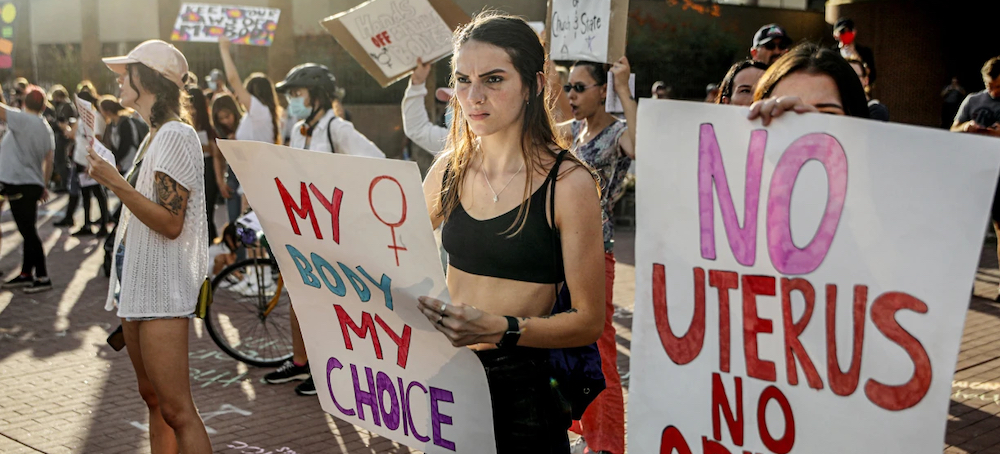 Abortion rights protesters chant during a Pro Choice rally. (photo: Sandy Huffaker)
But Howard, 53, also knows a woman who got pregnant in high school and said an abortion kept her life on track. She plans to vote “yes” this week on an Ohio ballot measure that would enshrine access to the procedure in the state constitution.
“I don’t think the government should be able to tell us what we should do with our own bodies,” Howard said on a break one recent evening from her shift at Target. “We give that right away, might as well give all our rights away.”
People like Howard could soon deliver an abortion rights victory in a Republican-leaning state, underscoring how a new era of abortion bans have stoked a backlash from voters — even in places that helped elect Trump and pave the way for an end to nationwide access. The results of Ohio’s Issue 1 vote, which ends Tuesday, will test support for abortion in a state where GOP leaders passed a ban after about six weeks of pregnancy. It will also offer a new data point on the politics of abortion ahead of the 2024 elections.
Since Roe was overturned in June 2022, voters have backed abortion rights in six states, including ruby-red states like Kansas and Kentucky that rejected antiabortion ballot measures last year that would have removed or explicitly denied a right to the procedure in their state constitutions.
And in August, Ohioans voted down another ballot measure — also called Issue 1 — in what was effectively a proxy fight on abortion. That measure, had it passed, would have made it harder to amend the constitution and boosted abortion opponents’ chances heading into November.
It also underscores how the issue of abortion access can scramble typical party lines. Fifteen counties that favored Trump for president in 2020 voted against raising the threshold to amend the constitution from a simple majority to 60 percent.
Howard lives in one of these counties, Greene County, near Dayton. In 2020, it broke for Trump by nearly 20 points, but in August, it voted against raising the constitutional amendment threshold by less than a point.
In Ohio, many Trump supporters may vote for abortion rights
A closer look at other red and swing states that have voted on abortion shows something similar. While voters favoring abortion rights are heavily concentrated in cities with large populations and more Democrats, they also won out in a number of counties that backed Trump in 2020.
Many counties Trump won have backed abortion rights
Abortion is currently legal in Ohio up until 22 weeks of pregnancy — not too different from the standard that Roe established half a century ago, which once barred states from restricting abortion before the point at which a baby can survive outside the womb.
But an expansive ban is working its way through the courts and could be reinstated. It would prohibit abortions after a fetal heartbeat is detected: around six weeks, before many realize they are pregnant.
The most common abortion procedures and when they occur
Ohio Gov. Mike DeWine (R) and the GOP-led state legislature passed the law in 2019, when such restrictions were deemed unconstitutional. It took effect in 2022 when a newly conservative Supreme Court overturned Roe. Trump reshaped the high court as president with three successful nominations of antiabortion conservatives.
If adopted, Issue 1 would prohibit state interference in an individual’s “reproductive decisions.” It would allow the government to ban abortion after the point of fetal viability, but not in cases where a physician determines it is necessary to protect “the patient’s life or health.”
Abortion opponents have been trying to appeal to voters uncomfortable with the strictest bans, arguing that Issue 1 would take Ohio too far in the other direction and that the “health” of the patient leaves too much room for interpretation. DeWine features in an ad calling Issue 1 “just not right for Ohio.”
Many voters in Ohio agree.
“My problem with Issue 1 is it’s too broad,” said Char Swingle, 63, a Republican-leaning voter from Beavercreek who plans to vote no this week. “I think they would get a lot more support if they spelled out — closed off the open-endedness of it.”
“Maybe they have a lot,” she added. “I don’t know.”
Beyond ballot measures, abortion continues to be a focal point in state and federal races, with Democrats overwhelmingly supporting wider access and Republicans often opposed but also divided over the best approach. Party strategists are closely watching this year’s results for clues to shape their 2024 strategies.
Abortion remains a galvanizing issue for the conservative base, and its opponents believe that better messaging — which multiple elections this week will put to the test — could combat Democrats’ apparent advantage on the issue in elections after Roe was struck down. But many Republicans worry their party has overreached in key states while struggling to match the energy of voters outraged over sudden rollbacks in access.
“Everything changes once the government takes away rights,” said Matthew Hildreth, the executive director of Rural Organizing, which has been working to rebuild Democratic support in rural areas and has been distributing thousands of yard signs supporting Issue 1. Under Roe, he said, it was easy to simply identify as “pro-life” — but those voters don’t necessarily support the restrictions that replaced Roe.
When Hildreth first dove into rural political organizing, he recalled, “people said, you can’t talk about abortion, you can’t talk about gay marriage. The social issues are what are killing us. And we’ve actually found that not to be the case — in fact, these days, abortion is one of the only policies that’s actually moving voters.”