Why Trump’s Power-Grid Bombing Plan Risks Catastrophe—for Iranians and Americans
Prof Robert Pape Escalation Trap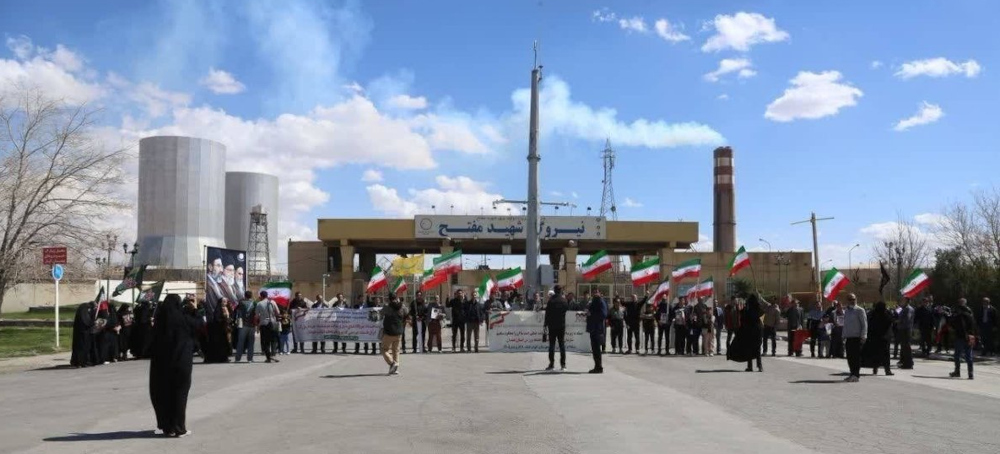 In response to President Trump's threat to attack Iranian civilian infrastructures, Iranians formed human chains near potential US and Israeli targets. (photo: Fars News)
ALSO SEE: Escalation Trap, Prof Robert Pape on Substack
It has never worked.
Across cases, bombing civilian infrastructure—especially power—has not caused populations to rise up and overthrow their governments. It has hardened societies, increased regime control, and set conditions for ground war to do the real coercive work. The historical record is unambiguous on this point.
Over and over, Donald Trump has bombed, strategically failed, climbed the escalation ladder, and failed again. This is bombing to lose, not bombing to win.
Striking Iran’s electric power will be another tragic failure—one that risks a humanitarian disaster of historic scale.
II. What “Taking Down the Grid” Actually Means
What follows is the part of this strategy that is never explained publicly—but determines whether it works or fails.
There are two operational pathways to crippling a national power system, and they are not equivalent.
The first targets high-voltage transformers at major substations. These are critical nodes that step power up and down across the grid. Destroying them can cascade outages across wide regions. But transformers, while expensive, are modular and replaceable. With focused repair and substitution, electricity can often be restored in weeks.
The second targets the generating “hulls” of power plants—the core physical structures that produce electricity. These are not modular components. They are massive, custom-built systems with long lead times and complex installation requirements. When hulls are destroyed, restoration is measured in months, not weeks.
The difference between these options is the difference between disruption and collapse.
One imposes a temporary shock.
The other dismantles the system that sustains civilian life.
III. What Trump’s Language Signals
That distinction is why a small detail in Trump’s public statements should set off alarms.
He has not simply threatened to “knock out” Iran’s power. He has said he intends to ensure that “every power plant in Iran will be out of business”—and, crucially, “never to be used again.”
That phrasing points to the hull-destruction option.
If that is the plan, the consequences are stark. Disabling electricity for several weeks would be damaging. Disabling it for six months or longer would be catastrophic. Hospitals lose life-saving equipment. Water systems fail. Food spoils without refrigeration. Supply chains fracture. Urban life—dependent on continuous power—begins to unravel.
This is not pressure.
It is the deliberate collapse of civilian infrastructure for tens of millions of people.
And it will not produce the political outcome its advocates imagine.
IV. The Strategic Illusion
The theory behind such attacks is simple: impose suffering, and civilians will turn on their leaders.
History says the opposite.
From World War II to more recent conflicts, large-scale bombing of civilian systems has consistently produced anger at the attacker, not rebellion against the regime. Populations under sustained air attack do not fragment; they cohere. Governments exploit the threat to consolidate control, suppress dissent, and mobilize nationalism.
Systematically destroying the generating capacity of Iran’s largest plants would almost certainly trigger a major humanitarian disaster for ordinary Iranians.
It would also fail to generate regime change.
Instead, it would deepen hostility, strengthen hardliners, and narrow the space for any internal opposition. What begins as a strategy of coercion ends as a mechanism of entrenchment.
A moral disaster for no strategic gain.
V. The Retaliation Americans Should Expect
The final danger is not in Iran alone. It is in what comes next.
Iran’s leadership has already signaled that attacks on core civilian infrastructure will be met with severe retaliation. Given the nature of the strike being contemplated, that retaliation is unlikely to be proportionate. It will be designed to impose pain—on Gulf states, on regional infrastructure, and potentially on Americans.
It is unrealistic to believe that a campaign that kills thousands, disrupts the lives of tens of millions, and lowers life expectancy across a society will not generate demands for vengeance. States do not absorb such blows quietly. Societies do not forget them.
This cycle is well established. When German bombing killed thousands of civilians in London during the Blitz, the British response escalated dramatically—shifting to area bombing of German cities that killed hundreds of thousands. The attacks did not break Germany’s will. They intensified the war.
The same logic applies here.
If the United States destroys Iran’s power grid, it should expect retaliation that is broader, harsher, and less controllable than anything seen so far in this conflict. Gulf civilians will be exposed. American personnel and potentially civilians will be at risk.
Escalation will not stop at the grid.
It will spread.
And once it does, it will be far harder to contain than to begin.