Why Trump’s Justice Department Is Redefining Dissent as Terrorism
Mark Joseph Stern Slate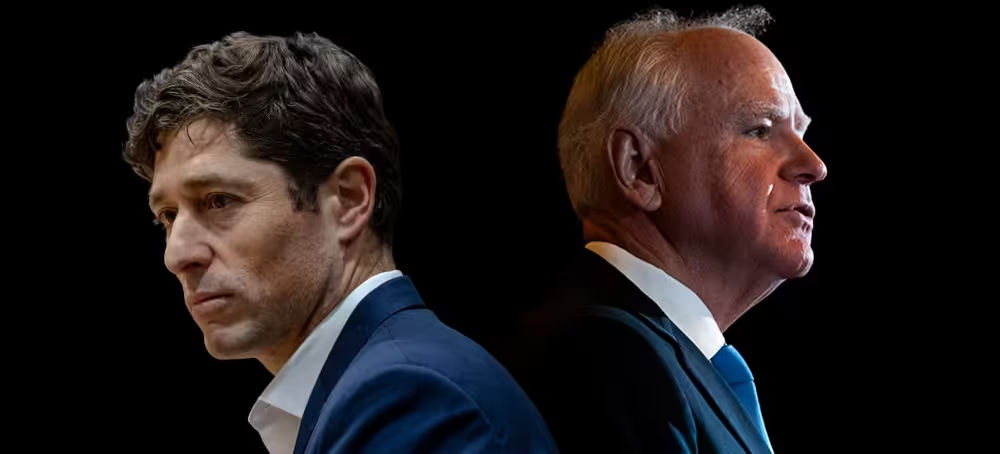 Minneapolis Mayor Jacob Frey, and Minnesota Gov. Tim Walz. (photo: Slate)
On this week’s episode of Amicus, Mark Joseph Stern spoke with Julia Gegenheimer about the rapidly expanding definition of terrorism, obstruction, and other charges that the government is weaponizing against political opponents. Gegenheimer is special litigation counsel at Georgetown Law’s Institute for Constitutional Advocacy and Protection and previously served at the Justice Department’s Civil Rights Division. An excerpt from their conversation, below, has been edited for length and clarity.
Mark Joseph Stern: You spent years working on cases involving domestic terrorism and extremist violence. Is this what happens when almost anyone can be classified as a “terrorist” and any opposition to the government, including protected First Amendment activities, can be classified as “terrorism”?
Julia Gegenheimer: I think it’s important here, when we talk about domestic terrorism, to take a step back and look at what we actually mean when we use that term. It’s being thrown around a lot in common parlance to stand in for people who are opposed to this administration or its policies, or who are protesting this administration, or who seek to hold it accountable. But federal law actually defines domestic terrorism. Under the law, domestic terrorism involves activities that are “dangerous to human life,” that are in violation of federal criminal law—and, on top of that, have the intent to intimidate a population, or to affect the “conduct” or “policy” of a government by “intimidation or coercion.”
Even then, domestic terrorism is not itself a federal crime. You have to have an underlying federal criminal violation, then these additional layers of motivation or intent stack on top of it. So the impact of throwing this term around very loosely is to threaten criminal punishment for conduct that falls far, far short of what federal law would actually look at as domestic terrorism.
We’ve seen the president and his allies calling these protesters “terrorists.” We’ve seen the government treating protesters like Renee Good much as they treated the fishermen in international waters, whom they bombed without any semblance of due process. It feels to me like an escalation to then accuse elected local and state leaders of terrorism.
It is profoundly disturbing. And the reason why this feels different to you is that it is a bit of a different flavor. It’s pitting the federal government against the states and creating tension where it doesn’t need to be. And frankly, it’s implicitly encouraging acts of political violence against these elected officials by turning them into the enemy.
So we have the Trump administration falsely accusing state and local leaders of encouraging political violence—and, in the process, actually encouraging political violence against the people they’re defaming.
Sure. We’ve seen this throughout history, even recent history: When you put people in opposition like that—when you portray them as the enemy, when you describe them as kind of threatening a person’s way of life or things that they hold dear—that creates the conditions under which people are more likely to resort to political violence, and it becomes more and more the norm.
It feels very much of a piece with the Trump administration treating blue states as the enemy of the federal government and even the American people. The administration is shutting off federal funds to blue states, canceling projects within blue states, trying to suppress the votes of blue state residents. It’s direct hostility and antagonism toward the half of the country that didn’t vote for Trump. It’s also a refusal to acknowledge the legitimacy of whom those people did vote for, including Tim Walz.
It seems to me that it leads to a really dark place when the federal government can almost declare war on a state because it didn’t go for him in the most recent election. Then occupy that state with federal agents who are actively hostile and in fact violent toward the local community.
Officials in this administration have been explicit that they are targeting blue states. We’ve seen the surges in Minnesota, Chicago, and Washington, D.C. The reasoning behind that has been that these are traditionally blue states or Democratic areas. It doesn’t take too much reading between the lines to see that that’s what’s going on.
In his address to Minnesotans, Gov. Tim Walz urged residents to bear witness and help to create a record. That record, of course, will be vital in prosecutions, should they ever happen. But at the same time, the Trump administration is telling citizens that following or recording ICE officers is a federal crime and maybe even domestic terrorism. That it’s an obstruction of law enforcement to follow federal agents and to document what they are doing. Is that true?
No. The act of observing and recording officers from a safe distance, including when they are making an arrest, is something that has been long- and well-recognized as protected by the First Amendment.
Could you explain why? There’s a wrinkle here because smartphones are 21st-century technology that the Framers couldn’t possibly have conceived of. But it does seem like this is bedrock First Amendment stuff, right? The First Amendment isn’t just billionaires buying an election. I would think that in a democracy, regular people have a right, if not a duty, to document what public officials are doing on the job, very much including armed agents of the state. Is that something the law bears out?
Yes. Cellphone recordings of ICE activity connect back to these really fundamental principles that the First Amendment was designed to protect. They’re connected to the idea that people have a right to know what their government is doing so they can express views on what their government is doing and protest peacefully against it.