Who the Madman Theory Is Really For
Bobby Ghosh Substack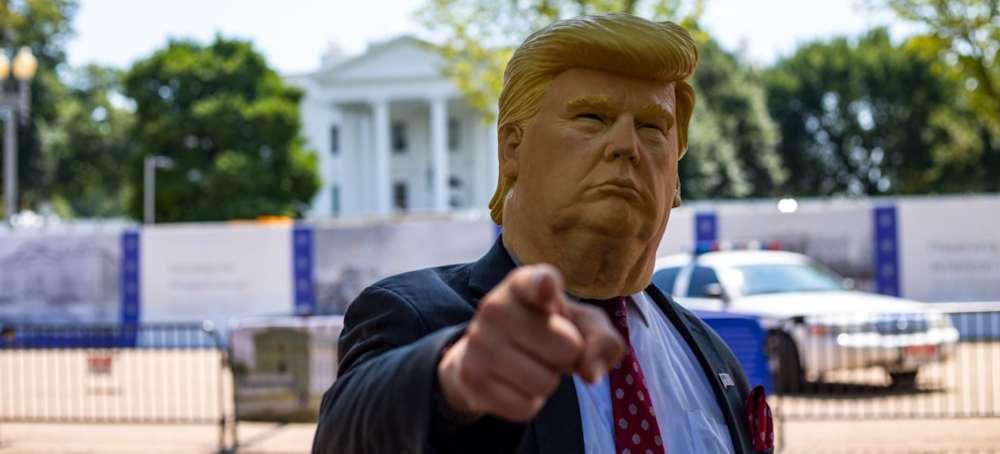 Trump’s conduct of the war against Iran is being marketed as Nixonian foreign-policy strategy, but it’s being aimed at a domestic audience. (photo: Darren Halstead/Unsplash)
ALSO SEE: Ghoshworld, Bobby Ghosh on Substack
Trump’s conduct of the war against Iran is being marketed as Nixonian foreign-policy strategy, but it’s being aimed at a domestic audience.
Over the last ten days, senior officials have briefed the Wall Street Journal on the president’s thinking behind his most inflammatory Truth Social posts on Iran — explaining that he wrote “Praise be to Allah” to appear unstable, and that his threats to destroy Iranian civilization were meant to frighten Tehran into terms. Marco Rubio has told people the language might do the trick. Anonymous aides have been quoted in Axios describing the president’s frame of mind (“He’s over it. He wants it done.”). A column in The Hill has drawn the explicit line to Richard Nixon, and the framing has now migrated through enough outlets that it is settling into the conventional wisdom of the Washington foreign-policy class.
This is a peculiar way to practice the Nixonian strategem. The Iranian political establishment, such as it is after the decapitation on opening night of the war, does not learn what Trump is doing by reading the WSJ. It reads its own cables, its own signals intelligence, and the record of his five blown deadlines. The audience for all this briefing is not in Tehran. It is in Washington.
Trump’s madman gambit is not a diplomatic instrument aimed at the Islamic Republic, but a domestic communications instrument aimed at Americans — and, more narrowly, at voters who will decide in November whether to punish its president for a war that he promised would last two or three weeks and is now entering its ninth.
The madman theory, in Trump’s hands, is a frame for explaining away failure. It converts a blown deadline into a head-fake. It converts a self-contradicting Truth Social post into four-dimensional chess. It converts Iran’s refusal to yield into proof that the pressure is working, because the pressure is always just about to work. Every time the president tells Fox News there is no time frame on the war, he is inviting his audience to believe that open-endedness is a choice, not a trap.
To see how the gambit works, compare it to the model Trump is reaching for. Richard Nixon ran his madman ploy as a covert operation, as the historians Jeffrey Kimball and William Burr established in a body of archival work culminating in Nixon’s Nuclear Specter, (I just reread the book, and cannot recommend it highly enough.) The centerpiece was a secret global nuclear alert in October 1969, with eighteen B-52s on provocative patrols near Soviet airspace.
The operative word there is secret. The American public was not told. H.R. Haldeman’s account of Nixon’s thinking only became public in a posthumous memoir. The whole mechanism depended on ambiguity, which is the raw material that madness requires to be coercive. An adversary can be frightened by what he cannot read. He cannot be frightened by what his enemy’s own newspapers are explaining to him in real time.
Roseanne McManus of Penn State, who has closely studied the madman theory, makes the important distinction between the version of perceived madness that is situational — tied to a specific crisis, a specific moment when the leader seems to have been pushed beyond his limits — and a version that is dispositional, applying to everything all the time. McManus finds modest evidence that situational madness can help in coercive bargaining. Dispositional madness, she concludes, does not.
When volatility is the leader’s default, it carries no information; it produces no marginal fear. The adversary has seen this movie before, and has learned the lesson the Soviet foreign minister Andrei Gromyko eventually drew from Nixon’s repeated nuclear alerts: when the Americans do this all the time, it is impossible to say what any particular instance of it means.
Trump’s version of the theory has exactly this dispositional problem. With this president, the volatility is always “on.” So the gambit cannot, in fact, be doing the work its promoters say it is doing. Something else must be.
What it is doing, I would argue, is managing — or, at any rate, trying to manage — the American public. The madman frame solves a specific political problem for this White House, which is what to do when the president is demonstrably failing to achieve his stated goal. It lets the administration avoid the two concessions it cannot afford: that the war is not going to end on Trump’s schedule, and that he does not even have a plan for ending it.
The same president who told Fox News last month he will know the war is over when he feels it in his bones is now said, by senior officials, to be executing a careful Nixonian stratagem. Both claims cannot be true.
The “feel it in my bones” line is for Trump’s MAGA base, which wants to believe he is a man of instinct and will. The madman-theory framing is for the slightly more fastidious slice of his MAGA-Republican-independent coalition that wants a respectable label for what it is watching. The “no firm deadline” language his spokespeople offered this week is for the traders who were about to panic. And the claims, variously made, that Trump is personally relaxed, that he is personally enraged, that he is personally disengaged, that he is personally in charge — these are for whichever slice of the audience each version happens to reach.
This is foreign policy by way of audience segmentation.
Which is not to say Trump doesn’t believe his own strategic frame. He probably does, sincerely, to the extent that sincerity applies. George H. Ross, the former senior counsel for the Trump Organization who wrote a book about his boss’s style of deal-making, quotes him as saying that “one trait of a good negotiator is a lack of predictability.”
The defenders who now claim he’s running a Nixon play are not wrong about what he thinks. But they are wrong about what the play can do. A strategy announced to the adversary through an open-source feed does not coerce. But it just might inform the perception about the playmaker’s among his home audience.
This is the real output of the madman frame. It is a story about Iran that is actually about Americans.
Is it working? Maybe. Oil prices are calm this week. The markets believe Tehran will reopen Hormuz and take Trump’s terms. The administration keeps claiming to be close to a deal it is serially unable to close. Media treatment of Trump’s deadline extensions has shifted, over five iterations, from hard news to running joke; the phrase TACO — Trump Always Chickens Out — trivializes a record that, coming from Barack Obama or Joe Biden, would have been reported as a serious credibility crisis. The madman frame has produced a political environment in which Trump loses nothing from blown deadlines and threats not carried out, because they have been re-labelled as tactics in service of a larger strategy.
Nixon used the madman theory on Hanoi, and it didn’t work. Trump is using it on Washington, and it seems to be working well enough. That is not a comforting finding. It means the cost of the failure in this war will be paid not in the American political market where presidential bluffs are supposed to be priced, but in the oil market, in the strait, in the next round of regional escalation, and in whatever country next draws the conclusion that the US cannot be safely negotiated with. There is no exponent of the madman theory in the White House, but the administration is asking us to believe there is, and hoping we won’t notice the president we actually have.