What’s in a Ceasefire? Mixed Messages, Faultlines and Fearing the Worst
Inzamam Rashid Monocle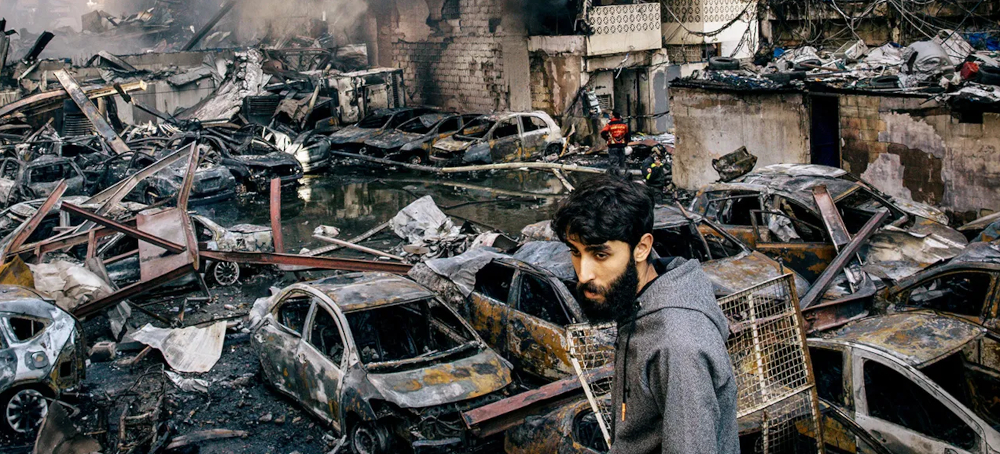 Burning bridges: A man looks on following an Israeli strike on Beirut. (photo: Chris McGrath/Getty)
The 11th-hour ceasefire between the US and Iran was met with sighs of relief around the world – but faultlines in the fragile agreement are already starting to show.
Israel’s strikes on Lebanon on Wednesday – among the deadliest of the conflict, with more than 250 people killed and upwards of 1,100 injured – have punctured any illusion of calm. The scale alone is destabilising; the timing makes it something more consequential. It raises a basic but unresolved question: was Lebanon ever meaningfully part of this ceasefire?
The answer depends on who you ask. Pakistan and Iran appear to interpret the framework as inclusive of Lebanon. Washington and Tel Aviv do not. US vice-president JD Vance has been explicit: “The Iranians thought that the ceasefire included Lebanon and it just didn’t.” A ceasefire that is not universally defined by all parties is one that is, by design, open to breach.
Trump’s approach to diplomacy has often prioritised speed and spectacle. This ceasefire, hastily assembled in the final hours before “sending Iran back to the stone ages”, carries those same hallmarks. It has created a pause but not a framework robust enough to manage what comes next.
That next phase could hinge on scheduled talks in Pakistan this weekend, where Vance will lead the American delegation of Steve Witkoff and Trump’s son-in-law, Jared Kushner. They’ll likely meet Iran’s foreign minister, Abbas Araghchi, with Pakistan’s prime minister, Shehbaz Sharif, and Field Marshal Asim Munir mediating. Considering that the ceasefire is already under strain, there is a growing expectation that its terms will require adjustment or risk becoming irrelevant before the two-week window elapses.
There is also a temporal illusion at play. Shipping is a slow business and many of the oil tankers currently docking in Asia and Europe departed before the worst of the disruption. The real economic effects of instability in the Strait of Hormuz – tighter supply, higher insurance costs, rerouted cargo – are still working their way through the system. When they arrive, they will do so with force. The global economy is, in effect, still consuming yesterday’s stability.
Then there is the question of who was – and was not – in the room. Gulf states, despite withstanding the bulk of Iranian retaliation and economic fallout, appear to have played little meaningful role in shaping the agreement. This omission is more than a diplomatic slight: it risks becoming a structural problem in the ceasefire agreement. Mahdi Jasim Ghuloom, a junior fellow at Observer Research Foundation, is blunt about the consequences. “The ceasefire has been announced with little apparent regard for Gulf states, even though they have borne the brunt of Iranian retaliation throughout the conflict,” he says. “Gulf interests are conspicuously absent from the framework.”
The reality on the ground appears to support that assessment. “The threat has not abated,” adds Ghuloom, pointing to Iranian strikes on Bahrain and heightened alerts across the region in the immediate aftermath of the announcement. That absence of relief is feeding a more assertive mood in Gulf capitals. “Gulf states won’t sit idly while Trump and Iran celebrate a ceasefire,” says Ghuloom. “There will be a lot of diplomatic pushback and clarification needed as to what happens with the Strait of Hormuz.”
That governance is now the crux of the next phase. Iran has floated the idea of asserting greater control over the strait, including potential tolls on shipping, a radical departure from established norms. “The acceptance of any tolls will not be tolerated by the Gulf,” says Ghuloom, suggesting that states might instead explore alternative export routes or apply pressure on Washington and its partners to address the issue swiftly.
All of which returns us to the central question: can this ceasefire last? That will depend less on the text of the agreement than on the behaviour it produces. Can Israel refrain from further escalation, particularly inside Iran and Lebanon? Can Iran’s Islamic Revolutionary Guard Corps maintain discipline across its various factions? And can Trump sustain a more measured tone, resisting the incendiary rhetoric that, only days ago, threatened the death of “a whole civilisation”?
For now the ceasefire is best understood as a temporary measure rather than a permanent outcome. It has created space for diplomacy, for recalibration and for markets to steady themselves. But it has not resolved the contest over security and control of one of the world’s most critical waterways. In that sense, what’s in a ceasefire is not peace but the possibility of it – and the just as likely possibility of another rupture.