What To Do When You See ICE in Your Neighborhood
Justin Caffier The Intercept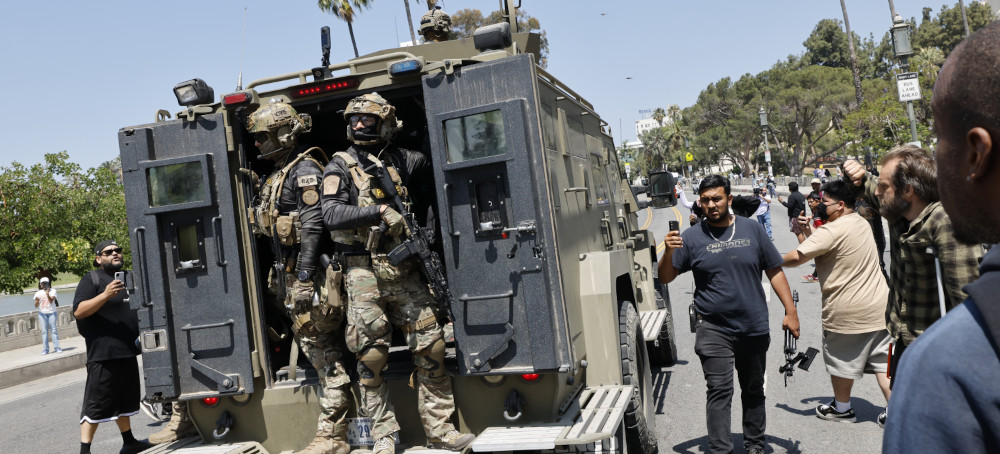 Federal agents near MacArthur Park in the Westlake neighborhood of Los Angeles on July 7, 2025. (photo: Carlin Steihl/Getty)
Local news reports indicate that activists were ready. They preemptively raised the alarm with multilingual flyers, had lawyers on deck, and shouted warnings through megaphones once federal agents arrived.
During the botched raid, U.S. Border Patrol Sector Chief Gregory Bovino made it clear that the occupation is only just beginning. “Better get used to us now,” Bovino told Fox News at the scene. “Because this is going to be normal very soon. We will go anywhere, any time we want in Los Angeles.”
But in Downtown LA that evening, a coalition of community groups held their own press conference celebrating 30 days of resistance. Well aware of the impotence or unwillingness of elected leaders to meaningfully hinder the federal terrorization of the city and the complicity of local law enforcement, these groups have spent the past month — many much longer than that — organizing collective approaches to protect those without documentation. Fired up by that morning’s raid, speakers were clear-eyed about the David-vs.-Goliath fight ahead. But they were more resolved than ever to win it. As everyone there seemed to fully understand, Los Angeles is the test case for what President Donald Trump will try to get away with elsewhere. Fighting back here matters far beyond city limits.
Ron Gochez, who founded Unión del Barrio’s LA chapter and volunteers patrolling the streets and manning the hotlines for the affiliated Community Self Defense Coalition, closed the rally with an impassioned call to action.
“If they want to keep attacking us, they have to know they’re going to suffer losses too,” he shouted to a roaring crowd. “You can take it how you want. We’re peaceful people. But we’re not going to allow y’all to kidnap us, to beat us, to brutalize us. We’re not going to allow it. We will fight back.”
But what can you actually do to effectively resist when, not if, ICE comes to your town?
With the One Big Beautiful Bill Act’s unprecedented new funding for Trump’s detention and deportation machine, it’s clear the administration’s fascistic operations will only grow bigger and bolder. I’ve been reporting on and observing anti-ICE agitation around LA nearly every day over the past month. In this time, I spoke with activists leading the fight, including Gochez, and experts from organizations like No Sleep for ICE, the National Immigrant Justice Center, and the National Lawyers Guild of Los Angeles, or NLG-LA. Here are some tips gleaned from those conversations on what to do when the state’s masked kidnappers descend upon your town.
Understand the Risks
To gain some on-the-ground advocacy experience while pursuing her law degree, Elizabeth Howell-Egan became a board member at the NLG-LA, which provides pro bono legal support for immigrants and protesters arrested by federal agents. She cautioned that while the First Amendment and other protections should safeguard those recording and reporting on immigration raids, there’s often a gulf between the letter and application of the law. NLG-LA takes great pains to underscore this disparity and the unfair but inherent dangers that come with exercising these liberties at their popular “know your rights” workshops.
“We say ‘know your rights, know your risks, know your reality,’” Howell-Egan explained. “Saying ‘I don’t consent to this search’ probably won’t stop the police from searching you. But that could make it so, in theory, they have to throw out whatever [charge] they find from that illegal search.”
Like others I spoke to, Howell-Egan encouraged activists to do their utmost to avoid the expensive, time-consuming, and physically perilous prospect of arrest. Calling resistance efforts “a marathon, not a sprint,” she stated a preference for collective, mass-defense approaches that endanger as few individual protesters as possible.
‘Salute’ When You’re the Source
Out running errands and see a cluster of weirdos kitted out for war, milling about like they’re stuck in a Call of Duty matchmaking lobby? Grab some pics and vids to raise the alarm. Keep in mind that specificity is paramount when logging these sightings, both to increase efficacy and avoid panic. Fortunately, one of master’s own tools has proven itself an invaluable counterintelligence asset. Plucked straight from U.S. military field books, the acronym S.A.L.U.T.E. can help you gather the most pertinent details. It’s also the practice almost universally recommended by the groups I spoke to.
Size: How many people and/or vehicles do you see?
Activity: What, specifically, are they doing that’s suspicious?
Location: What address, cross streets, or landmark are they at (the more specific the better)?
Uniform: What are they wearing, whether it’s fatigues, nondescript civilian clothes, or something else entirely?
Time: What date and time did you observe them?
Equipment: What guns, weapons, or devices do they appear to be carrying?
Follow and Repost With Discretion
Thanks for taking such comprehensive notes. Now where do you send them?
There’s no evidence the feds are conducting “how do you do, fellow antifa” honeypot busts. But anyone attempting to post alerts about the activities of federal agents would be wise to operate as if they were. The groups I spoke to remain concerned about infiltrators stymying their efforts. Even at the press conference, activists clocked and called out a suspected undercover among the crowd.
Unfortunately, there’s no one-size-fits-all approach for this element of activism. To safely discover and interact with the patchwork of anti-ICE activities around LA, I relied on trusted individuals from my personal network of journalists and activists, as well as community groups and organizers leading local efforts. But if you’re just getting started, the accounts mentioned in this article, any of the more than 65 groups that have joined LA’s Community Self Defense Coalition, or the Coalition for Humane Immigrant Rights are solid sources of information. And if you’re ever unsure about an entity’s bona fides, sites like mutualaidhub.org can help determine if an outfit is legit or carpetbagging.
After sharing your hot ICE tip, there’s another key step. Call your area’s Rapid Response Network, a multi-organizational, community-based coalition that helps mobilize to protect vulnerable immigrant groups in real time. These groups can take your tip and turn it into action.
Take, for instance, No Sleep for ICE. The group’s Instagram account provides daily lists of hotels lodging federal agents — resulting in noisy protests designed to make the occupation inhospitable for the occupiers. No Sleep for ICE also does the critical job of issuing on-the-fly corrections and victory posts once a location is confirmed agent-free.
A No Sleep for ICE representative, who spoke with me on the condition of anonymity out of concerns for their safety, said the account functions thanks to a network of volunteers who turn tips into a robust database of vehicles, license plates, individuals, and locations believed to be associated with the federal forces. This critical information is relevant for just a short moment, making the group’s work feel almost Sisyphean.
“Nothing is consistent. Everything changes every day,” the representative said. “We can produce photos today and, by tomorrow, none of it will matter.”
No Sleep for ICE relies almost entirely on community tipsters to piece together enough of the puzzle to build a working theory of which hotels are hosting agents, before the group begins the corroboration process. The last thing the group wants, according to the source, is to act on a false positive.
The overarching fear brought about by the raids has engendered a “better safe than sorry” reporting strategy among citizen spotters, where anything that could be ICE-related is passed along. But tipsters could considerably lighten the load by spending a few extra seconds confirming their information before contacting tip lines.
We may never know how much worse the false sighting problem has been made by deeply ingrained and addictive social incentives of the online platforms used to share warnings. Nonetheless, every tip sent to No Sleep for ICE and other community watchdogs has to be investigated — often sending volunteers scrambling to check false alarms, such as Recreation and Parks Department employees, Forest Rangers, and film crews. Taking an additional beat to check a suspicious car for tinted windows, hidden grille lights, or a backseat cage can mean the difference between sending volunteers on a goose chase or confirming a true threat.