What Nicolás Maduro’s Life Is Like in a Notorious Brooklyn Jail
Diego Lasarte The New Yorker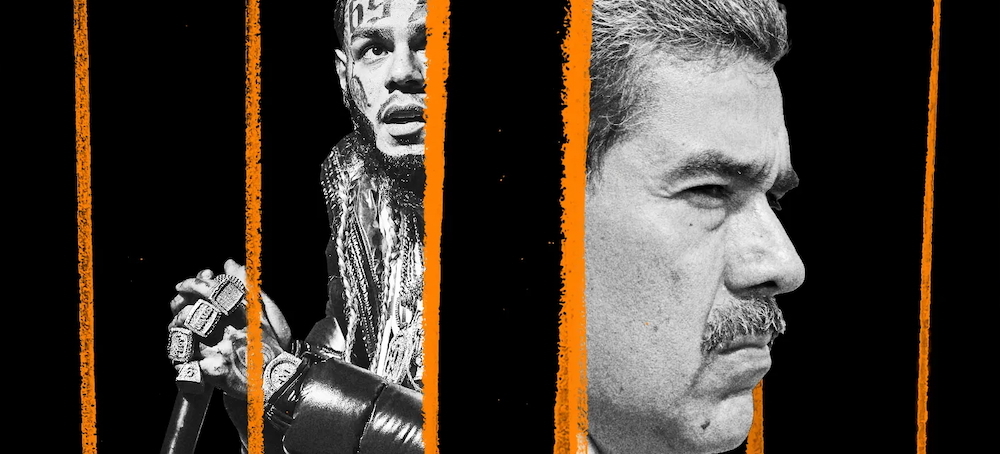 "The President of Venezuela has reportedly been stuck in a unit for high-profile inmates." (photo: Ben Kothe/The New Yorker/Getty Images)
The President of Venezuela has reportedly been stuck in a unit for high-profile inmates, known for housing rappers and tech moguls, while his country forms an uneasy relationship with Trump.
“Look, one of one,” 6ix9ine said, holding up the SpongeBob, which, he later explained, another inmate had meticulously crafted, folding six hundred pieces of paper and sewing them together, over the course of two weeks. “Maduro signed it,” he said, proudly, before adding, “Venezuela forever.”
On January 3rd, Maduro was abducted from Venezuela during a U.S. raid on a military complex in Caracas, dubbed Operation Absolute Resolve. That same day, he was transported to a D.E.A. office in Manhattan for booking, before being brought to M.D.C. Brooklyn, New York City’s only functioning federal detention facility. He has been held there for the past four and a half months.
6ix9ine, who was at M.D.C. Brooklyn after violating the terms of his supervised release related to a 2018 case, claims to have been roommates with Maduro for a portion of his sentence—an experience he described in great detail to Adin Ross, the manosphere streamer. “I didn’t want to bug him, like, I didn’t want to seem like a fanned-out little girl,” 6ix9ine told Ross. “ ’Cuz as soon as he came in, like, I was, like, Yo, whatever you need.” At one point, early in his incarceration, Maduro seems to have been kept in a unit designed for solitary confinement, as is often the case for inmates of his status. “He smelled like shit when he first came out the box,” 6ix9ine explained. “But then, you know, he was able to get time to take a shower and stuff like that.” (The Federal Bureau of Prisons declined to comment on Maduro’s conditions in the M.D.C. Brooklyn, citing the safety, security, and privacy of the inmates.) Afterward, Maduro was likely transferred to a unit known as 4 North, which is typically where high-profile inmates are held, such as the rapper Sean (Diddy) Combs, who spent more than a year at the jail, and more recently, 6ix9ine. (“I took Diddy’s bed,” 6ix9ine said.)
There are two main buildings in M.D.C. Brooklyn: a larger building, where most of the male detainees are held, and then a smaller building, which holds female inmates. 4 North is on the fourth floor of the latter, above the female jail. In the unit, which can house only a small group of detainees, the beds are clustered together dormitory-style, and there are no pillows. 6ix9ine described the cramped conditions. “Maduro slept, like, right across from me,” he told Ross, gesturing to a distance of about two feet.
The schedule at 4 North is similar to other units in the jail, with inmate counts multiple times a day. Meals are wheeled in, and there is a small room attached to the unit where detainees can work on their cases and communicate with their lawyers, according to someone who spoke often with an inmate held there. The jail has narrow windows, made of thick material. Toilets and showers offer minimal privacy. 6ix9ine said that he would use shower No. 2, whereas Maduro would use shower No. 1, because it was the biggest. (Maduro is six feet three.) 6ix9ine also claimed that Maduro told him the details of the raid in Caracas, an operation that has been shrouded in mystery. (President Trump has said that U.S. forces used a secret weapon he called the “discombobulator” to incapacitate Maduro’s guards.) “I don’t think I can share it,” 6ix9ine said, when asked to elaborate. “He did, though . . . Imma just keep it to myself. And, if I ever get killed, I am deciding not to say anything. Like, I don’t want to talk about it at all. And I’m never going to talk about it. I’m a true American patriot.”
The M.D.C. Brooklyn campus is tucked on the far side of New York Harbor in Sunset Park, just a stone’s throw from a busy Costco and one of the largest commingled recycling facilities in the United States. I recently walked around the detention center on a warm, spring day; it was windy, and seagulls flew overhead. From outside the jail, a person can make out the small windows set into patches of red brick.
The facility has more than thirteen hundred inmates, most of whom are awaiting trial in the Southern and Eastern Districts of New York. Over the years, the facility has been dogged by complaints of unsafe conditions. This includes a weeklong winter power outage in 2019, and reports, as recently as last year, of maggots in inmates’ meals. (A spokesperson for the Bureau of Prisons has said that M.D.C. Brooklyn “provides nutritionally adequate meals, prepared and served in a manner that meets established Government health and safety codes.”) Multiple people have died in the jail in recent years. But its notoriety largely stems from its famous residents. As a facility holding pre-trial detainees in one of the most prominent federal jurisdictions in the country, M.D.C. Brooklyn has had a disproportionate number of well-known inmates, from Luigi Mangione and Ghislaine Maxwell to R. Kelly and Martin Shkreli.
Recently, I spoke with a federal prison consultant named Sam Mangel, who, after serving close to twenty months at a prison in Florida for an insurance-fraud scheme, pivoted to a career in which he advises high-profile figures who are preparing for a stint behind bars. His former clients include the political operatives Steve Bannon and Peter Navarro. Mangel has worked in the M.D.C. Brooklyn on multiple occasions, including with his former client Sam Bankman-Fried, the cryptocurrency fraudster, who was detained in 4 North during his time there, from 2023 to 2025. He explained that such a unit is much safer than the rest of the prison, and that it makes sense that multiple prominent inmates, from rappers to heads of state, would be housed together. “They will never encounter inmates from any other part of the facility, and officials will not put any dangerous inmates in there, which could be a problem,” Mangel told me. “They’re not murderers. They’re not violent individuals who go there.” Typically, no sex offenders, either, he said, before quickly adding, “Even though Combs allegedly had some sexual charges, it made sense for him to be there.”
This is for the safety of the high-profile inmates, Mangel explained, who could be vulnerable to extortion or violence. It’s also owing to their international visibility. “It’s in our government’s best interest to keep Maduro safe,” he said. “They want to see this out to the finish, whether to a plea or to a sentencing. They don’t want another Epstein on their hands.” He continued, “The last thing the government, the Bureau of Prisons, and the D.O.J. want is to have an extremely high-profile individual slip and fall in the shower, just because, you know, he did. Then the conspiracy theorists will be all over the place.”
Incarcerating a head of state poses some unique challenges, logistical and otherwise, but it’s not completely unprecedented. When Bankman-Fried was at M.D.C. Brooklyn, he was in the same unit as Juan Orlando Hernández, the former President of Honduras, who was held at the jail for more than two years. (S.B.F. even advised Hernández on his case, encouraging him to testify in the trial.) Ultimately, Hernández was pardoned by Trump, at the end of last year. Maduro is highly unlikely to receive a pardon, meaning that he’s stuck at the jail until his trial is resolved. “Most likely he’s going to be in Brooklyn for, my best guess, at least another eighteen months,” Mangel told me. He offered Maduro some advice: “Like I advise anybody, whether they’re an indigent or a multibillionaire—you’re going into prison, you are just a number. You get the same amount of clothes, the same amount of commissary, you stand by your bed every day at the same time everybody else does.”
In the days before he was abducted, and in anticipation of being targeted by the Trump Administration, Maduro was regularly changing his sleeping locations. In early December, Antonio Ledezma, a former mayor of Caracas and member of the opposition, said that Maduro was “consumed by an insomnia of twenty-four hours,” and that “he does not sleep, he does not rest.” This sleeplessness has reportedly persisted in jail. According to the Spanish newspaper ABC, Maduro could be heard at night yelling, “I am the President of Venezuela!” and “Tell my country that I have been kidnapped!”
Since arriving at the jail, Maduro has left the facility only twice, for two brief court appearances. (Currently, he is represented by Barry J. Pollack, who has defended Paul Manafort and Julian Assange.) For the most recent appearance, he and his wife, Cilia—who is also detained at M.D.C. Brooklyn—arrived at the federal courthouse in lower Manhattan in a black motorcade. Outside the courthouse, two duelling protests waited for them. One side was sharply critical of Maduro, and included demonstrators who identified themselves as having escaped Venezuela. Two men carried an effigy of Maduro, his eyes blood-red, and his teeth vampiric, wearing a prison jumpsuit with a chain around his neck. The other side held signs criticizing U.S. involvement in Latin America, and waved Venezuelan and Palestinian flags. Two women stood on a bench and held an enormous banner with a picture of Maduro, which read “Maduro Amigo, Los Pueblos Estan Contigo,” or “Our friend Maduro, the peoples are with you.” Other signs suggested that some of the protesters were members of the Workers World, a revolutionary socialist party.
After the court appearance, which lasted less than ninety minutes, Maduro told his lawyer, “Hasta mañana,” and was taken back to M.D.C. Brooklyn. Suddenly, he was just another prisoner again. While Maduro is technically still the President of Venezuela, Delcy Rodríguez, his former Vice-President, has led Venezuela in his absence as the acting President. She has condemned Maduro’s abduction as a “kidnapping,” but has proved willing to work with Trump, and has begun exporting more Venezuelan oil to the United States. María Corina Machado, a longtime opposition leader and the recipient of the 2025 Nobel Peace Prize, which she later presented to Trump, has been living in exile since last December. She has signalled she will return to Venezuela, although the timing of that remains uncertain, and the leader of Venezuela’s National Assembly has said that the country will not hold a Presidential election in the near future. And, even if it did, Machado might have some unlikely competition. “I’m polling higher than anybody has ever polled in Venezuela,” Trump claimed, at a press conference earlier this month. “After I am finished with this, I can go to Venezuela, I will quickly learn Spanish—it won’t take too long, I’m good at language—and I will go to Venezuela, and I am going to run for President.”
In the meantime, Maduro continues to wait in jail. The Venezuelan government has encouraged citizens to write him letters. According to 6ix9ine, Maduro spends much of his time reading. “He just reads the Bible. He reads every Bible,” 6ix9ine said. “Like, right when I left, he was reading the Chinese Bible. Like, I don’t know if it’s the Buddha . . . he was reading something. But he read, like, every Bible, and was comparing them.”