What Do Ukraine and Taiwan Have in Common? A US They Can't Depend On
Alon Pinkas Haaretz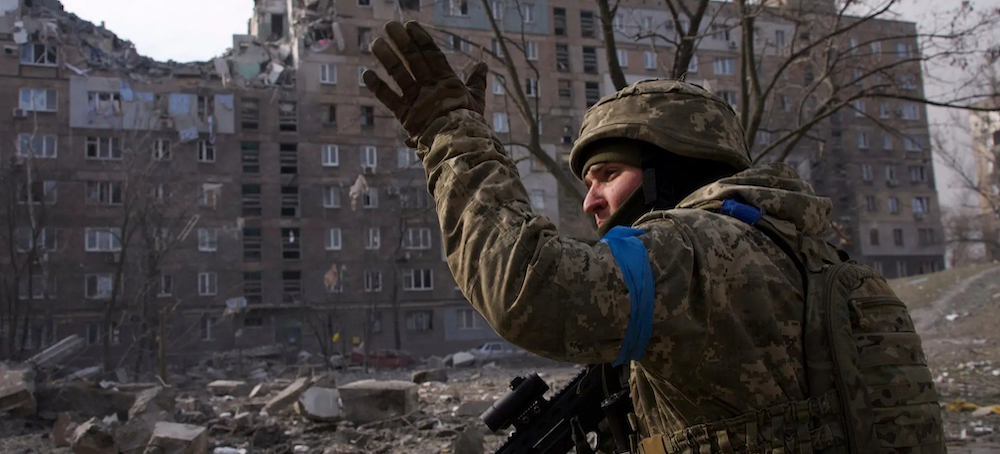 A Ukrainian soldier guards his position. (photo: Mstyslav Chernov/AP)
In the same way that the Trump administration is now favoring Russia over Ukraine, Taiwan fears it could soon be the collateral victim of a grand geopolitical and economic deal between the U.S. president and China
NATO is worried. Japan and South Korea are jittery. But nowhere are these concerns more emphatically accentuated than in Taiwan. Why? Because it could be the collateral victim of a grand geopolitical and economic deal between Trump and China. Ironically, that is something both Trump and Chinese President Xi Jinping agree on. The confusion is exacerbated because all they get from Trump are mixed signals wrapped in the traditional U.S. "strategic ambiguity" about Taiwan.
The analogy to Ukraine may be somewhat alarmist, given the circumstances and geopolitical context are different. But they do make sense. Much the same way that the Americans have deserted Ukraine, they could also desert Taiwan.
Much the same way Trump is negotiating with Russia over the fate of Ukraine while excluding the Ukrainians from the talks, he could negotiate the eventual fate of Taiwan with China without the Taiwanese being present.
Much the same way Trump has a natural and expressive pro-Russia bias, he can easily and quickly conjure a pro-China bias in respect to Taiwan. As much as he has a Vladimir Putin adulation bias, he could also develop a pro-Xi bias.
Much the same way he mendaciously blamed Ukraine for the Russian invasion, blaming his predecessor Joe Biden for "promising" Kyiv accession to NATO and thus threatening Russia, he can unflinchingly and effortlessly blame Taiwan for creating tensions in the Taiwan Strait since 1949. He can also blame Biden for making reckless defense commitments despite not having a formal defense pact with Taipei.
Much the same way the United States is blackmailing Ukraine into a rare earths-sharing agreement worth in excess of $500 billion to compensate for U.S. assistance during the last three years of war with Russia, it is also eyeing TSMC – Taiwan Semiconductor Manufacturing Company, the company that manufactures 90 percent of the world's advanced chips.
Last July, Trump told Bloomberg Businessweek that Taiwan should pay the United States for defense, especially after how "they took almost 100 percent of our chip industry. ... You know, we're no different than an insurance company. Taiwan doesn't give us anything."
In a New Year's address last December, meanwhile, President Xi bluntly said that "no one can stop the historical trend of national reunification."
There is also a strategic analogy to be made between Ukraine and Taiwan. In the same way that Canada, Mexico and the Panama Canal are perceived in Washington as an exclusive U.S. sphere of influence, Beijing may likewise define Taiwan and the Korean Peninsula as natural Chinese spheres of interest. The Americans would hesitate to project power there, which might lead to an armed conflict with China.
And so, the same way he sacrificed Ukraine for relations with Russia, once he begins negotiating a grand trade deal with China – which is what he wants – Trump will surely sacrifice Taiwan. In terms of the world order he is actively undermining, both Ukraine and Taiwan are eminently expendable.
On the other hand, Trump's record on Taiwan during his first term was much more sympathetic, which only adds to Taipei's sense of uncertainty concerning Washington.
During that first term, defense sales to Taiwan were the highest in years: the Americans struck around $18 billion of military deals with Taiwan, including 66 F-16 fighter jets for $8 billion. By contrast, during President Barack Obama's eight years in office, there was only $14 billion in military sales to Taiwan, while Biden – who twice broke with "strategic ambiguity" and pledged to assist Taiwan if it were to be attacked by China – sold military equipment worth $8 billion.
While China keeps pressuring other countries to sever relations with Taiwan, and has consistently condemned Taiwan's inclusion in international forums such as the World Trade Organization, it was the Trump administration that in 2020 enacted the Taiwan Allies International Protection and Enhancement Initiative (apt acronym: the TAIPEI Act).
Strategic ambiguity has essentially been the U.S. policy since President Richard Nixon's visit to China in 1972, and particularly after President Jimmy Carter switched America's diplomatic relations from Taiwan to communist China in 1979.
Taiwan was contested during the Chinese Civil War that ended in 1949, after which – in the context of the Cold War – the Americans recognized the Republic of China in Taiwan (formerly the Portuguese colony of Formosa), headed by Chiang Kai-shek after the Chinese Nationalist Party lost the civil war to the communists.
During Nixon's visit in 1972, the People's Republic of China issued a communique asserting that "Taiwan is a province of China." The Americans acknowledged that "across the mainland and Taiwan" there is "one China," and that Washington would not challenge that principle. This became known as the "One China" policy.
In 1979, the same year the U.S. change-of-diplomatic-relations went into effect, the U.S. Congress passed the Taiwan Relations Act. This stated that peace and stability in the region covering Taiwan and China is "in the political, security, and economic interests" of the United States, and that "the future of Taiwan will be determined by peaceful means."
Under that law, the Americans could provide Taiwan with military means and platforms, but would not come to Taipei's defense in the event of an attack. The mutual defense treaty the United States and Taiwan had maintained since 1955 was unilaterally terminated by the Americans in 1979.
Nowhere are China-U.S. relations more potentially explosive than around Taiwan and the Taiwan Strait – a choke point for maritime traffic where $2.5 trillion passes in a year. That makes it second only to the Strait of Malacca, which is the shortest shipping route between the Far East and the Indian Ocean.
It is noteworthy that in terms of Sino-American relations, Taiwan is mentioned far more frequently than North Korea – which reportedly possesses 40 nuclear weapons and is developing advanced intercontinental ballistic missiles.
Today's China is completely different to the China of 1949, or even 1979. It is a superpower, the world's second largest economy, with a population of some 1.4 billion, possessing significant and advanced high-tech capabilities, exerting and projecting power in Asia and beyond.
China is also defined by the United States as the greatest strategic challenge of the coming decades, and an unofficial spectrum of relations has been defined by several U.S. administrations: competition-rivalry-hostility-enmity.
While so-called China hawks have prevailed in the realm of public discourse and policy shaping in Washington in recent years, perceiving China as an enemy for all intents and purposes, there is also a potent school of thought which argues that the economic interdependence is broad and deep; that reconciliation and cooperation on issues from climate change to artificial intelligence to regional conflicts can be developed; and that belligerent rhetoric can lead to catastrophic unintended consequences such as a total and utterly devastating war.
It is unclear to Taiwan on which side Trump will end up. His animosity toward China is not geostrategic, political or ideological. It is trade-related. When foreign policy becomes a financial transaction in all but name, Taiwan is right to feel threatened. When Trump demands more investments from Taiwan, it will gladly agree. But China can obviously invest more.
Following the 10 percent tariffs he imposed on China, and the most recent threat to impose an additional 10 percent, Trump may be preparing a crackdown on Chinese investment and access to technology. But that could be a tactical move to get better leverage in trade talks. The last thing Trump will do is decline major Chinese investment in the United States if China offers it.
The Americans know that containing and deterring China by committing to Taiwan's defense exposes it to the risk of miscalculated escalation. Some in Washington are contending that U.S. policy in the Indo-Pacific, and particularly in the South China Sea, cannot hinge on defending Taiwan.
On the other hand, deserting Taiwan after Trump's Ukraine betrayal is something that will cost the Americans dearly in terms of reputation, prestige, dependability and reliability. That is why so many in Taipei are studying Kyiv for clues.