We’re Not Sending Our Best to Islamabad and the Iranians Know It
Bobby Ghosh Substack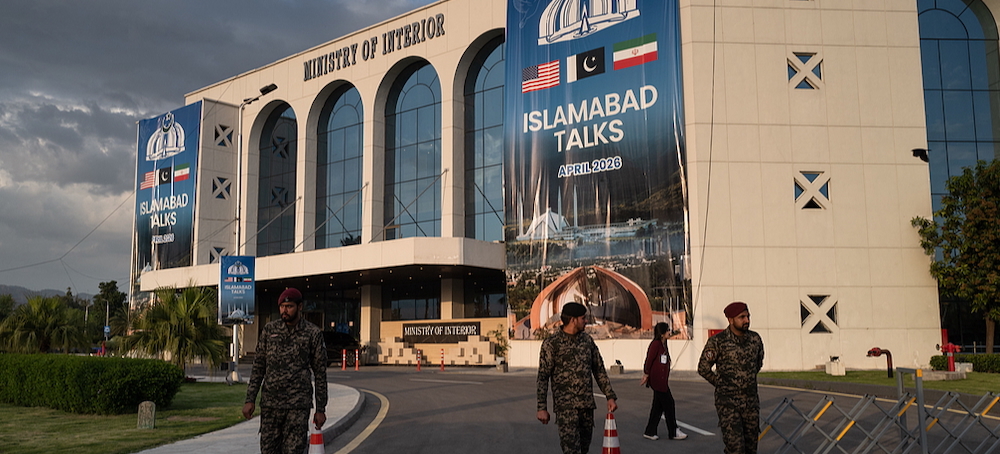 Pakistani security personnel walk through the Jinnah Convention Center, where international media have gathered to cover talks between US and Iranian officials, taking place in the nearby Serena Hotel, in Islamabad, Pakistan. (photo: VCG)
The American delegation heading for negotiations with Iran is woefully underqualified. The Iranians know exactly what that means — and they’re counting on it.
In my last column, I warned that if Trump sent Witkoff and Kushner back to the table, “he is not negotiating. He is merely performing negotiation.” The Vance announcement confirms that assessment.
Real negotiation, especially over nuclear programs, is a slow, technical, grinding exercise conducted by people who have spent careers learning its grammar. Performance is something else: it is spectacle dressed as statecraft, designed for domestic consumption, optimized for the news cycle rather than the diplomatic calendar. The Iranians, who have played both versions of this game for decades, know the difference. It is not clear that the American president does.
Consider the team Trump is sending to Islamabad. Witkoff and Kushner have already demonstrated their ineptitude at parleying with the Iranians. The Arms Control Association’s meticulous post-mortem of the pre-war Geneva talks found that Witkoff “did not have sufficient technical expertise or diplomatic experience to engage in effective diplomacy,” and that his mischaracterizations of Iran’s nuclear program “likely informed Trump’s assessment that talks were not progressing.”
But the two envoys have at least some private-sector pedigree as negotiators — however ill-suited real estate dealmaking is to arms control. Vance has none at all. His career — the Marines, Yale Law, venture capital, two years in the Senate, fifteen months as Vice President — contains no chapter on negotiation of any kind, let alone the subspecialty of nuclear arms control.
And in the days leading up to his departure for Islamabad, he gave ample evidence of his infelicity for the task at hand.
On Wednesday, as the ceasefire held by a thread and Iranian officials pushed back on the deal’s terms, Vance questioned whether his counterpart for the upcoming negotiations, Parliament Speaker Mohammad Bagher Ghalibaf, could “understand English.” Anybody with an iota of experience in these kinds of negotiations would know that language skills are irrelevant, not least because there are always translators at hand. And anybody who has ever negotiated with the Iranians would know that, in this particular set of parleys, the man who will be doing most of the talking is Iran’s foreign minister, Abbas Araghchi — who earned his doctorate at a British university, has been negotiating in English with Western powers for over two decades.
There will certainly be a language gap — a metaphorical one — in Islamabad, but it will not be on the Iranian side of the table.
No less revealing was Vance’s dismissal of Iran’s objections over Lebanon — suggesting the Iranians would be “dumb” to let the negotiations “fall apart over Lebanon, which has nothing to do with them.” Lebanon has everything to do with Iran. Hezbollah is Tehran’s most consequential strategic asset, cultivated over four decades at enormous cost, and central to Iran’s entire regional deterrence architecture.
Asking Iran to set Lebanon aside is approximately as sensible as asking Washington to set Israel aside. Any serious student of Iranian foreign policy knows this. Vance, it appears, does not.
The White House spin is that Vance has been involved “since the very beginning,” that he is the president’s “right-hand man.” Press Secretary Karoline Leavitt offered no other qualification for his appointment. This is worth noting: the administration’s own public case for sending its second-highest official to the most consequential American diplomatic encounter in decades rests entirely on proximity to power, not competence to exercise it.
There is a clue in how this came about. Iran had made clear, in the weeks before the ceasefire, that it would not negotiate further with Witkoff or Kushner, whom Tehran accused of previously misrepresenting its positions. The Iranians asked for Vance instead.
This has been interpreted, in some quarters, as a sign of Iranian good faith — a willingness to engage with a figure seen as more sympathetic to ending the conflict. A more unsentimental reading is that Tehran picked the opponent it could most easily outmaneuver. The Iranians didn’t ask for Vance because they trust him. They asked for Vance because they’ve seen Witkoff and Kushner up close, and calculated that someone with even less expertise would serve their purposes better.
What are those purposes? It is more than likely that the Iranians, recognizing that Trump is only performing negotiations, figure that they might as well make this work for them. They may not get a deal in Islamabad, but the ceasefire gives Tehran something it urgently requires: time.
A pause suits Iran in several ways. Start with politics. Mojtaba Khamenei, who was reportedly wounded when his father was killed on the first day of the war, has not appeared publicly since February 28. He needs to consolidate authority over the Revolutionary Guard, reassert control of Iran’s fractured political class, and demonstrate to a traumatized population that the regime has survived and can negotiate from strength. Every day of ceasefire is a day of recovery. Every week of talks in Islamabad is a week of institutional rebuilding.
Then there’s geopolitics. Russia and China, conspicuous by their absence during the fighting, also need to be brought back into Iran’s orbit. Both condemned the American and Israeli strikes, but stopped well short of any material support. Tehran will use the pause to remind Moscow and Beijing that the regime survived, that any doubts about its staying power were misplaced, and that common interests in limiting American dominance of the region are as alive as ever.
Next, there are the military and economic considerations. A pause in the war allows Iran’s battered armed forces to regroup, to move men and materiel around, to repair manufacturing capacity. Since Iran has been exporting more oil, at a higher price, than it did before the war, the ceasefire allows Tehran to build up its coffers — and it will need all the money it can get to start rebuilding.
And here’s the cherry on this particular cake: some of that money will come from the Strait of Hormuz, over which the Iranians now seem to have established ownership. The Iranian proposal that Trump called “a workable basis” reportedly includes a formalized protocol for managing passage through the strait, complete with transit fees. Whether or not those fees survive the final deal, Tehran can collect $2 million per ship while the parleys are proceeding.
Seen from this perspective, Iran doesn’t necessarily need this round of negotiations to succeed. They need it to continue. We know how that works from the years-long discussions that led to the 2015 nuclear deal. Ghalibaf and Araghchi will engage, propose, counter-propose, request clarification, request more time. From time to time, they will threaten to end the talks, perhaps even occasionally storm out, only to be persuaded by mediators to return to the table.
Araghchi is the man to watch. His presence on the Iranian side makes asymmetry becomes almost unfair to contemplate: sitting across the table from the troika of tyros— Vance, Witkoff and Kushner — will be a seasoned pro who has been involved in nuclear negotiations with Western powers since the early 2000s and was the principal Iranian negotiator of the JCPOA. Wendy Sherman, the former US deputy secretary of state who was Araghchi’s interlocutor through two years of talks, knows him better than almost any American alive. She described him to CNN’s Fareed Zakaria as “tough, capable, and detail-oriented,” adding that he is “a very serious adversary,” and that “the negotiations will be extremely difficult.”
It may interest Vance to know that Araghchi speaks and writes perfect English. More to the point, he has been dealing with Western diplomats in their own language for decades; indeed, he’s even written a book called The Power of Negotiation outlining his philosophy of the craft.
Somebody please get Vance a copy.
The American team has nobody of comparable experience. This would be a major problem for any negotiations, but it is several magnitudes worse in any discussion about Iran’s nuclear program. The Carnegie Endowment for International Peace, drawing on hard-won lessons from the JCPOA negotiations, explains what effective nuclear diplomacy requires: “The nuclear elements of any deal with Iran must rest on the foundation of a solid technical understanding of nuclear material production, nuclear weapons, and civil nuclear fuel cycles. Technical experts do need to be involved — ideally, in the room — to make any deal credible.”
It is sobering to recall that the American team that assembled the JCPOA in 2015 included physicists, former IAEA inspectors, and diplomats who had spent decades on nonproliferation. And those negotiations still took twenty months.
An incompetent negotiating team doesn’t just fail to make a deal — it fails to read the room. It misreads Iranian proposals, as the ACA found Witkoff had done in Geneva. It cannot distinguish between real engagement and strategic delay. It reports back distortions to the president, who then makes decisions based on a false picture.
Sherman has described a characteristic Iranian negotiating move that any experienced diplomat learns to expect: just as consensus seems imminent, a point previously considered settled will “suddenly resurface to trouble the waters.” This is a technique for testing resolve, extracting concessions, and resetting the clock. The Iranians will be perfectly positioned to exploit every gap in American comprehension.
And when the talks stall, as they almost certainly will, Trump faces the same dilemma he faced on Tuesday: reach for the lever of annihilation, or back down again. Having already blinked once, the credibility of the next ultimatum will be greatly diminished. The Iranians will be watching for exactly that moment.
None of this means the Islamabad talks will collapse immediately. They may produce some form of interim framework, some confidence-building gesture that both sides can present as progress. Trump needs a win; the Iranians, needing time, would be smart to give him the appearance of one.
But a performance of negotiation is not negotiation. And a pause, however welcome, is not peace. The enriched uranium is still somewhere underground. The Strait of Hormuz can be closed again in a matter of hours. The structural antagonisms that produced this war have not been dissolved by a ceasefire announcement and a flight to Islamabad.
What this moment demands from the US is expertise, patience, and a willingness to accept that nuclear diplomacy does not reward impatience or showmanship. What it is getting is a vice president auditioning for 2028, flanked by two real estate developers who already failed at this once.
The Iranians are ready for that. The question is whether Washington understands what it is walking into. The answer, from all available evidence, is no.