Vietnam v. Ukraine, Part I: Winnability
Marc Ash Reader Supported News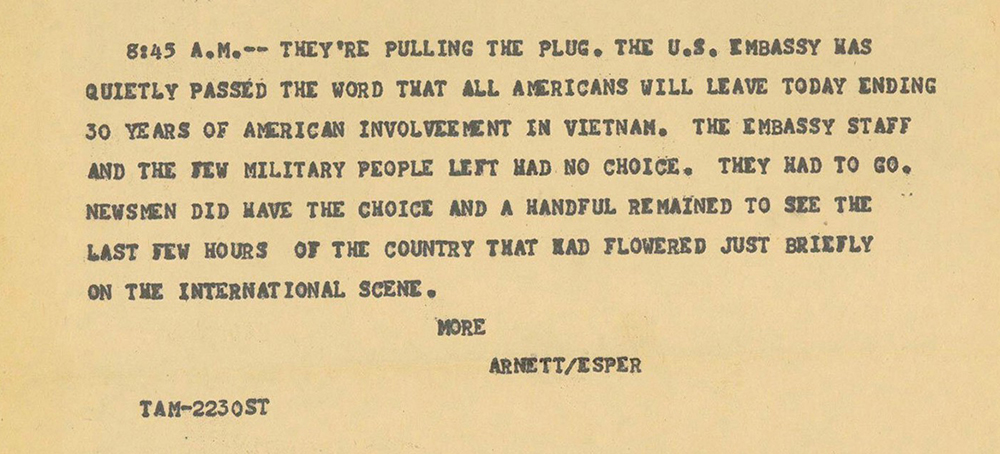 A dispatch from Associated Press reporters Peter Arnett and George Esper on the day of the US evacuation from Saigon, Vietnam, 30 April 1975. (image: Peter Arnett and George Esper/AP)
As that logic is extended to the current situation on the ground in Ukraine. Those who argue the Ukraine is Vietnam theory lean heavily on the most historically significant perceptions that swayed US public support against the US war effort in Vietnam. Foremost among them was that the war was unwinnable. Contained within that argument is a kaleidoscope of false arguments and willful misconceptions.
The Long Road to Public Awakening in Vietnam
By the time Daniel Ellsberg made his incredibly courageous decision to deliver the entire contents of the Pentagon Papers report, officially titled Report of the Office of the Secretary of Defense Vietnam Task Force to, among others the New York Times and ultimately the American kitchen table, anyone who wanted to know what the war in Vietnam was about already knew or should have known.
To understand the US war effort in Vietnam it is essential take into consideration two ancillary conflicts. First the French Indochina War of 1946-1954 and the concurrent US war in Korea from 1950-1953. The failed French colonialist occupation of Vietnam was rich in lessons for American geopolitical planners. Lessons that were catastrophically ignored. But just as important was the war the US waged on Korea.
In Korea as in Vietnam the US was determined to confront the spread of global communism, a political objective wrongly pursued through military means. In Korea the US did manage to maintain control of the southern half of the country after being forced to withdraw from the north. That became the model for the US effort to maintain economic and military control of South Vietnam, divide and conquer. The big difference in Vietnam was the will of the Vietnamese people.
There were many in South Vietnam that wanted closer ties to western nations. There were also concerns about Ho Chi Minh, his bellicose tone and his close ties to the Chinese and Soviet communists. All this made people in the south nervous. But the Vietnamese had just fought a long war against French colonialism. They knew foreign domination all too well and they had the tools to resist at hand. The South Vietnamese were edgy about Ho Chi Minh to be sure, but their discomfort with Minh paled in comparison to the horror visited upon them by the full weight America’s military. The Vietnamese, North and South were united in their determination to drive those they regarded as foreign invaders from their land.
The Rules of Putin’s Theater
Back to the basis for the “Ukraine is another Vietnam for the US rhetorical vehicle.” If you accept the rules of Putin’s theater then Russia and Ukraine are one, in the same way North and South Vietnam were one. Once you believe that then you can be convinced the US is trying to divide the rightful unity of Russia and Ukraine in the same way the US sought to divide North and South Vietnam.
To understand the truth, forget what the US and the Russians are saying altogether and listen to the Ukrainians. The Ukrainians are speaking with the same voice as the people of Vietnam, “Invaders off our land, we want freedom and self determination.” For ten long years 1960–1970 Westerners could not hear the voices of the Vietnamese people. How long before we can hear the voices of the Ukrainians?
In that context, against that backdrop, yes the war in Ukraine is indeed unwinnable, for the invaders — not the defenders. The invasion of Ukraine will end like the invasion of Vietnam with home-rule prevailing.