US Panel Votes to Exempt Gulf of Mexico Drilling From Endangered Species Act
Jake Spring The Washington Post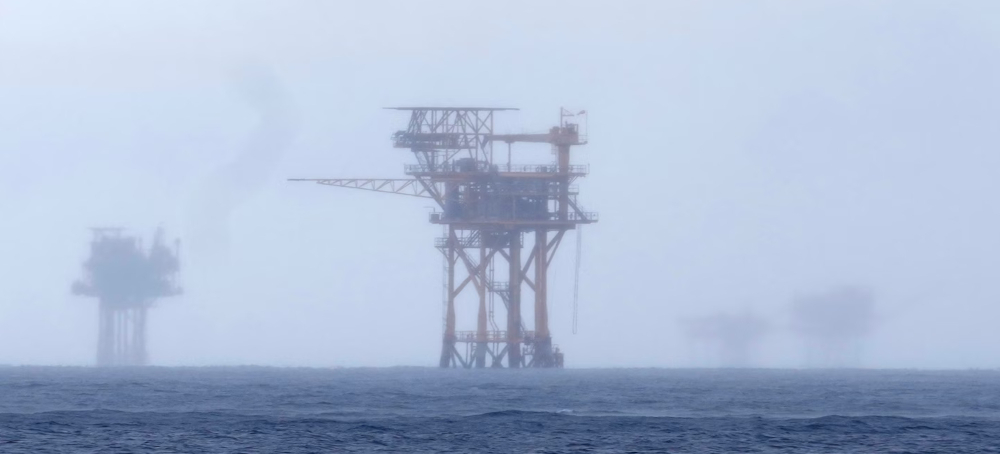 Oil platforms near the Flower Garden Banks National Marine Sanctuary off the coast of Galveston, Texas, in September 2023. (photo: LM Otero/AP)
The committee — nicknamed the “God Squad” for its ability to decide the fate of species — voted to exempt oil and gas firms from federal wildlife protections, citing the Iran war.
Meeting for the first time in more than 30 years, the group — nicknamed for its ability to decide the fate of species — approved the exemption on “national security” grounds in a discussion that took about 15 minutes. Trump officials said the decision would protect critical domestic energy production at a time when global supplies are disrupted by the war with Iran. It’s the first time an administration has sought a national security exemption since the passage of the 1973 Endangered Species Act.
Defense Secretary Pete Hegseth told the committee the exemption was “a matter of urgent national security,” saying active lawsuits based on the Endangered Species Act threatened to halt oil and gas production.
“This is not just about gas prices. It’s about our ability to power our military and protect our nation,” Hegseth told the committee.
“The Strait of Hormuz is the world’s busiest oil route, and recent hostile action by the Iranian terror regime highlights yet again why robust domestic oil production is a national security imperative.”
The Endangered Species Act has never been used to stop oil drilling in the Gulf, so doing away with protections will not meaningfully impact the amount of oil produced there, said Brett Hartl, government affairs director for the Center for Biological Diversity, an advocacy group.
“I don’t think anyone honestly thinks that there’s a legitimate national security issue here,” Hartl said.
The Biden administration had sought to restrict oil and gas activity in the Gulf by seeking to declare nearly 30,000 square miles as critical habitat for the Rice’s whale species, at the urging of marine scientists. The 2023 proposal was never finalized.
The exemption nevertheless will have an outsize impact on endangered species because oil companies will not need to make efforts to limit their impacts on them. Hartl said boats would no longer be required to run at lower speeds to reduce the number of collisions with the whales, which are found only in the Gulf of Mexico.
There are currently about 51 Rice’s whales left, according to the Center for Biological Diversity. The population collapsed following the 2010 Deepwater Horizon explosion at a BP-operated oil rig, which resulted in the largest-ever marine oil spill. The charcoal-colored whales — which were declared as a separate species in 2021 — have distinctive ridges on their heads and grow to about 40 feet long.
“Our industry has a long track record of protecting wildlife while developing offshore energy responsibly,” said Andrea Woods, a spokesperson for the American Petroleum Institute, an industry group. “Over the long term, American energy leadership depends on getting that balance right through reasonable, science-based protections while meeting growing energy demand.”
The center said the decision will also hurt the populations of sea turtles, whooping cranes and other endangered wildlife. The advocacy group challenged the Tuesday meeting in court, but a judge ruled last week that the meeting could go forward.
Environmental advocates blasted the committee’s unanimous approval of the exemption.
“Today, the Trump administration illegally cleared the way for the federal government to decide whether a species lives or dies,” said Julia Singer, a campaigner for advocacy group Oceana.
“This administration is putting oil profits ahead of America’s wildlife and the laws meant to protect it.”
Hegseth said at the meeting of the group formally known as the Endangered Species Committee that he had requested the exemption after the Interior Department informed him that litigation was threatening to halt production. The law states that the committee is expected to grant such exemptions when requested by the defense secretary and is not required to present evidence.
All members of the committee are Trump appointees, including Interior Secretary Doug Burgum and Environmental Protection Agency Administrator Lee Zeldin.
The God Squad last met in 1992 to consider whether Oregon timber sales threatened the northern spotted owl, where exemptions were granted only after lengthy hearings.