US Justice Department Can Use Military Lawyers to Prosecute Civilians, Judge Rules
Nate Raymond Reuters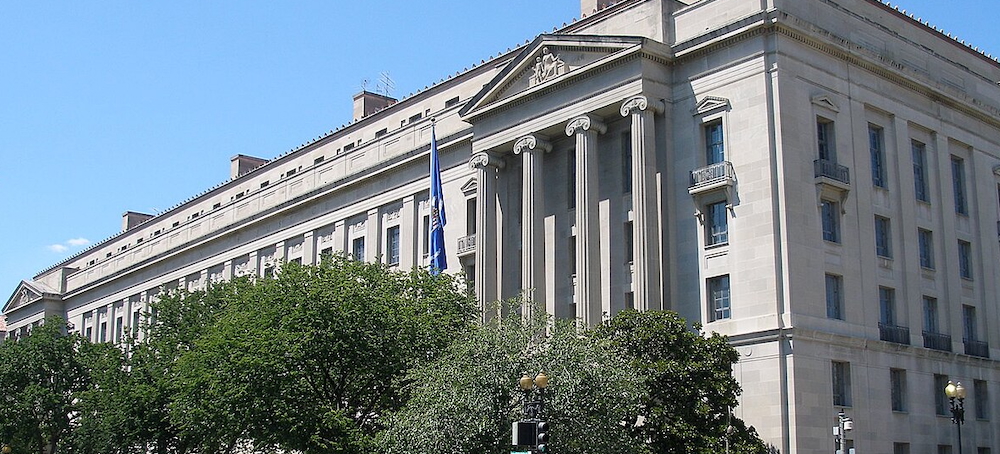 The U.S. Department of Justice headquarters. (photo: Coolcaesar/Wikipedia)
U.S. Magistrate Judge Shannon Elkins in Minneapolis reached that conclusion in a closely watched case in which a defendant challenged the lawfulness of being prosecuted by a lawyer from the armed services.
Paul Johnson, a Minnesota resident, was charged with assaulting a Customs and Border Protection agent in January as President Donald Trump's administration pursued an aggressive immigration enforcement surge in his state.
During the surge, the Defense Department assigned lawyers belonging to the Judge Advocate General's Corps to assist the U.S. Attorney's Office in Minnesota, after it had sent JAGs to help prosecute crime in Washington, D.C., and Tennessee.
Lawyers for Johnson argued that the use of JAG lawyers to prosecute civilians in cases without a military nexus violated the Posse Comitatus Act, an 1878 law that generally forbids the military from taking part in civilian law enforcement, as well as Department of Defense regulations.
He sought to have the military lawyer removed from his case, a cause that garnered national attention after 11 former JAG lawyers filed a brief supporting him that argued "the government has crossed a perilous line."
But Elkins sided with the government in finding that Congress had through two other laws created exceptions to the Posse Comitatus Act that give the U.S. attorney general the authority to appoint JAG lawyers to prosecute civilians as special assistant U.S. attorneys.
"If Congress passes statutes giving the Department of Justice the authority to appoint active military personnel as SAUSAs to prosecute civilians, that is the law," she wrote.
She agreed with the defense that the appointment of a JAG lawyer in Johnson's case violated binding regulations allowing such attorneys to only prosecute cases "in which the Army has an interest."
But Elkins said that while those regulations recognize it would be "ill-advised" for JAG lawyers to prosecute civilians in cases unrelated to the military, they do not give her the power to disqualify a military lawyer from Johnson's case.
Kevin Riach, a lawyer for Johnson, said he plans to appeal. Representatives for the U.S. Attorney's Office in Minnesota did not respond to requests for comment.