Ukrainian Civilian Casualties Rose by 26% in 2025, Researchers Say
Alex Croft The Independent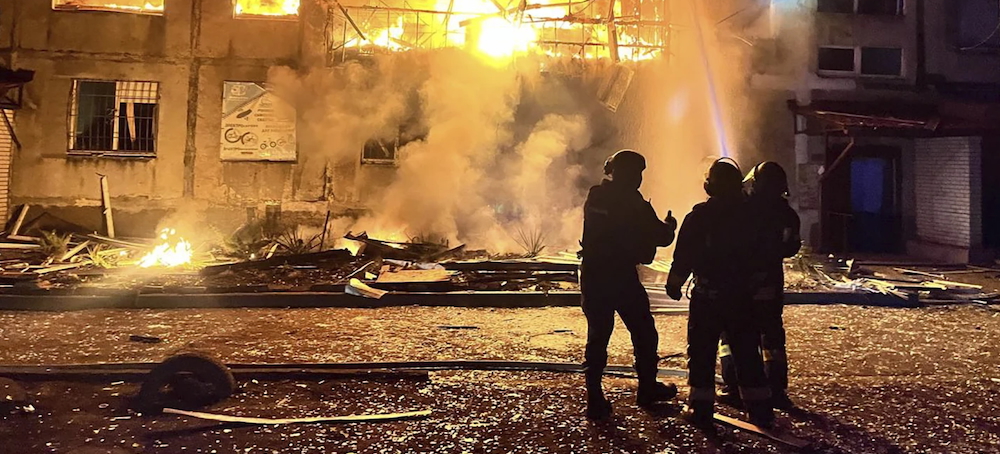 Firefighters put out a fire following a Russian rocket attack in Ukraine. (photo: Ukrainian Emergency Service/AP)
US-backed peace talks with Kyiv and Moscow have made little progress – and Vladimir Putin has ramped up his deadly attacks
Figures from NGO Action on Armed Violence (AOAV) state there were 14,775 Ukrainian casualties last year, up from 11,765 in 2024. The 2025 figures include 2,250 deaths – up 11 per cent from the previous year’s 2,027 – and 12,525 injuries, up 28 per cent.
The average number of casualties-per-incident also rose significantly to 4.8, a 33 per cent jump from 2024, with researchers suggesting Russian attacks are being designed to cause maximum civilian harm.
At the same time, during his first year back in office, US president Donald Trump said he wanted to end the war by bringing the warring sides together.
US-backed talks have seen Ukrainian and Russian delegations sit down together for the first time since 2022, but so far, little concrete progress has been made.
Moscow has meanwhile continued to target Ukraine with drones and missiles in increasing numbers.
After a drive to boost its domestic production of drones, Putin’s forces were able to launch unprecedented numbers of projectiles at targets in Ukraine, increasingly targeting energy infrastructure and other residential buildings.
Last summer, Russia launched what would be its worst attack of the year on the central city of Dnipro on 24 June, killing 21 and injuring 314, including 38 children, in a strike on a passenger train, apartments, and schools.
The trend has continued into 2026, with Moscow launching a series of heavy air attacks targeting energy infrastructure as Ukraine faced its coldest winter in years.
“The data points to a worrying shift in the character of the conflict,” the AOAV report states. “Fewer attacks are causing more harm.
“This suggests that explosive weapons by Russia in Ukraine are being used in ways that generate greater civilian impact, whether through more drone strikes, heavier munitions, specific targeting choices of populated areas, or repeated strikes on urban infrastructure.”
Before Trump took office in mid-January 2025, he promised to bring an end to the war “in 24 hours”. According to a tally by CNN, the US president made this promise 53 times while on the campaign trail.
He later claimed he was speaking “figuratively” when Moscow made it clear it had no intention to stop launching its huge overnight air attacks, or advancing on the eastern frontline, until Kyiv accepted its maximalist demands.
Despite ongoing peace talks between Ukraine, Russia and the US, there appears to be very little progress on the critical stumbling block that has prevented peace for months: territory.
Ukrainian President Volodymyr Zelensky repeated his frustrations over the talks at the Munich Security Conference on Saturday. He said Ukraine was being asked too often to make concessions, and accused Moscow of seeking to delay decisions by changing its lead negotiator.
“We truly hope that the trilateral meetings will be serious, substantive, helpful for all us, but honestly, sometimes it feels like the sides are talking about completely different things,” Zelensky said.
Ukrainian, Russian and American delegations are due to meet in Geneva on Tuesday and Wednesday this week.
Beyond the Russian war on Ukraine, the AOAV report also looks at trends in other global conflicts, including Gaza, Sudan, Myanmar and Yemen.
“What this global data shows, grimly and repeatedly, is that civilian harm is not an adjunct of war but an inevitable and predictable outcome when explosive weapons are used,” said Dr Iain Overton, AOAV’s executive director.
“Even where overall use of such weapons declines, as in Ukraine, civilians continue to suffer disproportionately when bombs and missiles are deployed in towns, cities and residential areas.
“The patterns we are documenting in Ukraine, Gaza, Sudan, Myanmar and Yemen point to the same conclusion: without meaningful restraint on the use of explosive weapons in populated areas, civilian lives will continue to be ruptured long after the headlines move on.”