Trump’s Plan for an American Gulag Just Got a Major Boost in Court
Mark Joseph Stern Slate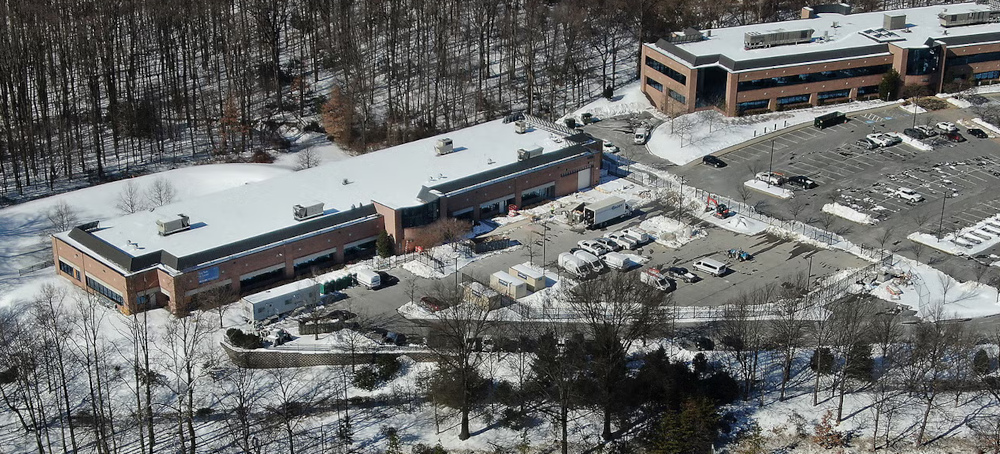 A detention center has been under construction in a former warehouse building in an office park in Maryland. (photo: Jeffrey F. Bill/Getty)
The 5th Circuit’s Friday decision gives new legal muscle to the Stephen Miller–orchestrated mass deportation campaign by endorsing the administration’s audacious rereading of a 1996 immigration law governing the detention of unauthorized migrants. For nearly 30 years, both the executive branch and the federal judiciary have understood this statute to draw a sharp line between migrants “seeking admission” at the border and those already in the country. The former are subject to mandatory detention without bond (with a few narrow exceptions). The latter, by contrast, can seek release on bond. If that request is denied, they can demand a bond hearing before an immigration judge. Most of the roughly 11 million immigrants without permanent legal status in the U.S. today fall into this second, bond-eligible group.
In July, the Trump administration collapsed the long-standing distinction between new arrivals and everyone else. It announced that it had “revisited” its view of the law and concluded that unauthorized immigrants already present in the United States are subject to mandatory detention, just like migrants encountered at the border. To reach that result, the government asserted that anyone who was never legally admitted to the country must, by definition, be “seeking admission” today. Under its theory, an immigrant who has lived here for decades is subject to the same harsh rules as someone who tried to cross the border yesterday. This shift empowered Immigration and Customs Enforcement to detain exponentially more immigrants without bond, prompting a flood of habeas petitions from those detainees challenging their confinement. Indeed, according to ProPublica, noncitizens have filed more of these petitions in the last 13 months than in the last three administrations combined.
Although the Trump-stacked Board of Immigration Appeals swiftly adopted the administration’s distortion of the statute, federal judges have overwhelmingly rejected it and freed detainees in habeas proceedings. As Kyle Cheney reported in Politico, at least 360 judges have spurned the government’s reasoning in more than 3,000 cases. They’ve done so in increasingly alarmed terms. Last week, Judge Thomas E. Johnston, a George W. Bush appointee, wrote: “It is appalling that the government insists that this Court should redefine or completely disregard the current law as it is clearly written,” deriding the administration’s theory as “dystopian absurdity.”
The problem, as these judges have explained, is that an unauthorized immigrant who’s already present in the country is not “seeking admission” at all; they are seeking to remain here. Yet ICE is detaining them under a statute reserved for new arrivals. By doing so, the agency is flagrantly breaking the law. So judges keep ordering ICE to release detainees—orders the agency has repeatedly flouted, prompting scathing judicial rebukes around the country.
On Friday, however, the administration finally caught a break at the 5th Circuit, the nation’s most reactionary appeals court. Justice Department officials maneuvered to ensure that the court would take up the question as quickly as possible, evidently hoping to notch a win. Two far-right judges, Edith Jones and Kyle Duncan, were happy to oblige: They embraced the administration’s reinterpretation on an expedited schedule, over a furious dissent by Judge Dana Douglas, who warned: “The border is now everywhere.” With this decision in hand, ICE can enforce the mandatory detention policy in Texas, Louisiana, and Mississippi, the three states covered by the circuit. (The agency had been funneling migrants from other jurisdictions into these states already, perhaps in anticipation of such a ruling.)
Jones and Duncan’s rush to bless this mandatory detention policy smooths the path for another component of Trump’s mass deportation push: The use of mega-warehouses to detain up to 10,000 noncitizens each and supplement the much smaller facilities that currently house detainees. ICE has been buying up these warehouses over the last few months—reportedly above market value to speed up the transactions—and converting them into makeshift detention camps. More than a quarter of the proposed sites fall within the 5th Circuit. As the American Immigration Council’s Aaron Reichlin-Melnick has pointed out, these detention facilities will house far more people than any jail or prison in the U.S. today.
Reichlin-Melnick told me on Tuesday that the mandatory detention policy now supported by the 5th Circuit is “a key part of the plan to fill these warehouses.” To achieve “the broader project of mass deportation,” Reichlin-Melnick said, “you need both the legal authority and physical space.” The government’s draconian rereading of immigration law “provides the legal authority. Warehouses provide the physical spaces.”
The overarching goal is to condemn as many noncitizens as possible to these sites, then hold them there without bond until they are so desperate and miserable that they agree to be deported. ICE already subjects its detainees to horrific, degrading, and inhumane conditions while blocking attempts at meaningful oversight. The situation may grow even more dire once the agency begins locking hundreds of thousands of noncitizens—many of whom may have lived here for years with pending legal claims to resolve their status—in industrial buildings that were never designed to hold human beings. Those subject to abuse at the hands of ICE officers will have no real mechanism for redress.
Even before the mandatory detention policy, noncitizens faced an uphill battle when seeking bond before an immigration judge. Trump purged many of these judges (who lack tenure) for alleged leniency, replacing them with ideologically aligned substitutes. But release on bond was still a real possibility for those who could show that they did not pose a flight risk or danger to the community. Now the government has shut off that safety valve, and—at least in the 5th Circuit—the machinery of detention can run at full speed. A series of Supreme Court decisions have closed off the possibility of a nationwide injunction or class action that could put a stop to this regime all at once. Immigrants’ only hope is that SCOTUS will swiftly and definitively shoot down the government’s contortion of the statute.
There is some reason for optimism that it will. Just eight years ago, the conservative justices appeared to foreclose the conflation of new arrivals and longer-term residents, acknowledging that the latter group is eligible for bond. But this Supreme Court has repeatedly twisted the law for Trump, particularly in his quest to immiserate noncitizens, and there’s no guarantee it will resist this act of legal vandalism. The administration is proceeding as if it already has the justices in its pocket. Unless and until they intervene, each new warehouse moves the country one step closer to the president’s vision of an American gulag.