Trump’s Ignorance on Iran Was Willful
Bobby Ghosh Substack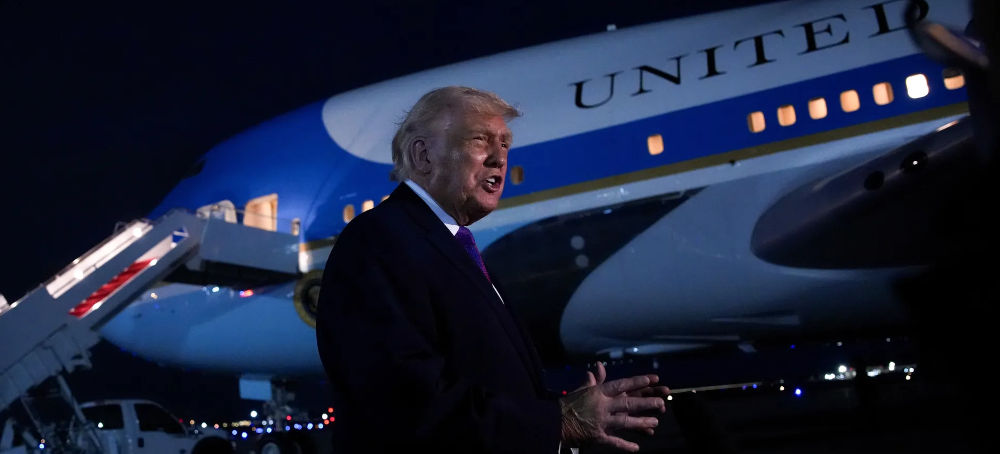 President Donald Trump speaks in front of Air Force One. (photo: Andrew Harnik/Getty)
ALSO SEE: Ghoshworld, Bobby Ghosh on Substack
The administration that went to war had every indication of how the regime in Tehran would respond. It chose not to pay attention.
Let us be precise about what this claim requires us to believe. It requires us to believe that the people who planned and authorized a massive joint military operation against Iran — killing its supreme leader on the first day, targeting its nuclear infrastructure, its military command, its navy — did so without any serious reckoning with how Iran would respond.
That they launched what they called “Operation Epic Fury” without having read, or heeded, the library’s worth of analysis — from think tanks, from academics, from their own intelligence services, from their own Gulf allies — that described, in detail, exactly the retaliation that has now materialized.
That is not a failure of intelligence. It is a failure of attention. And there is a word for willful inattention to inconvenient information: ignorance.
Iran has never been shy about its doctrine. For years — decades, really — its officials have stated clearly what they would do if attacked. U.S. military bases in the Gulf are legitimate targets; this was not improvised after the bombs fell on February 28th. Iran’s foreign ministry spokesperson said as much in the immediate aftermath, almost word for word: “All military bases, installations and assets that in any form or manner are being used to help the aggressors are regarded as legitimate targets. We had warned often that if they start war against Iran, that war would not be limited only to Iran.” That last sentence is worth underlining. We warned you. They had, and at length.
The Strait of Hormuz threat was equally well-documented. Iran has threatened the closure of that waterway, through which a fifth of the world’s oil supply passes, every time it felt sufficiently cornered. When Trump ended sanction waivers for Iranian oil importers in 2019, Tehran’s response was to threaten the Strait. It is not a bluff that comes from nowhere; it is a standing card in a hand that Tehran has shown repeatedly. The International Crisis Group has maintained a running tracker of Strait of Hormuz flashpoints for years. The Stimson Center noted, in analysis published before the bombs fell, that Iran had “threatened repeatedly to close the Straits with mines or missiles if a major US attack occurs.” This is not obscure scholarship. It is the working consensus of everyone who has studied Iran with any seriousness.
As for Iran’s willingness to strike the oil and energy infrastructure of its Gulf neighbors, well, there is a word for that, too: precedent. In September 2019, Iranian drones and cruise missiles hit the Aramco processing facilities at Abqaiq and Khurais in eastern Saudi Arabia. The attack knocked out half of Saudi Arabia’s oil production overnight, representing five percent of global supply, and triggered the largest single-day spike in oil prices ever recorded. Washington attributed the strike to Iran. The UN eventually concurred on the origin of the weapons. Anyone — and I do mean anyone — paying attention to that attack understood that Iran had both the capability and the willingness to cripple Gulf energy infrastructure. To claim surprise in 2026 is to pretend 2019 never happened.
And then there was the dress rehearsal of June 2025. When U.S. and Israeli forces struck Iran’s nuclear facilities during the Twelve-Day War, Tehran responded by hitting Al Udeid Air Base in Qatar, the largest American military installation in the Middle East. No casualties that time, the strike was largely symbolic, but Iranian officials were explicit that any future response would be far less restrained. The lesson was there to be learned. Washington apparently filed it away without reading it.
The think-tank community, that much-derided “establishment,” had done the work. The Center for Strategic and International Studies published a detailed analysis of Iran’s retaliation options before the strikes, laying out precisely the scenarios that have since materialized: drone and missile attacks on Gulf bases, disruption of Hormuz shipping, cyber operations. The Middle East Forum’s pre-war assessment listed Iran’s “retaliation playbook” in sequence — “ballistic missiles struck at U.S. bases across the Gulf and at Israeli territory, Hezbollah opened fire from Lebanon, intelligence detected Houthi preparations from Yemen” — and watched it activate almost exactly on schedule. Responsible Statecraft had noted, in blunt terms, that Iran had “repeatedly signaled that U.S. bases in the region are legitimate targets,” citing the memory of the Al Udeid strike as still fresh in the minds of Gulf leaders.
None of this analysis came from fringe voices or contrarian provocateurs. It was the sober, mainstream assessment of serious regional experts. The American foreign-policy community, for all its many sins, has spent decades building up genuine expertise on Iran. That expertise pointed, with remarkable consistency, toward what is now unfolding.
The administration’s own intelligence was equally unambiguous. Pentagon briefings to Capitol Hill stated that Iran was not planning to attack unless struck first, directly contradicting the “imminent threat” justification offered by Secretary of State Marco Rubio. The Defense Intelligence Agency’s 2025 threat assessment said Iran was not producing nuclear weapons. Inside the White House, figures as unlikely as Steve Bannon and Director of National Intelligence Tulsi Gabbard reportedly warned against going to war with Iran. The warnings were not just in think-tank papers and academic journals. They were in the room.
Most damning of all: America’s Gulf allies said all of this to Trump’s face. In January 2026, leaders from Oman, Qatar, Saudi Arabia, and Egypt warned the president directly that an attack on Iran would have devastating consequences for the wider region — consequences that would, they noted, ultimately rebound on the United States. Trump hesitated. And then, when he decided to go ahead six weeks later, he didn’t bother to tell them. The countries whose territory would inevitably bear the brunt of Iranian retaliation — whose cities would be struck, whose airports shuttered, whose energy infrastructure targeted — were not given advance notice of Operation Epic Fury.
The Associated Press, reporting from Cairo, captured the fury of Gulf officials: they were “disappointed,” had been “ignored,” and had explicitly warned Washington of what was coming. A Chatham House analyst said the U.S. appeared to have assumed that American troops and Israel would be the primary targets of Iranian retaliation. “I don’t think they saw that there would be as much exposure to the Gulf,” he said. “This speaks to U.S. short-sightedness.” Defense Secretary Pete Hegseth, in an inadvertent moment of candor, acknowledged that while the exact response was not anticipated, it was “recognised as a possibility.” Senator Chris Murphy, emerging from a closed-door congressional briefing, was less diplomatic: the administration had “no plan” to safely reopen the Strait of Hormuz.
No plan. For the most foreseeable consequence of going to war with Iran.
There is a distinction worth making here between ignorance and surprise. Anyone going to war can be surprised by the enemy’s ingenuity, their speed of adaptation, the fog of battle. These are the inevitable companions of conflict. But to be surprised by the direction of an enemy’s retaliation — by the fact that they retaliate at all, and by the broad outlines of how they do it — requires something more active. It requires the deliberate filtering out of information that contradicts a preferred narrative. In this case, the preferred narrative appears to have been that Iran would fold, or fracture, or that its response would be limited and manageable, the Venezuela model, as one academic sourly put it.
Iran is not Venezuela. It is a large, proud, militarized state with a four-decade record of strategic patience, asymmetric capability, and ideological commitment to resistance. It does not bluff. It absorbs punishment and it retaliates. This is not a matter of cultural mysticism or Oriental inscrutability. It is a matter of documented behavior, stated doctrine, and the long public record of a regime that has made its intentions perfectly legible.
To go to war without absorbing that record is not naivety. It is a choice. Whether that choice was driven by ideological contempt for expert opinion, by Netanyahu’s urgency, or by a president who believes that shock-and-awe is a strategy unto itself, the consequences are the same. American soldiers are dead. Gulf cities are under fire. The Strait of Hormuz is partially closed, and oil markets are convulsing. Allies who were never consulted are now footing a bill they were never given the chance to refuse.
Ignorance, in a private citizen, is sometimes forgivable. In a government that just started a war, it is not. And when the evidence of what was coming was this abundant, this loud, and this accessible — ignorance stops being an excuse. It becomes a verdict.