Trump Takes His Cut
James Surowiecki The Atlantic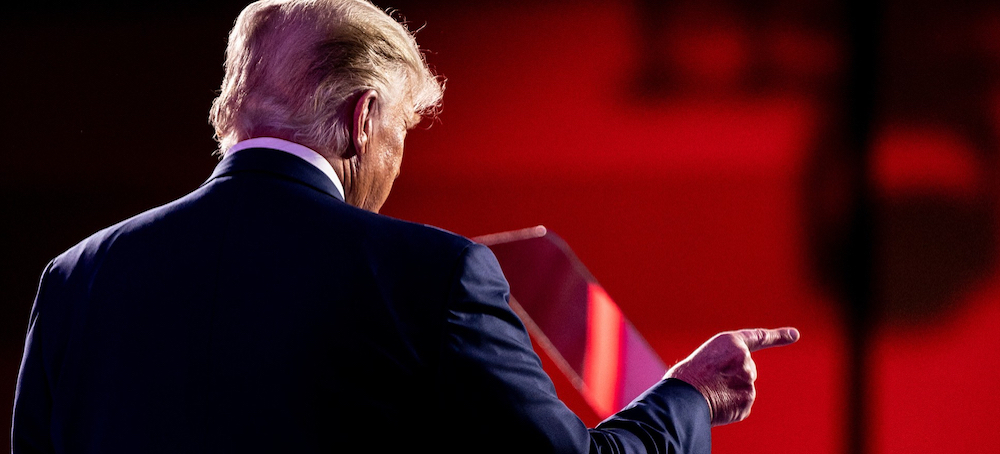 Donald Trump. (photo: Erin Schaff/NYT/Redux)
When it comes to the government’s relationship with business, Donald Trump is the most activist president since Franklin D. Roosevelt. He has wielded tariffs, the government’s purchasing power, and the threat of regulatory action to bend companies to his will. Over the past year, the president has even made the federal government a corporate shareholder across a range of industries. Just last week, the Commerce Department announced that it was taking stakes in a portfolio of quantum-computing companies in exchange for $2 billion in investment.
The federal government’s bold entrance into the world of corporate investing began last June, when Trump agreed to allow Japan’s Nippon Steel to buy U.S. Steel as long as the combined company granted the United States veto power over certain management decisions and ensured that key leadership roles went to American citizens. In the months since, the administration has taken sizable stakes in rare-earth firms and a new rocket company. Most dramatically, the administration insisted last year that the semiconductor giant Intel hand over nearly 10 percent of the company in exchange for $8.9 billion in grants that had already been earmarked in the CHIPS Act and other government awards but not yet paid. Trump now likes to brag that Intel’s stock has since surged by 300 percent.
This isn’t the first time that the federal government has taken equity in public companies. But in the past, it happened almost exclusively in times of crisis, as in the bailout of U.S. automakers and Wall Street banks in 2008, and the government promptly divested itself of the stock once the turmoil had passed. Trump, by contrast, is making government ownership commonplace, which means any company that accepts government funding now has to wonder if it’ll have to give up shares as a result. That kind of government investment in the fate of individual companies opens the door to a type of crony capitalism the United States has historically done a good job of avoiding.
The argument for Trump’s moves is easy to understand. If the federal government is going to subsidize the research and development of various companies, as it already does via loans and direct grants, then surely it should reap some of the benefits too—or “enhance the return for the U.S. taxpayer,” as the Commerce Department put it when announcing its investments in those quantum-computing companies. Trump isn’t alone in feeling this way. Some progressive Democrats, including Senator Elizabeth Warren, had already suggested that the government take a stake in companies awarded CHIPS Act grants. Senator Bernie Sanders, a democratic socialist, backed the administration’s plans to buy a stake in Intel, explaining, “If microchip companies make a profit from the generous grants they receive from the federal government, the taxpayers of America have a right to a reasonable return on that investment.”
But bipartisan support for these moves doesn’t make them right. Part of the problem is that the administration has not made it clear how these investments work, or even how they are being made. No law authorizes the Commerce Department or any executive-branch agency to take equity stakes in companies, which means there’s no legal protocol for how or when the government might sell those stakes, or where the proceeds from such a sale would end up. Nor has there been any transparency into how the government is picking these companies in the first place.
The administration can argue that it has targeted sectors connected to national security: steel, rare earth metals, defense contracting, semiconductors. But when Spirit Airlines recently tried to avoid liquidation, Trump talked openly about buying it, even though the airline’s fate is hardly a matter of national security. In practice, then, these decisions may be subject to Trump’s whims. Although all government spending is meant to be allocated by Congress, the president has made it plain that he believes the power of the purse is his.
But even a more rigorous and transparent process would not alleviate the fundamental problems of government ownership. A big federal stake in a company will invariably tilt the marketplace, which creates incentives for the state to tilt things further, perhaps via regulatory relief, exemptions from tariffs, or just plain presidential meddling. Apple, for instance, recently resumed using Intel chips in some of its products after Trump lobbied it to do so. Apple certainly could have done this regardless, as part of the company’s move to diversify its chip supply. But Trump’s willingness to use government power to help companies that support him and hurt those that oppose him means that for many companies it’s economically rational to simply accede to his wishes—even if the move would not be economically optimal in an actual free market.
Companies are coming to see these transactions as a cost of doing business. Trading away shares can be a way to gain favorable treatment, or at least avoid getting punished. Take the bidding war earlier this year between Netflix and Paramount for Warner Bros. Discovery, which Paramount won, contingent on regulatory approval. One can easily imagine Trump demanding a stake in the newly merged company in exchange for a blessing from the Federal Communications Commission. Paramount would be hard-pressed to say no.
When the government supports American companies with loans and grants, these companies can keep the administration at arm’s length. When the government takes a stake, the partnership becomes intimate and long-term. The upsides of this arrangement are greater, but so too are the costs. We want regulatory decisions and government policy to be shaped by what’s best for the economy, not by what’s best for the companies that the government happens to own. Federal stakes in public companies may be a good deal for the government, but they’re still bad for America.