Trump Still Doesn’t Understand Iran, Or the Mess He’s Made
Bobby Ghosh Substack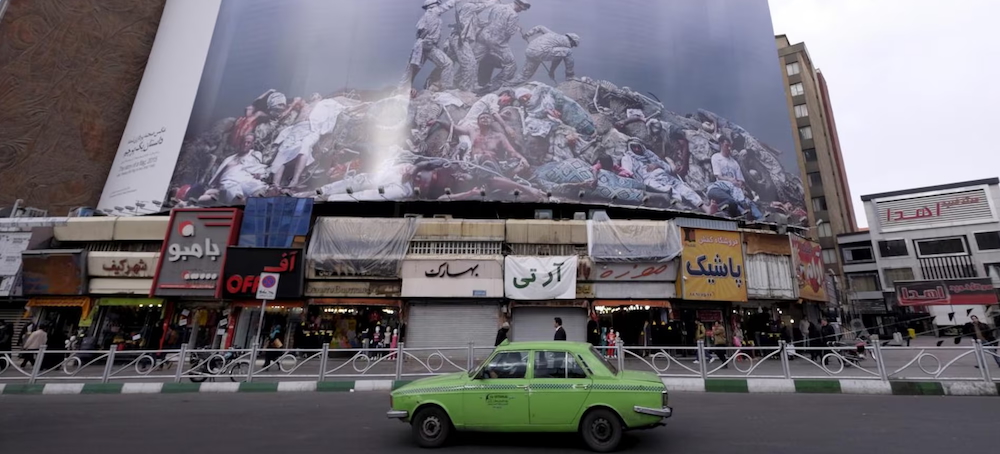 A mural in Tehran's Valiasr Square. (photo: Reuters)
ALSO SEE: Ghoshworld, Bobby Ghosh on Substack
His 48-hour ultimatum to Tehran reveals something deeper than bluster: a strategic failure to understand the adversary.
There is a school of thought that takes such statements at face value, parsing them for strategic intent and asking, “Will Trump act on his threat?” This is the wrong question.
The right one is: “Does Trump even understand what he is dealing with?”
The evidence, accumulating by the day, suggests he does not. And neither, if we are being honest, do many of the advisers and analysts who have shaped Washington’s approach to Iran over the past decade.
Start with the strait itself. The Hormuz ultimatum is not a negotiating card that Tehran is holding and might eventually lay down. It is, at this moment, one of the only instruments of leverage the Islamic Republic possesses against the most powerful military on earth. Iran’s foreign minister Abbas Araghchi told CBS bluntly last weekend that Iran had never asked for a ceasefire, had never asked for negotiations, and was “ready to defend ourselves as long as it takes.”
Read that again: he said this while his country was absorbing daily airstrikes from two nuclear-armed states.
In Washington, that kind of statement tends to be filed under “propaganda.” In Tehran, it is policy.
It’s a safe bet that Iran will not bend to Trump’s latest demand. To give up the strait would be to surrender the one geographic chokepoint that gives Tehran any meaningful claim to symmetry in this conflict. A regime fighting for its survival — which is precisely how the new leadership understands its situation — does not hand that away in response to a Truth Social post. It would sooner set the Gulf on fire.
And this is the deeper problem with the 48-hour threat: it paints Trump into a corner from which he has no good way out. If the deadline passes — as it almost certainly will, with the strait still closed — the US must either strike Iranian power plants or stand down. Striking civilian infrastructure would shatter what remains of international support for this war and, as the Atlantic Council warned this week, risk triggering a cascade of retaliatory strikes on Gulf desalination infrastructure. Standing down, meanwhile, hands Tehran a visible victory and hollows out whatever coercive credibility Washington has left.
This is the corner into which Trump, who began a war without a plan for its most predictable complication, has driven himself.
The planning failures are, by now, painfully visible. Before February 28th, the administration was warned that Iran might attempt to close the Strait of Hormuz — and pressed ahead anyway without a credible plan for what to do if it did. The Bloomberg editorial board noted last week that after nearly three weeks of fighting, the U.S. is approaching the outer limits of what air power alone can accomplish. The government in Tehran has absorbed the blows and kept fighting.
Iran had telegraphed this leverage for years. The International Energy Agency has been explicit for over a decade that roughly one-fifth of the world’s oil and liquefied natural gas passes through Hormuz, with no adequate alternative routing for the majority of Gulf production. To launch a war against Iran without a credible plan for the strait — without having first secured, at minimum, the alternative pipeline capacity of Saudi Arabia and the UAE — was not boldness. It was negligence.
Iran has since climbed what CSIS analyst Mona Yacoubian has called a “vertical escalation ladder.” Beginning with military targets in the opening hours, Tehran methodically expanded its campaign to civilian transport hubs, then to energy infrastructure across the Gulf, then to the world’s largest LNG facility at Ras Laffan in Qatar. Oil is now trading above $110 a barrel. The IEA is urging people to work from home and reduce highway speeds. Economists are using phrases like “largest supply disruption in the history of the global oil market.”
Iran, meanwhile, has formally warned that if U.S. strikes hit its energy infrastructure, all energy, IT, and desalination infrastructure belonging to American allies in the region will be targeted.
None of this was unforeseeable. Much of it was foreseen — by analysts, by allied governments, by anyone who had studied Iran’s strategic thinking carefully. The question worth asking is why those warnings did not shape the war plan.
The water dimension of this conflict has, until recently, received insufficient attention, and it may prove to be the most consequential of all. The Gulf states are among the most water-scarce societies on earth, having long since solved that problem — or so they believed — through desalination. As CNN reported this week, Kuwait and Oman depend on desalinated water for roughly 90 percent of their supply; Bahrain for 85 percent; Saudi Arabia for around 70 percent. Dubai, Doha, Abu Dhabi, and Kuwait City are, for practical purposes, wholly dependent on plants that are now within easy missile range of a country that has every incentive to expand the circle of pain.
“Their economies, even the short-term survival of their population, are heavily dependent on the safety of these desalination plants,” Nader Habibi, professor of Middle East economics at Brandeis University, told CNN. He was not speaking hypothetically. Bahrain has already reported Iranian drone damage to one of its desalination facilities.
A CSIS analysis published this week noted that more than 90 percent of the Gulf’s desalinated water is produced by just 56 plants — a concentration that makes the region’s water supply extraordinarily vulnerable to a determined, systematic campaign. It quoted a classified CIA warning from 2010, only recently made public, that disruption of desalination in most Arab Gulf states would have greater consequences than the loss of any other industry or commodity.
And then there is the matter of Iran itself — what it is now, and how profoundly that has been misunderstood.
The Islamic Republic that Washington has been trying to coerce, contain, or confront for four decades was a specific kind of actor: calculating, ideologically committed, but ultimately guided by a supreme leader who, despite his hostility to the West, had developed a sophisticated instinct for knowing when to absorb a blow and when to stop escalating. Ali Khamenei was no moderate. But he had governed for nearly 37 years, and longevity in power tends to produce, if not wisdom, then at least a preference for institutional survival over apocalyptic confrontation.
That Iran is gone.
In its place is a regime whose new supreme leader watched the United States and Israel kill his father, his mother, and his wife in the opening hours of this war. Mojtaba Khamenei was described by WikiLeaks cables as “the power behind the robes” long before his formal elevation — a figure who spent decades accumulating institutional control through the IRGC, managing elections, orchestrating the 2009 Green Movement crackdown, and embedding his loyalists throughout the state apparatus. He is, in the assessment of analysts who have tracked him closely, his father’s ideology expressed without his father’s restraint.
Paul Salem of the Middle East Institute has put it simply: “Nobody emerging now is going to be able to compromise. This is a hardline choice, made in a hardline moment.” The Assembly of Experts did not select Mojtaba despite the circumstances of his father’s death. They selected him because of them. His appointment was an act of doctrine, not merely of succession.
Foreign Affairs observed this week that Trump’s own public declarations — calling Mojtaba “unacceptable,” demanding a role in choosing Iran’s next leader — paradoxically made the younger Khamenei the only conceivable choice. Picking anyone else would have looked like capitulation to Washington. The American president, in his eagerness to dictate terms, helped manufacture the very outcome he said he opposed.
The practical consequences of this are significant. The premises that once underpinned Iran diplomacy — that Tehran would hesitate before using force directly, that it would trade partial concessions for sanctions relief, that it preferred managed tension over open-ended confrontation — belong to a different era. Washington analysts who still reach for those assumptions when thinking about what Iran might accept at the negotiating table are describing a government that ceased to exist on February 28th.
What, then, are the actual options? They are fewer and worse than the administration has publicly acknowledged.
Striking Iranian power plants, which Trump has now threatened, would plunge tens of millions of civilians into darkness and deprivation, invite massive retaliation against Gulf infrastructure including those desalination plants, and push the conflict into territory from which there is no controlled exit. It would also be unlikely, on its own, to reopen the strait. Iran’s military does not need electricity to fire missiles.
A negotiated ceasefire remains theoretically possible, but requires the United States to offer something meaningful in return — which almost certainly means abandoning the stated goal of regime change, a concession that neither Trump nor Netanyahu has shown any inclination to make. And even then, as the American Prospect noted last week,, it is far from clear that Iran’s new leadership would trust any deal brokered with an administration that killed the previous supreme leader in the middle of nuclear negotiations.
The remaining option — grinding attrition, indefinite pressure, hoping that Iran’s domestic situation eventually produces collapse — carries its own enormous risks: sustained energy disruption, the progressive degradation of Gulf civilian infrastructure, and the possible entry of the Houthis into active combat, which would close a second strategic chokepoint at Bab al-Mandeb and make the current energy crisis look manageable by comparison.
None of this needed to be the choice set. Other choices were available and were consciously not made.
In the winter of 2015, I arrived in Tehran in the small hours of the morning, just days after the nuclear deal had been signed. A taxi driver stopped at Valiasr Square, dead quiet at 2:30am, to show me a brand new mural: a reworking of the Iwo Jima flag-raising, soldiers planting their banner on a mound of bodies. Anti-American propaganda, state-commissioned, freshly painted. And yet, when the driver learned I was a New Yorker, his face lit up. He wanted to talk about basketball. He asked whether I’d tried Persian food. The hostility projected from the walls and the warmth offered by the people beneath them were not contradictions — they were a precise map of the country: a population with no grievance against the West, governed by a system whose survival depended on manufacturing one.
And now, on the other side, we have a President who seems eager to create new grievances, for ordinary Iranians as well as for their oppressive leaders.