Trump Signed a Deluge of Executive Orders. There Are a Few We Should Really Be Worried About.
Shirin Ali Slate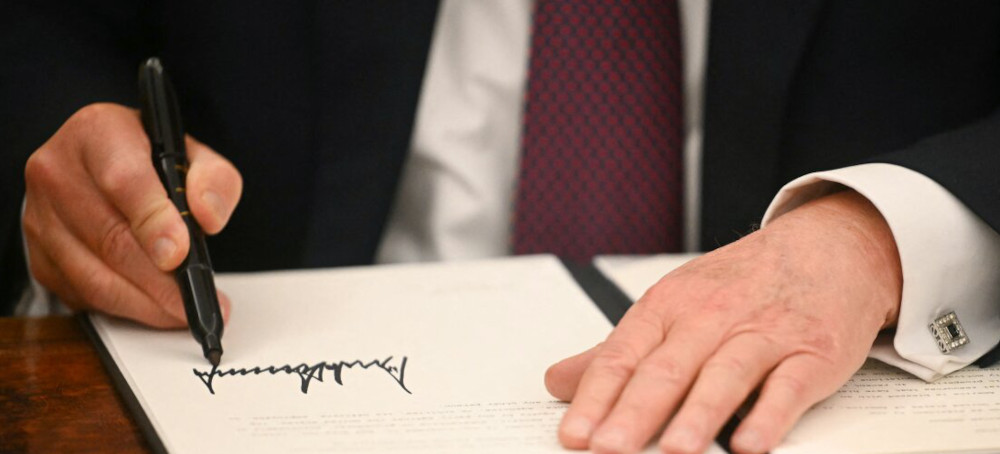 President Donald Trump signs an executive order. (photo: Jim Watson/Getty)
At first glance, it can be hard to tell which of these orders are just for show and which are actually a huge deal. After all, it’s tradition for American presidents to issue several executive orders on their first day in office, and many are more symbolic than anything. However, as Trump begins his second term as president, some of his executive orders do break from the norm, according to Deborah Pearlstein, the director of Princeton University’s Law and Public Policy program.
To help us understand which executive orders are genuinely alarming and which are just “legal theater,” Pearlstein broke them down into four categories:
The Totally Standard Orders
Trump used executive action to appoint James McHenry as interim head of the Justice Department until his nominee, Pam Bondi, is confirmed. Robert Salesses was in a similar boat, being named acting defense secretary until Pete Hegseth is confirmed. A similar cadre of folks were tapped for interim jobs in the Treasury, Education, and Labor departments.
All in all, a small portion of Trump’s executive actions fall squarely into this category and are “unremarkable,” said Pearlstein, who added, “I don’t think anybody should pay much attention to them.”
The Do-Nothing Orders
Trump’s order demanding emergency price relief for American families and defeating the cost-of-living crisis sounds great, but “has zero effect on anything at all,” Pearlstein said. In reality, it’s a broad mandate for all of the executive departments within the federal government that does not come with any applicable law—and no court can do anything with it either. Executive orders have limits, after all, as Pearlstein noted in a popular thread on Bluesky: they can force other offices within the executive branch to do things, but they do not have the authority to force individuals, companies, or organizations to act.
Trump’s executive order restoring “freedom of speech” to federal employees and ending “federal censorship” is also basically toothless. Trump is using executive action to simply declare his personal interpretation of the Constitution as president of the United States, Pearlstein said, whereas traditionally executive action is used pursuant to a specific federal statute or provision of the Constitution.
This one may come as a surprise, but Trump’s executive order on TikTok doesn’t actually do much of anything. Pearlstein explained that it only states that the federal government will not enforce fees or other penalties on Apple and Android for making the TikTok app available to users in their app stores after Jan. 19; it does not undo the legislation banning TikTok that Congress passed last year. “It’s nothing more than reassuring the companies that are now subject to the law and facing billions of dollars of liability for violating it that ‘I promise I won’t pursue any enforcement actions against you for 75 days while I figure out what to do,’ ” Pearlstein explained.
Trump’s action on this makes the app’s future in the U.S. no more certain than it was just a few days ago. When TikTok was on the verge of being blocked from U.S. app stores, the company voluntarily shut down its services for U.S. users, only to turn them back on 14 hours later when Trump publicly vowed to “make a deal” that would keep the app available.
The Party-Line Orders
When the presidency changes hands from one party to another, it’s pretty much expected that the new president will undo a bunch of his predecessor’s executive orders. That’s what Trump is doing with his orders to withdraw from the Paris climate accords, lift restrictions on drilling in Alaska’s coastal areas, and ban transgender people from joining the military—all are reversing executive actions former President Joe Biden took.
“These are very common switch-flipping kind of executive orders that we see a lot,” Pearlstein said. They might be distressing, but they’re not a departure from American democracy as we know it.
Some of these orders are more about appearing to change things rapidly without actually doing much right away. For instance, withdrawing from the Paris Agreement takes about a year and cannot take effect “immediately,” as Trump proclaimed.
Trump’s ban on transgender people serving in the military, on the other hand, will have an immediate impact on people’s lives and could very well end up in the courts.
The Unusual and Alarming Orders
Trump’s executive orders on immigration—suspending the refugee resettlement program and attempting to end birthright citizenship—are “both unusual and potentially consequential,” Pearlstein said. “This is where people need to pay attention and worry and investigate further.”
Like Trump’s infamous 2016 Muslim ban, the order suspending the refugee program invokes the president’s authority to make unilateral decisions about who is allowed to enter the country and who is not—and it will likely be challenged in the courts.
The same goes for Trump’s order requiring asylum-seekers at the southern border to wait for their immigration court date in Mexico, a policy he first implemented in 2019 that became known as “Remain in Mexico.” Similarly, a separate executive order ends the practice of allowing migrants to enter the U.S. while they await immigration court. The impact of these orders was immediate, with Customs and Border Protection cutting off its mobile app, CBP One, on Monday afternoon shortly after Trump was sworn into office. All pending immigration court proceedings were also canceled.
Many of these orders demand federal agencies come up with a plan to execute within the coming days and weeks—while many of Trump’s Cabinet picks are not yet confirmed. There’s a good chance this could lead to messy interagency feuds, depending on how each department head chooses to interpret and enforce the president’s demands. Pearlstein believes these orders “will absolutely end up in the courts.”
Trump’s birthright citizenship order is already facing two lawsuits that will almost certainly end up before the Supreme Court, since the high court has consistently held that the U.S. Constitution guarantees birthright citizenship, going back to the foundational 1898 case, United States v. Wong Kim Ark.
Pearlstein also singled out the order granting immediate top-secret security clearance to a list of unvetted individuals cherry-picked by the president. “I do worry about monkeying with security clearances, either turning them on or off as a way of empowering or disempowering people who are critical in the national security apparatus,” Pearlstein said.
And then there’s Trump’s executive order gutting federal diversity, equity, and inclusion policies. Though the action is directed only at federal agencies, Pearlstein worries it will end up also encouraging the private sector, particularly businesses with federal contracts or those who want to earn government business, to end their DEI initiatives. “Those companies are still of course bound by federal antidiscrimination laws, but the government’s ability to influence private contractors in this space has been important and it’s been in place since the advent of the modern Civil Rights era,” Pearlstein said. She believes this action was designed to ultimately have a chilling effect on the country’s most influential institutions.