Trump Secretly Yanks National Guard Out of Three Blue Cities
Edith Olmsted The New Republic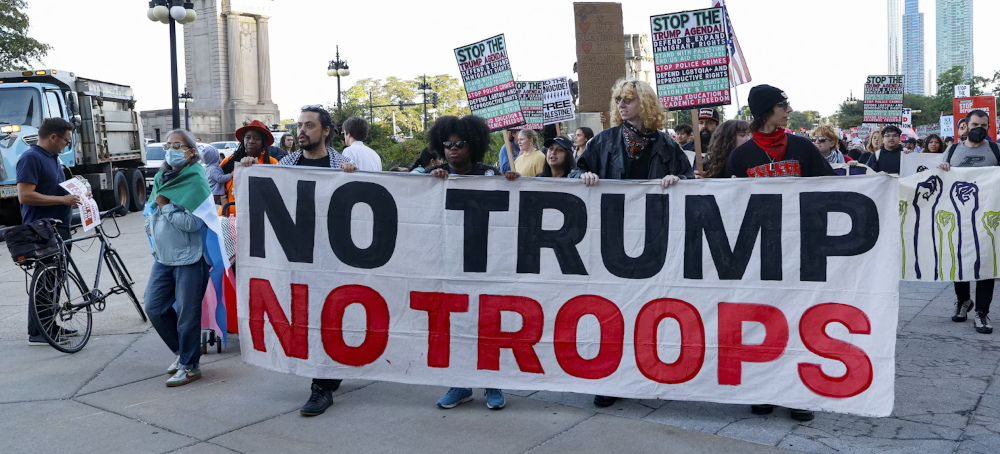 A Protest in Chicago. (photo: Getty)
Donald Trump appears to have admitted defeat.
Hundreds of service members deployed as part of Trump’s federal takeover of American cities—including the 500 to Chicago, 200 to Portland, Oregon, and 100 troops remaining in Los Angeles—were quietly dispatched home by the end of January, U.S. Northern Command told The Washington Post Wednesday.
There are still National Guard service members deployed in American cities, but only ones working under a nonfederal status. More than 2,500 National Guard troops remain in Washington, D.C., where they will continue their essential work as groundskeepers for the capital city until the end of the year. There is an ongoing presence in Memphis and New Orleans, but those deployments are being overseen by the governors of Tennessee and Louisiana, respectively.
The decision to remove the troops was not publicly acknowledged, as the Trump administration has tried desperately to proclaim that they’re “winning” big-time.
Trump’s embarrassing pull-out game comes after fierce opposition from state leaders and a staggering series of legal defeats.
In November, a federal judge ruled that Trump’s deployment in Washington had “exceeded the bounds” of the Pentagon’s authority, and a federal judge in Portland ruled that Trump “did not have a lawful basis to federalize the National Guard.” In December, a federal judge ordered him to remove National Guard troops from California, rejecting the federal government’s inane assertion that protests against federal immigration agents amounted to rebellion, and the Supreme Court refused to allow the Trump administration to deploy more troops to Chicago
Randy Manner, a retired two-star general in the U.S. Army and former acting vice chief of the National Guard, told the Post that the rules governing National Guard troops meant that they were “100 percent ineffective in doing what [Trump] wanted them to do.”
“The administration finally realized the amount of resistance that was coming up, in terms of legal and public condemnation, was more than anyone anticipated,” he told the Post.