Trump Reportedly Frustrated by His Inability to Make Good on Foreign Policy Promises
Steve Benen MSNBC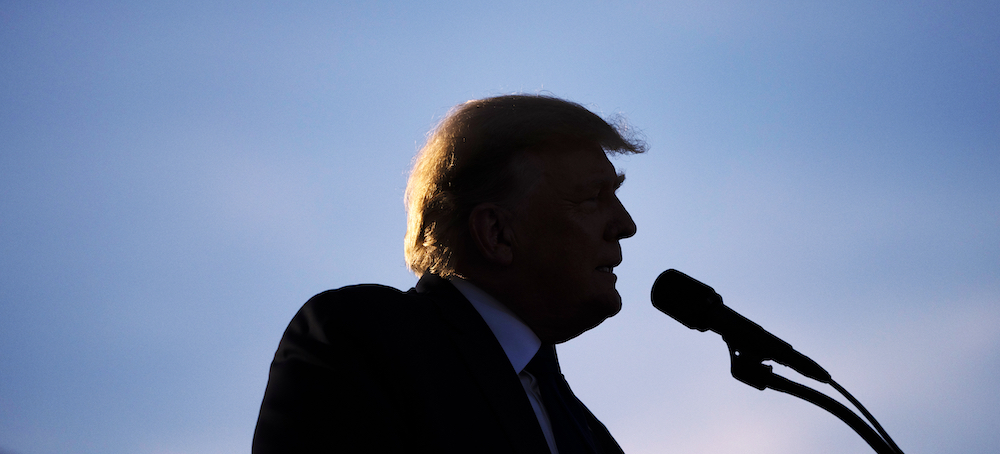 Donald Trump. (photo: MSNBC)
The president wanted to resolve crises in Ukraine and Gaza quickly once in office. I’m surprised by the degree to which he’s surprised.
The president claimed in March that he was “being a little bit sarcastic” when he repeatedly vowed to end the conflict in a day, but his defense was literally unbelievable.
The underlying question, though, is why he made the ridiculous claim in the first place. The Wall Street Journal had an interesting report along these lines over the weekend.
When President Trump spoke to a room of top donors at his Florida club last week, he described ending Russia’s war in Ukraine as a growing frustration that keeps him up at night, people in the room said. Russian President Vladimir Putin was particularly tough to negotiate with, and wanted ‘the whole thing,’ Trump said, referring to Ukraine, according to an attendee. His comments came in response to a donor’s question about his biggest foreign-policy concerns. The war in Gaza was also notably challenging, Trump told the crowd.
The Journal’s report, which has not been independently verified by MSNBC or NBC News, added that despite Trump’s pre-election boasts about breakthroughs he’d reach with ease — in Ukraine, Gaza, Iran and elsewhere — the president is “finding solving the world’s problems more difficult than he had thought.”
The article quoted Kyle Haynes, a professor of U.S. foreign policy at Purdue University, who said, “If he hadn’t promised such things repeatedly throughout the campaign it’d be wildly unfair to criticize him for failing to achieve them. But he did.”
The broader point isn’t just that Trump made outlandish promises he’d never be able to keep. Rather, I’m surprised by the degree to which the president is surprised.
One of my favorite quotes from Trump’s first term came in 2017 when he and his party were struggling mightily to come up with an alternative to the Affordable Care Act. “Nobody knew that health care could be so complicated,” the president said, roughly a month into his first term.
It was amusing, of course, because literally everyone who’s familiarized themselves with the governing details of health care policymaking is well aware of how incredibly complex and challenging the issue is. But Trump, upon arriving in the White House, was gobsmacked: He assumed he’d take power, scrap “Obamacare,” tell Congress to give everyone better health care coverage at a lower cost and — voila! — he’d “repeal and replace” the ACA.
When the rookie president actually confronted reality, however, he found himself frustrated by the fact that health care “could be so complicated.”
Eight years later, Trump seems to have had similar assumptions about international crises that led him to make wildly unrealistic promises, which he’s reportedly now frustrated by.
But in his first term, the president arguably had a credible excuse: Trump had absolutely no idea what he was doing. He was the first and only president to take office despite never having spent a day in public service; he never took even the slightest interest in brushing up on the basics of governing; and he was guided by absurd assumptions that policymaking was easy and the only thing standing between elected officials and success was idiocy and timidity.
Trump apparently thought he’d assume power, use common sense, bark a few orders and, in a snap, problems would disappear. He instead faced a brutal learning curve, as he racked up one humiliating failure after another.
But the whole point behind his second term was that things were supposed to be different this time. Trump, voters were told, had four years of lessons on how to be a president, and he’d apply this acquired knowledge upon his return to the Oval Office.
Except, Trump — even now, in his fifth year — is still behind the presidential learning curve.
The Journal’s report noted that the president is “finding solving the world’s problems more difficult than he had thought,” which is timely evidence that Trump is almost certainly the slowest learner in the history of American presidential politics.