Trump Plans Putin Summit on Ukraine, Raising Stakes for Zelensky Meeting
Michael Birnbaum The Washington Post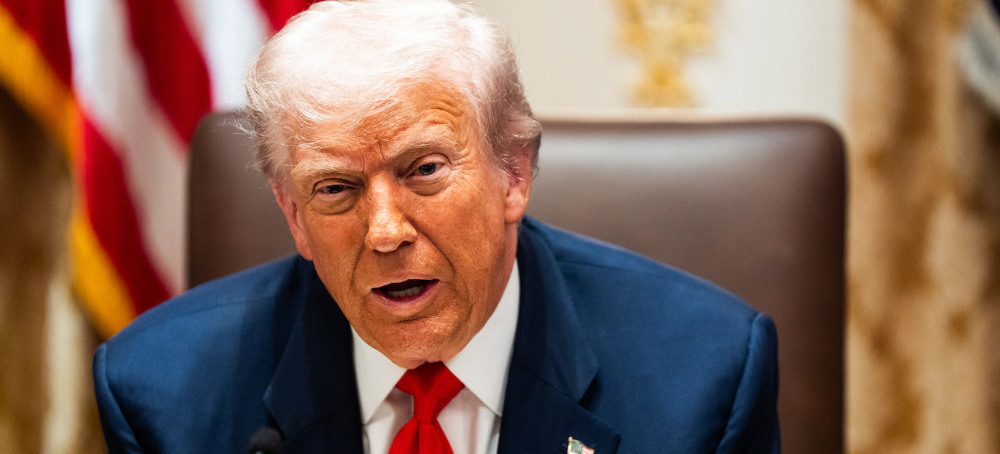 President Donald Trump said Thursday that he and Russian President Vladimir Putin will meet in Budapest. (photo: Demetrius Freeman/The Washington Post)
The call with Putin may have derailed Zelensky’s hopes to obtain new long-range weaponry to use against Russia in his upcoming meeting with Trump.
President Volodymyr Zelensky is in Washington seeking to shore up U.S. support to force Putin to negotiate an end to the war and is urging Washington to sell Ukraine Tomahawk missiles that would strike deep into Russian territory.
The threat of the Tomahawks appeared to have spurred the Kremlin into action by setting up a phone call after weeks of describing any possible sale of the missiles to Ukraine a provocation. After the call with Putin, Trump expressed skepticism about a Tomahawk deal with Ukraine, saying “we need Tomahawks for the United States of America, too.”
Zelensky, hours before his meeting with Trump, tweeted from the U.S. that despite the call “nothing has changed for Russia — it is still terrorizing life in Ukraine,” pointing to the swarm of Russian drones that struck his hometown of Kryvyi Rih overnight. “Russia is trying to leave this part of Europe an island of peril and torment for human life. It’s crucial not to let that happen.”
Trump and Putin will meet in Hungary “to see if we can bring this ‘inglorious’ War, between Russia and Ukraine, to an end,” Trump wrote on Truth Social. “I believe great progress was made with today’s telephone conversation.” Trump is seeking another diplomatic breakthrough days after brokering a ceasefire deal between Israel and Hamas.
Trump has long courted Putin even as he has faulted him for not ending the war. The president in August rolled out a red carpet for Putin in Anchorage, where the two joked and sat for hours of discussions. Russian attacks on Ukraine have increased since, and Trump has become increasingly critical of the Russian leader in recent weeks. Thursday’s discussion was an opportunity for Putin to regain the initiative and promote Russian narratives before Zelensky’s visit on Friday.
A pattern has emerged in Putin’s conversations with Trump, in which the Russian leader has used them to deflect pressure to halt attacks on Ukraine. Already he has convinced Trump that there was no need for a ceasefire to allow peace talks to go ahead and resisted calls for a meeting with Zelensky.
Despite the eight phone calls between Trump and Putin since the inauguration discussing an end to the conflict, there has been no slackening of the Russian assault on Ukraine, leading critics to say the moves are just to buy time to let the war continue.
“I don’t know about you, but it feels to me like we’re being served ‘tomorrows’ again — while really, we’re just being led by the nose,” said Valeriy Chaly, a former Ukrainian ambassador to the U.S., in a comment on social media.
Putin has offered little in return so far, sticking to his maximalist demands that Ukraine must be demilitarized and neutral, as he fights on to force Kyiv back into Moscow’s sphere of political influence.
The Kremlin signaled Thursday that it was leveraging trade to incentivize Trump’s cooperation, a tactic Putin has used as a way to attack a president who likes to brag about how much money he is bringing back to the United States through deals with other countries. Russian leaders have sought to lure Trump with promises of billions of dollars in American investments in Russia’s energy industry.
“One of the American president’s main points was that ending the conflict in Ukraine would open up enormous — I emphasize, enormous — prospects for developing economic cooperation between the U.S. and Russia,” Putin adviser Yuri Ushakov told reporters after the call.
U.S. energy companies, mindful of moments in Russia’s post-Soviet history when their investments in the country have been frozen or seized, have been cautious about the prospect of resuming business there even if sanctions are lifted.
Putin on Thursday also sought to convince Trump that Russia had the upper hand on the battlefield, Ushakov said, with the Russians mindful that the U.S. leader is often attentive to fellow leaders’ assessments of battlefield situations.
That played to Ukraine’s advantage when Trump gave Zelensky a sympathetic ear last month at the United Nations, as the Ukrainians laid out their case for why Russia was losing. Shortly afterward, Trump declared his belief that Ukraine could beat Russia militarily by expelling it from Ukrainian territory — a major shift in rhetoric.
Putin on Thursday said the opposite.
“Russian armed forces fully control the strategic initiative along the entire line of contact. Under these circumstances, the Kyiv regime is resorting to terrorist methods, striking civilian targets and energy infrastructure, to which we are forced to respond accordingly,” Ushakov said, complaining about Ukrainian drone strikes on Russian oil refineries that have taxed Russian energy production.
Ukraine’s commander, Gen. Oleksandr Syrsky, pushed back against the Russian assertions on Friday, saying that the Kremlin’s objectives in the war have been constantly foiled. “I can state with confidence: Ukrainian warriors have ceased the enemy’s spring-summer offensive campaign and continue to disrupt the Kremlin’s further plans.”
Both sides are dug in, and neither has made significant territorial gains over the last year, as the rise of drone warfare has upended traditional military strategy. Russia launched a full-scale invasion of Ukraine in February 2022, and it currently holds about a fifth of Ukraine’s territory.
Casualties in the war are a closely guarded secret and are difficult to confirm. The British Defense Ministry estimated in June that Russia had suffered more than 1 million military deaths or injuries, with about 250,000 soldiers killed. The Center for Strategic and International Studies estimated that same month that about 400,000 Ukrainian soldiers had been killed or wounded, with 60,000 to 100,000 dead.
The Budapest meeting between Trump and Putin will take place “within two weeks or so,” Trump told reporters Thursday. Hungarian Prime Minister Viktor Orban is the most Russia-friendly leader in the European Union and has sought to be a bridge between Washington and Moscow.
“We have a problem. They don’t get along too well, those two. And it’s sometimes tough to have meetings. So we may do something where we’re separate. Separate but equal. We’ll meet and talk,” Trump said. “This is a terrible relationship the two of them have.”
Trump will dispatch Secretary of State Marco Rubio to meet with Russian Foreign Minister Sergei Lavrov next week to lay the groundwork, he said.
“I am concerned that we are now witnessing a violation of the fundamental principle ‘nothing about Ukraine without Ukraine,’” said Ukrainian lawmaker Iryna Gerashchenko, about the upcoming summit. “No agreements or negotiations should take place behind the backs of Ukrainians.”
The president said on the campaign trail last year that he could broker peace in Ukraine in “24 hours.” The continued hostilities have frustrated him as he has made progress in Gaza and boasted that he has averted conflicts elsewhere. But the ceasefire deal in the Middle East this month appears to have bolstered Trump’s confidence that he can end the war.
Some European officials say that the missiles Zelensky is requesting are more symbolic than practical, demonstrating U.S. willingness to escalate pain on Russia as a bargaining tactic. Tomahawk missiles have enough range to hit Moscow from Kyiv, but Ukraine already has domestically produced drone and other capabilities that enable it to reach far into its neighbor’s territory.
Training Ukrainian soldiers on the weapons system also would take time. Trump has embraced the possibility of Tomahawk deliveries as a way to pressure the Kremlin into a truce.
Trump’s conversation with Putin came as congressional leaders said they would be likely to move forward on legislation that would strengthen U.S. sanctions against Russia and buyers of its energy.
“I don’t want to commit to a hard deadline, but it’ll be soon,” Senate Majority Leader John Thune (R-South Dakota) said Thursday, predicting a vote in “the next 30 days.”
Sen. Lindsey Graham (R-South Carolina) and Sen. Richard Blumenthal (D-Connecticut) are leading the bill, which has 84 co-sponsors, and have been tweaking its language with the White House to prepare for the president’s final approval. The legislation would impose 500 percent tariffs on Russia and countries purchasing the country’s oil and uranium, with the potential to sever entire nations from the American market.
Trump on Thursday said the legislation may not be necessary if he can strike a deal between Ukraine and Russia.
“I’m not against anything. I’m just saying, it may not be perfect timing, but it could happen in a week or two. But it’s at my option,” he told reporters.
In response to the announcement of a Trump-Putin meeting today, Graham agreed that a negotiated solution would be necessary to end the war but added that “it’s very important that we continue to sell Ukraine the weapons they need to protect their people and to finally go on offense.”
He added that Russia should halt its attacks until the meeting takes place. “Bombing and promising to talk has not proven to be the pathway to peace thus far.”