Trump Is Still Deporting People Wherever He Wants
Isaac Chotiner The New Yorker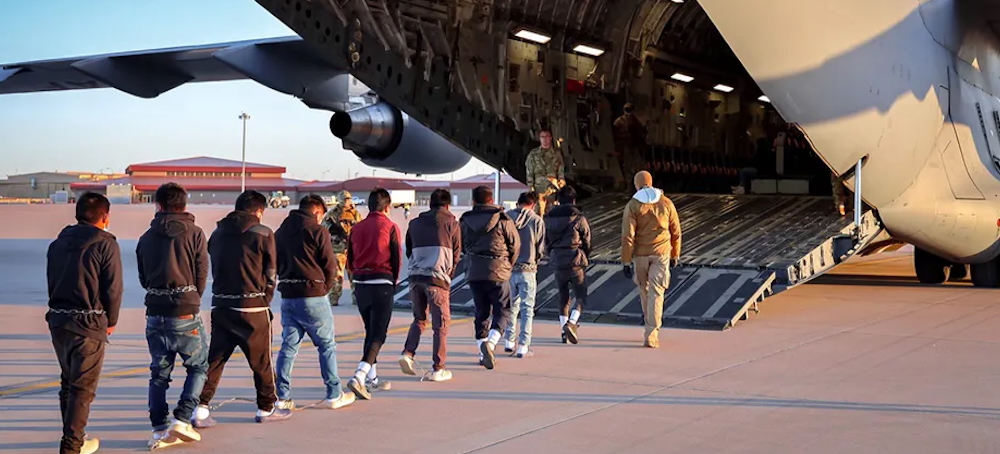 People are seen boarding a deportation flight. (photo: White House)
How the Administration is overwhelming federal courts and getting away with third-country removals.
I recently spoke by phone with Ahilan Arulanantham, a law professor at U.C.L.A. and the faculty co-director of the Center for Immigration Law and Policy there. During our conversation, which has been edited for length and clarity, we discussed how judges have tried to limit the Trump Administration’s use of this third-country loophole by demanding that it bring wrongly deported immigrants home, the legal process that allows this type of deportation, and how the Supreme Court’s unwillingness to rein in the Trump Administration has strained federal courts.
Early in Trump’s second term, there was a lot of concern about the degree to which immigration authorities would start removing people from America and sending them to third countries. A year later, how prevalent is this?
I think it’s important to distinguish between third-country arrangements that result in the deportees being imprisoned in a foreign country, and other kinds of third-country arrangements, where, for example, Mexico has agreed to take in people who are not from Mexico and then, in some way or another, encourage those people to go back to their home countries. I would say that, in the case of the latter, the deportations to countries where people are just left at sea have happened on a massive, really unprecedented scale.
The former, which are these deportation-to-prison arrangements, obviously happened with El Salvador, and then in other places like Ghana, and they’re also very troubling. But the total number of them is small. It’s probably less than a hundred, if you leave out the ones to El Salvador.
In January, the Trump Administration secretly deported nine people to Cameroon, where none of them are from, according to the Times. It seems like when the Administration is legally prohibited from deporting people to a country where they may be persecuted, they send people to a third country, and then essentially throw up their hands and say, “Well, if the third country is going to send them to the country that they’re not supposed to be sent to, we can’t do anything.” Some legal observers argue that this workaround is just as illegal. How do you see it?
I think it’s clearly illegal for two different reasons. The Administration’s recent arrangement with Cameroon resulted in the imprisonment of these nine people in Cameroon, and, at least in the reporting that I’ve read, most of them will be imprisoned unless they agree to go back to their home country. So that’s punishment. When you send somebody to a place to be imprisoned, that is imprisonment without trial. And so that, I think, is unquestionably illegal.
Separate from that, even in cases where they’re being sent to these places, and it’s not necessarily resulting in imprisonment, but it’s resulting in a follow-on deportation, that is illegal—absent the person having had an opportunity to challenge that arrangement in the United States in immigration court. The law requires deportees to receive notice of the country to which they are going to be removed, and then an opportunity to raise any claims against that decision in court. This was challenged in Department of Homeland Security v. D.V.D. last year, a class-action lawsuit challenging the government’s practice of sending people to third countries without providing any notice or opportunity to challenge the legality of that arrangement. A lower court held a hearing, took evidence, and issued a ruling declaring that procedure unlawful and requiring the government to provide notice in such situations. But the Supreme Court then stayed that order in mid-April without real explanation. They didn’t say that the lower court was wrong. They just said that the government can keep doing third-country deportations while the case is pending.
Is the Court going to come back and provide an explanation for why it stayed the order at some point?
The way the Supreme Court handles stay orders requires that the case come back to the Supreme Court, and then the Court has to either agree to take it or not. And if they decide not to take it, then the stay expires at that point. So you’re right that every time the Supreme Court stays an order in these cases, it means that the case will return to the Supreme Court, but it’s not like that happens immediately. That can take months and months, and there is, in my view, a direct line from the Supreme Court’s stay order in the D.V.D. case to the months of third-country removals that we’ve been seeing without people having any opportunity to contest the legality of that practice.
So is the lack of any opportunity for the deportees to have the Supreme Court rule on the challenge to third-country removal before they were flown away the reason that you think this was illegal?
The law on this is that a noncitizen gets to elect the country to which they will be deported in the event of an order of removal after a deportation hearing. The immigration judge asks the person to elect which country they wish to be removed to. In that case, the government has to try to send the person to their requested country. But if they can’t, for whatever reason—and one reason might be because the immigration judge has said, “You’ll be tortured there,” and barred it—then the government has to go through a whole list of other possible places to which they can send the person, like places where the person transited through or any other place where the person held any residency status. If none of those places agree to take them, they can be deported to any other country that accepts the person. But in that case they have to tell the person, We’re going to send you to this country. And because that wasn’t the subject of the original removal proceeding, they have to be given the opportunity to challenge the removal to that country.
Take an example of Venezuelans being deported to Mexico. The deportees might say, I don’t believe that the Mexican government has a problem with me. The Mexican government isn’t in league with the Maduro regime. But here’s the evidence that when you send me to Mexico what’s going to happen is the Mexican government is going to then deport me to Venezuela, and so I will face harm from being sent to Mexico because it will inevitably result in my return to Venezuela where I am going to be persecuted or tortured as you’ve already found, Your Honor. So that argument should be available to the people being sent to Cameroon.
“I don’t want to go to my home country of Zimbabwe, and Cameroon’s going to send me to Zimbabwe,” basically.
Exactly, exactly. Because I have a reasonable fear that they will send me to Zimbabwe, I also have a persecution claim against Cameroon directly.
So, just to be clear, if there is no overlap between the countries that the person wants to go to and the places that will take them, then what?
Then the government has the right to try to send you to any other country that will accept you as long as that country consents.
And then you get a chance to challenge that. And then if you lose the challenge, you go.
Correct. So you could imagine a situation where there was a hearing about this, and the government said, “No, actually, you’re wrong. In fact, you will not be forcibly sent to Zimbabwe,” or “That’s not the nature of the arrangement with Cameroon” and “Here’s the evidence from the Cameroonian government that says they’ll allow people like in your situation to stay and live and work in their country, and there isn’t a reasonable probability that you’ll be sent anywhere else.” And if they win that argument, then it’s fine.
My understanding is that the Administration’s reply to court orders concerning people who have already been deported to a third country is “What do you want us to do? They’re in a third country now.”
Yes, I think that is what the government has said in a few of these cases. They said this in the El Salvador situation, saying, “What could we do in El Salvador? It’s not up to us.” If they had allowed a hearing in advance, as they are legally obligated to do, and as the district court in the D.V.D. decision found that they had to do, then this would not have been an issue. Because the probability that Cameroon is going to send you to Zimbabwe or that Mexico is going to send you to Venezuela should be litigated when you’re still in U.S. custody on U.S. soil.
But if the issue only arises after the person has already been sent there, then it presents a more complicated question. This was a question in the Kilmar Ábrego García case, an immigrant who had been living in the United States and was deported to El Salvador last March, as well as in some other cases where the government is now obligated, as the Supreme Court has said, to “facilitate” their return to the U.S., but exactly what that entails depends very much on the nature of the arrangement between the two countries.
That leads us to Judge James Boasberg, a district-court judge in Washington. Last week, he said that the government needs to bring back more than a hundred Venezuelans who were wrongly deported under the Alien Enemies Act. What did you make of his order?
That order is limited to people who were sent to third countries and not Venezuelans who were sent to Venezuela. So that’s an important distinction: it doesn’t order the return of the Venezuelans who ended up, via El Salvador, in Venezuela.
What’s the importance of that?
Because it means that even this forceful order is not going to provide any measure of justice to the large number of people whose due-process rights were violated in the original incident that gave rise to litigation.
The Supreme Court order in the case, Trump v. J.G.G., is from early April and says due process requires that these Venezuelan nationals being deported be given notice, and they weren’t given notice. So although they ruled that all of these deportations were illegal, for all the people who ended up in Venezuela, this order isn’t going to provide them any justice. What the Boasberg order does is say that, for those who ended up in third countries, the government is obligated to “facilitate” their return. And that’s the language of the Supreme Court in the Ábrego García case, where he was deported in violation of an already existing court order that prohibited his removal.
This used to be pretty standard practice—that the government, when it made a mistake and deported people in violation of a court order, would facilitate their return. It would do that by having the embassy personnel contact the person and arrange their travel back to the U.S. Sometimes this would require the U.S. to pay for their travel, sometimes not. The Boasberg order requires the government to pay for the return travel of all the men who had been sent to El Salvador last March. Like I said, sometimes it happens, sometimes it doesn’t. But, either way, the obligation of the government to correct its mistake by facilitating the return of people should be uncontroversial because it is definitely something that happened routinely before.
I assume what we’re going to hear from this Administration is that this order interferes with the President’s ability to conduct foreign affairs. I imagine previous Administrations were not objecting to facilitating the return of wrongly deported people on these grounds.
Correct.
And the danger here is that such arguments do have some sort of merit for courts that are in favor of strong executive power.
For years, it has been routine practice for the government to facilitate the return of people who are deported in violation of court orders. There are a number of cases that establish this. I’ve had clients of mine who were in this situation, and this was the outcome. And Ábrego García was obviously brought back, although they charged him with a crime and kept trying to extradite him.
What I am confused by is, if the Supreme Court decided back in April that the Administration could continue deporting Venezuelans, why were these removals illegal?
That’s not quite right. There were Venezuelans who the Trump Administration asserted were members of the Tren de Aragua gang. And there was a habeas petition, which is a particular kind of lawsuit that allows somebody to challenge the legality of their imprisonment or other deprivations of liberty. The plaintiffs said, The government is trying to deport us without any process at all, and that is a violation of the Constitution, and we’re challenging that.
The government responded by saying, Oh, what you’re actually trying to do is challenge the lawfulness of your detention and the related deprivation of liberty. That means this has to be a habeas petition, and if you file it as a habeas petition, then it can only be filed in the district where you’re actually detained. And since the plaintiffs originally filed this lawsuit in Washington, D.C., the Court said, “You filed in the wrong court, because the plaintiffs are detained all over the country, with most of them in a couple of different divisions in Texas. So the suit has to be brought there.” But the plaintiffs disagreed, and insisted they were challenging the Alien Enemies Act itself.
Initially, Boasberg and the D.C. Circuit Court agreed with the plaintiff, but then the Supreme Court reversed that. And what the Supreme Court said was, If you can file a case as a habeas petition, then you have to file it as a habeas petition. So, even though you might think that this is a broad challenge to an unlawful policy, it can’t be brought that way. This is a challenge to your unlawful imprisonment and deportation, and, therefore, it has to be brought as a habeas petition. And because it has to be brought as a habeas petition, you can’t bring one lawsuit in D.C. to challenge this whole thing everywhere around the country. You have to file in each district separately where the people who are being detained actually are.
That was the holding of J.G.G. in early April, before the D.V.D. ruling. So the Supreme Court’s ruling was effectively that the government won because the plaintiffs filed in the wrong court and filed the wrong type of case. But they went on and said, Of course, the due-process clause applies in deportation cases. So these people are entitled to notice and an opportunity to challenge the invocation of the Alien Enemies Act in their cases. There is an obvious tension between this and the D.V.D. case, which allowed the government to continue removing people. And Justice Sonia Sotomayor pointed this out in her dissent in D.V.D.
But J.G.G. established a rule. And that rule is that the due-process clause requires notice and an opportunity to be heard before you can deport somebody under the Alien Enemies Act, just as with all other deportation cases. So that’s why it’s both true that the result of the J.G.G. was that they filed in the wrong court, and they had to refile. But it was also true that the Court’s ruling meant that the first attempt to deport these people under the Alien Enemies Act was illegal.
And that allows Boasberg to now say that the Administration has to facilitate their return?
Right. That, coupled with the fact that they violated his own order. It’s still the law that when a court issues a ruling, people have to follow the ruling. And if they think the ruling’s wrong, then they can appeal, but it doesn’t excuse them from following the ruling. When Boasberg ordered the planes to turn around in his original order, they should have turned the planes around. And they didn’t.
I know this is not exactly what we’ve been talking about, but it’s very closely related: Did you know, since the J.G.G. ruling, there have been thousands of habeas petitions filed, swamping the federal courts? It has gotten acute in Minnesota, but it’s happening all over the country. I know of habeas petitions being filed in huge numbers in Los Angeles, in Texas, in New York, and all around. That is happening in large part because the Supreme Court said in J.G.G. that, if a claim can be filed in habeas, it has to be filed in habeas. And this is a new ruling that they created in that case. There had been no prior precedent for that idea. As a result, these unlawful detentions that are the product of about maybe four or five Trump Administration policies that many courts have already ruled are illegal—like how the government has said that every undocumented person has to be held to mandatory detention—now have to be challenged in individual habeas filings. Normally, these policies would have been challenged broadly, just like the Trump Administration’s usage of the Alien Enemies Act was first challenged through a single case. And then the Court would’ve either enjoined it, in which case the government would’ve stopped using it to detain people, or they would’ve not enjoined, in which case the government would’ve continued to use it, but nobody would’ve sued over it. There wouldn’t have been a thousand individual cases about it. The plaintiffs would’ve appealed, and then the case would have been resolved.
But now, because of what the Supreme Court did in J.G.G., it has led to this proliferation of thousands and thousands of individual cases.
Why did the Court do this?
That’s a great question. I don’t know if they foresaw all the implications of what they were doing at the time they issued that ruling. The government hadn’t yet adopted all of these broad, new draconian detention rules. They had adopted some of them, but not all of them. So maybe the Court didn’t fully anticipate what was going to happen. But I think it’s also true that, for the past several years, the Supreme Court has had two simultaneous agendas. One is a very strong opposition to class action, and the idea that people who would otherwise go unrepresented should be able to get relief by combining their claims together. And then the second is restricting the availability of habeas relief for people who have alleged that they’re unlawfully detained. You can’t get rid of habeas claims, because they are in the Constitution. But they can make them more difficult to file, as we have seen this Court do.