Trump Illegally Deployed National Guard During LA ICE Protests, Judge Rules
Alicia Victoria Lozano, Ryan J. Reilly and Megan Lebowitz NBC News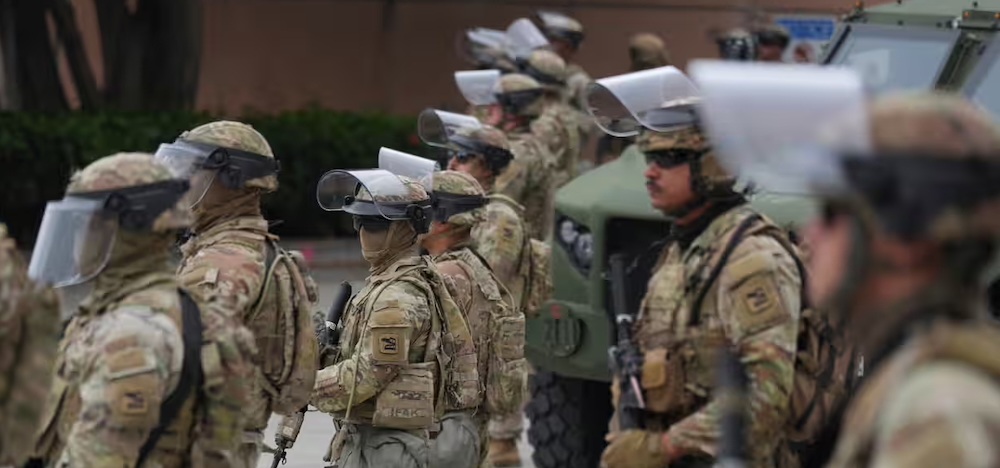 The US National Guard is deployed outside the federal prison in downtown Los Angeles. (photo: Jae Hong/AP)
U.S. District Court Judge Charles Breyer said the use of the California National Guard and the U.S. Marines to conduct law enforcement in the city violated a 19th century law.
"The evidence at trial established that Defendants systematically used armed soldiers (whose identity was often obscured by protective armor) and military vehicles to set up protective perimeters and traffic blockades, engage in crowd control, and otherwise demonstrate a military presence in and around Los Angeles," U.S. District Judge Charles Breyer in San Francisco said in a 52-page filing.
"In short, Defendants violated the Posse Comitatus Act," he said.
The judge's ruling strikes a blow to President Donald Trump's push to deploy troops to city streets as part of an effort to fight crime. Critics have branded the deployments as a federal government overreach.
Trump first deployed National Guard troops to Los Angeles before sending soldiers into Washington, D.C., enraging many political opponents and residents. The president has indicated his interest in deploying troops to other cities as well.
“Once again, a rogue judge is trying to usurp the authority of the Commander-in-Chief to protect American cities from violence and destruction," Anna Kelly, White House spokesperson, said in a statement.
Lawyers representing California argued during a trial last month that the president had exceeded his authority by deploying federal troops after thousands of protesters took to the streets of downtown L.A. to protest his immigration policies.
The Trump administration had framed the protests as violent riots that were overwhelming local authorities and endangering residents. The National Guard was necessary, it argued, to protect federal property and personnel from the escalating chaos.
But Gov. Gavin Newsom and Mayor Karen Bass, both Democrats, pushed back immediately, insisting they had matters well in hand and arguing the protests were largely peaceful.
Lawyers representing California had asked Breyer, a Clinton appointee and younger brother of retired Supreme Court Justice Stephen Breyer, to order the Trump administration to return control of the remaining troops to Newsom and to stop using the military “to execute or assist in the execution of federal law.”
The Department of Justice countered that the deployment was necessary to protect federal property and personnel, and that the troops acted within the confines of an obscure law called the Posse Comitatus Act.
The 1878 statute prohibits the president from using the military as a domestic police force without approval from Congress.
The Trump administration “deployed the National Guard and Marines to Los Angeles, ostensibly to quell a rebellion and ensure that federal immigration law was enforced,” the judge wrote in Tuesday’s ruling.
“There were indeed protests in Los Angeles, and some individuals engaged in violence,” he wrote. “Yet there was no rebellion, nor was civilian law enforcement unable to respond to the protests and enforce the law.”
Breyer ordered the Trump administration to stop using military troops in California “to execute the laws, including but not limited to engaging in arrests, apprehensions, searches, seizures, security patrols, traffic control, crowd control, riot control, evidence collection, interrogation, or acting as informants” unless the situation meets the bar for invoking the Posse Comitatus Act.
The judge gave the Trump administration until noon on Sept. 12 to comply. The several hundred National Guard troops in Los Angeles are allowed to remain but must abide by the judge's order.
"Defendants are not required to withdraw the 300 National Guard troops currently stationed in Los Angeles, nor are they barred from using troops consistent with the Posse Comitatus Act," Breyer wrote.
The judge also wrote that Trump’s intention to call National Guard troops into federal service in other cities would be “creating a national police force with the President as its chief.”
The White House did not immediately respond to NBC News' request for comment.
Newsom celebrated the ruling, saying in a statement that "no president is a king — not even Trump — and no president can trample a state’s power to protect its people."
"Trump’s attempt to use federal troops as his personal police force is illegal, authoritarian, and must be stopped in every courtroom across this country," the statement added.
Bass, who repeatedly accused the Trump administration of "invading" Los Angeles, applauded the court ruling and said the city would not "buckle."
"We will not be divided and we will not be defeated," she said in a statement.
The Department of Defense ordered some 4,000 California National Guard members and 700 Marines to Los Angeles in June. Several hundred National Guard members remain in the city, while all the Marines have returned to their regular stations.
They were spotted at several high-profile immigration enforcement actions, including in MacAurthur Park and at two cannabis cultivation centers north of Los Angeles. Both incidents sparked backlash from immigrant rights advocates and local leaders.
During their testimonies, Maj. Gen. Scott Sherman, who commanded the National Guard troops, and William Harrington, deputy chief of staff for the task force, each told the court that intelligence briefings suggested there was minimal risk to immigration officers during several operations, including the MacAuthur Park action.
Sherman said he was told by his chain of command that federal troops could conduct security patrols as well as traffic, crowd and riot control, in addition to protecting federal property and personnel.
“We were allowed to do these four things because it was in line with what the president was directing,” Sherman told the court.
Breyer bristled.
“What limiting factors are there, to the use of this force?” Breyer asked. “Why is the federalized National Guard, even though it’s been drawn down, still in place?”
Justice Department attorney Eric Hamilton said the guard members and Marines were serving in a protective function, which is not a violation of the Posse Comitatus Act.
“In other words, we’re going to see federal officers everywhere if the president determines there’s a threat to the safety of federal agents?” Breyer pressed Hamilton. “That’s what you’re saying the law is.”