Trump Had No Plan B for Iran
Tom Nichols The Atlantic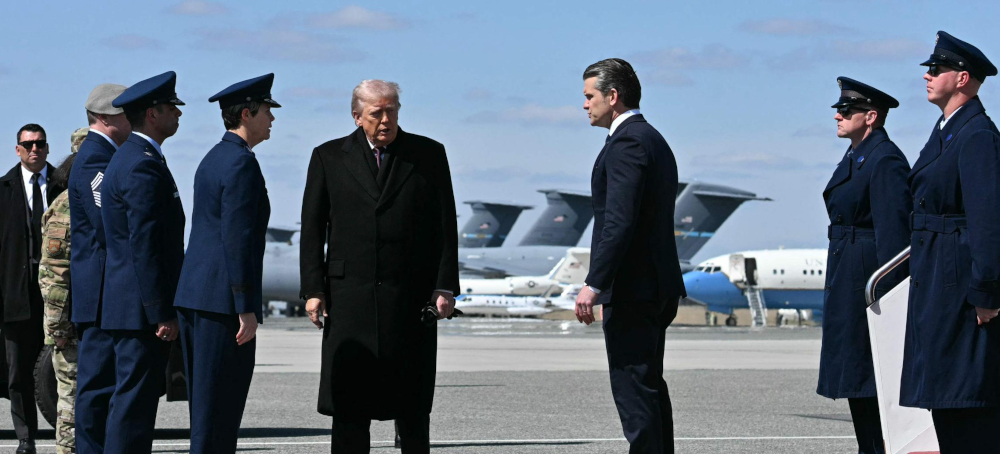 Donald Trump and Secretary of Defense Pete Hegseth at Dover Air Force Base (Delaware) on March 18, 2026, as the bodies of six American soldiers killed in the war against Iran arrived. (photo: Jim Watson/AFP)
But Trump did seem to have an overarching goal at the start of the war: regime change. In a video he released during the first night of the attack, he told the Iranian authorities to surrender and called on the Iranian people to rise up against their government. Unfortunately, the regime in Tehran seems to be recovering and, even worse, consolidating power. The American intelligence community has reportedly issued an assessment that the regime “will remain intact and possibly even emboldened, believing it stood up to Trump and survived.” Trump now appears lost, unable to comprehend how a blockbuster movie that he scripted out, one in which he cast himself as the Liberator of Iran, has turned into a poorly received miniseries that might yet be renewed for another dreary season.
The commander in chief was reportedly told that the mullahs might not agree to go gently into the night, but he seems to have waved away such concerns because he was so convinced that the Iranian regime would collapse almost immediately. According to The Wall Street Journal, when General Dan Caine, chairman of the Joint Chiefs of Staff, warned the president that a U.S. attack would prompt Iran to close the Strait of Hormuz, Trump “told his team that Tehran would likely capitulate before closing the strait—and even if Iran tried, the U.S. military could handle it.”
Trump’s Plan A was to hit Iran hard, watch the theocrats flee, and then hand power to a government of his own choosing. Should such things not come to pass, Plan B was … well, apparently, there was no Plan B.
Regime change, as americans learned the hard way in Afghanistan and Iraq, cannot merely be willed into existence. Such operations necessitate planning, the creation of an alternative government, and both the muscle and dedication to ensure that the old regime dies and a new one can take root. It requires time, and some hard thinking about what to do if the enemy regime—and the country’s population—will not cooperate with such grandiose schemes.
Trump and his officials have shied away from the term regime change, perhaps realizing that it evokes the failure in Afghanistan and the bloody struggle for Iraq. Trump, however, promised regime change to the Iranian people in his first statement on the war, released during the initial attack. He told the Islamic Revolutionary Guard Corps, the Iranian military, and the local police all to disarm and surrender or “face certain death.” Then he addressed “the great, proud people of Iran”:
I say tonight that the hour of your freedom is at hand. Stay sheltered. Don’t leave your home. It’s very dangerous outside. Bombs will be dropping everywhere. When we are finished, take over your government. It will be yours to take. This will be probably your only chance for generations.
The president’s statement was, in some ways, puzzling. The United States had no forces on the ground and the Iranian people were hiding in their homes. To whom, exactly, were the IRGC and others supposed to offer a surrender? But one part was clear: The exhortation to take back power was a vow, to the enemy and to its people, that the American attack would end with a new government in Tehran. Since then, Trump has demanded that he be allowed to pick the new Iranian government—the very essence of regime change.
The Israelis and the Americans underscored this goal by rapidly eliminating most of the Iranian leadership. They hurried the ailing 86-year-old Ayatollah Ali Khamenei to his final reward (perhaps only a bit ahead of nature’s schedule), and dispatched at least a dozen other top figures in Tehran. Trump and his only military partner so far in prosecuting in this war, Israeli Prime Minister Benjamin Netanyahu, apparently believed that hitting Iran in a comprehensive attack, destroying its military capacity, and killing its leaders would somehow instantly produce a new reality in Iran.
Instead, the Iranian government lashed out at several countries in the region, widening the war both to sow chaos and to emphasize the danger of working with the reckless Trump administration. And in a completely predictable move, it has closed the Strait of Hormuz. Or, more accurately, it has exercised its control over the strait, allowing some ships, including its own, safe passage while counting on fear and uncertainty among ship captains and the world’s insurers to choke the flow of oil to the rest of the world and perhaps create an oil shock in the West of a kind unseen since the 1970s.
Some observers have criticized American planners for failing to anticipate such a move. This is unfair: The intelligence community and the U.S. military have analyzed, planned, and exercised for this scenario for decades. The failure came not from the national-security community, but from the civilians, and specifically the commander in chief, who evidently refused to heed warnings from his senior military advisers that the Iranians would do exactly what anyone paying attention suspected they would do.
This arrogance is likely why Trump began the war by haughtily dismissing the need for allies; he is now whining that America’s allies should help open the strait while paradoxically claiming that he doesn’t need their help. Things have gotten so far out of Trump’s control that the president of the United States has even suggested that the People’s Republic of China—the same China that his top aides think is America’s greatest threat—should become involved in the Gulf.
Ironically, Trump’s flawed decision making on Iran emulates the errors committed by someone Trump admires, and from whom he might have learned a lesson: Vladimir Putin. The Russian president launched a war against Ukraine because he was certain the government in Kyiv would collapse in a matter of days under the onslaught of Russian arms. Putin (perhaps while in isolation during the coronavirus pandemic with only a few close advisers) got it into his head that the Ukrainian regime was on the brink of collapse, and that ordinary Ukrainians were waiting for Russian liberation. He then blundered into Ukraine without a backup plan. Four years later, the Kremlin’s war is an ongoing disaster.
Both presidents made classic strategic errors. They engaged in what analysts call “scriptwriting”: They decided what they wanted to happen, and then wrote out a kind of script in which their adversaries would dutifully play their part and recite their lines. They also both seem to have ignored the standard war-gaming caution to plan for what the enemy can do, not for what you would prefer that it do.
The analogy is not exact. Most important, Putin is engaged in a war of conquest, while Trump, however ineptly, is on the side of right, even if he is in it for his own vainglory. Trump’s rush to war was shortsighted; he evaded Congress (and likely U.S. law); he overrode American public opinion. But the Iranian regime is a malignancy and a threat to global peace, and had Trump succeeded in taking it down quickly and efficiently, he would deserve some credit. Indeed, Trump could later have tried to defy the legal and moral consequences of launching a war on his own by arguing that he took a bold risk, much as George H. W. Bush did in 1990. (Bush privately told my then-boss, the late Senator John Heinz, that going to war against Iraq in Kuwait was the right thing to do, and that he was going to order the operation even if it meant his impeachment.) And Trump, unlike Putin, has not thrown a generation of young men into a meat grinder.
Or at least not yet. Trump this week ordered thousands of Marines to head to the Persian Gulf, and new reports suggest that he is considering sending thousands more. (Asked about these reports on Wednesday, Trump said, in one of his usual circumlocutions: “No, I’m not putting troops anywhere. If I were, I certainly wouldn’t tell you,” after which he added that he “will do whatever’s necessary to keep the price” of oil down.) The likely explanation for the movement of the Marines is that they are being positioned for an attempt to seize Kharg Island, a major installation that serves as one of Iran’s most important lifelines to the global oil economy. But if Trump is about to send a much larger force, he may be planning to occupy territory on the Iranian mainland in order to push back threats to the strait.
The U.S. military has long studied and planned for such operations, but on a strategic level, these moves amount to improvisation. Trump’s statements in public and to Caine imply his assumption that the war wasn’t supposed to last very long—certainly not long enough that deploying Marines would even be a question, which is probably why the Japan-based 31st Marine Expeditionary Unit wasn’t in the region at the start of the war and won’t arrive there for another week or so.
What now? Trump’s options are not appealing, as sometimes happens when a leader goes all in on a hunch and a wish. The U.S. military can continue its operations. It can go on destroying installations, enemy forces, and other targets at will. Sooner or later, as Trump himself recently suggested, the military will run out of things to bomb, but for now, the United States can keep inflicting pain on the Iranian government (and its people).
Without a clearly defined goal, however, these operations are unlikely to lead to strategic success, not least because Trump seems to still be holding on to some unrealistic notion that Iran will surrender—whatever “surrender” now means. Instead, these operations are more like an attempt to play the first days of the war over and over, in hopes that the Iranian regime will finally collapse and hand power to someone else, despite the fact that there is no “someone else” ready to take the reins. (The son of the former shah has offered his services, but he is a would-be king without a throne or an army.)
The Iranian leaders, for their part, know they can win merely by surviving. (Again, the parallel—and contrast—with Ukraine is striking: The authoritarian regime in Tehran and the democratic government in Kyiv both understand that they are winning against much more powerful opponents by stubbornly continuing to exist.) The new ayatollah and his lieutenants are likely betting that Trump’s infamously short attention span and his frustration with anything that doesn’t instantly go his way will lead him to use some arbitrary metric of destruction, call it victory, and get out.
Whatever Trump chooses to do from here, the American president is now being driven by events instead of controlling them. Like a gambler chasing his losses, he keeps investing new money to stay at the table. Worse, Trump faces far more risk today than he did during his first throw of the dice: If he quits anytime soon, he will affirm that the Iranian control of oil is an even more effective shield against regime change than any putative nuclear program.
Trump has said that the war will not last long. The Iranians have been severely weakened, and their nuclear program is, for the time being, almost nonexistent. For the president, that may be enough to declare a win and let the world’s markets (and nerves) settle back down. But if the regime survives, and Tehran keeps its fist around the throat of the global economy, Trump’s Plan A will have failed. And without a Plan B, the temptation to escalate will grow as Trump tries to spackle over the gap left by his own unwillingness to engage in judicious strategic thinking when it counted most: before the war.