Trump Deploys Troops to Portland, Authorizing ‘Full Force’ if Necessary
Michael Birnbaum The Washington Post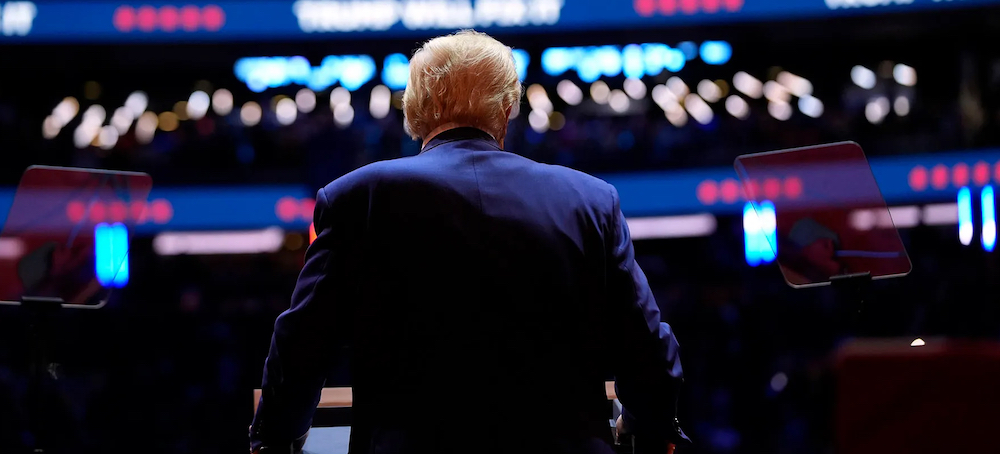 President Donald Trump. (photo: Alex Brandon/AP)
The president authorized the use of “Full force, if necessary,” in a campaign to use the military against Americans that has little modern precedent.
Trump said in a social media post that he was directing Defense Secretary Pete Hegseth to provide troops to what he dubbed “War ravaged Portland” as well as “any of our ICE Facilities under siege from attack by Antifa, and other domestic terrorists.”
Portland has been a target of right-wing politicians for the way it has handled racial-justice protests as well as its homeless population, tolerating encampments in the central part of the city. But Trump will again encounter the dynamic he did when he deployed the National Guard in Los Angeles — a military deployment in a state run by a Democratic governor who objects to the decision and will have grounds to fight it in court.
It was not immediately clear whether Trump plans to deploy active-duty troops or National Guard members, or both, to Portland. As was the case in similar discussions in other cities, there are legal limits to how he can do so.
One official familiar with the discussion Saturday said defense officials were seeking clarity on what Trump desires in this situation. The official spoke on the condition of anonymity to speak frankly about private planning.
Oregon Gov. Tina Kotek (D) was one of 19 Democratic governors who signed a letter to Trump last month opposing his deployment of the National Guard over governors’ objections.
“Instead of actually addressing crime, President Trump cut federal funding for law enforcement that states rely on and continues to politicize our military by trying to undermine the executive authority of governors as commanders in chief of their state’s National Guard,” the governors said in the letter.
A spokesman for Kotek did not immediately respond to a request for comment.
Trump deployed National Guard members to Los Angeles this year over the objection of California Gov. Gavin Newsom (D) and more recently deployed them to Washington and Memphis.
Critics of Trump’s domestic deployments have said they are a needless militarization of a law enforcement activity and that they potentially endanger U.S. citizens’ lives and politicize the military.
The California deployment was contested by Newsom and his team in a lawsuit, and District Court Judge Charles R. Breyer ruled this month that the Trump administration violated the Posse Comitatus Act by placing the troops involved into law enforcement roles.
The Trump administration appealed the decision. In a brief order, a three-judge panel with the U.S. Court of Appeals for the 9th Circuit granted the Trump administration’s motion to stay the case until its argument could be heard in greater detail.
National Guard troops in Washington — whose federalized, non-state status gives Trump more leeway to act — have mostly acted in support roles to law enforcement and other federal officers.
In June, Trump seized control of the California National Guard over the objections of Newsom, a Democratic political rival, deploying about 4,000 Guard members and a battalion of about 700 active-duty infantry Marines to Los Angeles after protests against Immigration and Customs Enforcement raids turned violent in a few cases. He did so under authorities in Title 10 of federal law, which prohibited the troops from performing any law enforcement missions.
Trump also could invoke the Insurrection Act to send active-duty troops to Portland, but such an action is sure to prompt a fierce reaction from political opponents and some military officials and be contested in court. The law allows the president to send military forces if there is an armed rebellion against the United States but has rarely been invoked in U.S. history.
Trump flirted with invoking the Insurrection Act in 2020, during unrest following the police murder of George Floyd in Minneapolis. Senior Pentagon officials at the time, including Defense Secretary Mark T. Esper and Gen. Mark A. Milley, then chairman of the Joint Chiefs, both raised objections and said the situation did not merit such extreme actions.
The Pentagon did not immediately respond to requests for comment on the latest directive from Trump.
It is unclear what Trump meant by allowing “Full force,” a phrase not typically used in the Pentagon. But in linking his announcement to antifa, he appeared to equate protesters who oppose ICE to terrorists, and therefore justifying the move to seek stronger action against them. Trump on Monday designated antifa — a loosely organized group opposing fascism — a domestic terrorist organization, citing a “pattern of political violence designed to suppress lawful political activity and obstruct the rule of law.”
The legal significance of the terrorism designation is unclear, both because domestic political organizations are protected from terrorist designations under the First Amendment and because antifa itself is not a unified organization.
But Trump’s Saturday invocation of “War” in relationship to Portland, and his mention of “domestic terrorists,” suggested that the deployment may be a first test for his latest effort to expand his powers against opponents to his political agenda.
The Washington Post reported in August that, for weeks, the Trump administration had been planning a military deployment to Chicago that could he used as a model in other cities, prompting a fierce backlash from Gov. JB Pritzker, a Democrat, and other officials. The effort could have had Trump federalizing the National Guard, as he did in California, or sending in active-duty troops.
Trump eventually backed off the plan, saying he wanted to crack down on crime in cities where there were governors willing to cooperate. Smaller deployments in Louisiana and Memphis were later approved with support from Republican governors in those states.
The deployment to Memphis is expected to arrive in the coming days.
Trump’s announcement came after Attorney General Pam Bondi said Friday that she ordered Justice Department agents to guard ICE facilities amid “continued onslaught of violence” and that she directed counterterrorism task forces to investigate the attacks.
Bondi’s announcement, made in a social media post with few details about which federal law enforcement agencies would be aiding the effort, came after a shooting at an ICE field office in Dallas. One immigrant detainee was killed and two more were injured Wednesday. Investigators said the gunman wanted to shoot ICE officers but shot three immigrants instead.
“The Department of Justice will not stand idly by in the face of such lawlessness,” Bondi wrote on X.
She said she was “deploying DOJ agents to ICE facilities” to safeguard federal agents and property, and to make arrests.
Bondi also said she was ordering the Joint Terrorism Task Forces “to disrupt and investigate all entities and individuals engaged in acts of domestic terrorism, including the repeated acts of violence and obstruction against federal agents.”
Stephen Miller, the White House deputy chief of staff, responded Friday night to Bondi’s post, writing on X, “Assets mobilizing. This campaign of terrorism will be brought down.”