Trump Declares Russia ‘Extraordinary Threat to US’
Joe Barnes, Kieran Kelly The Telegraph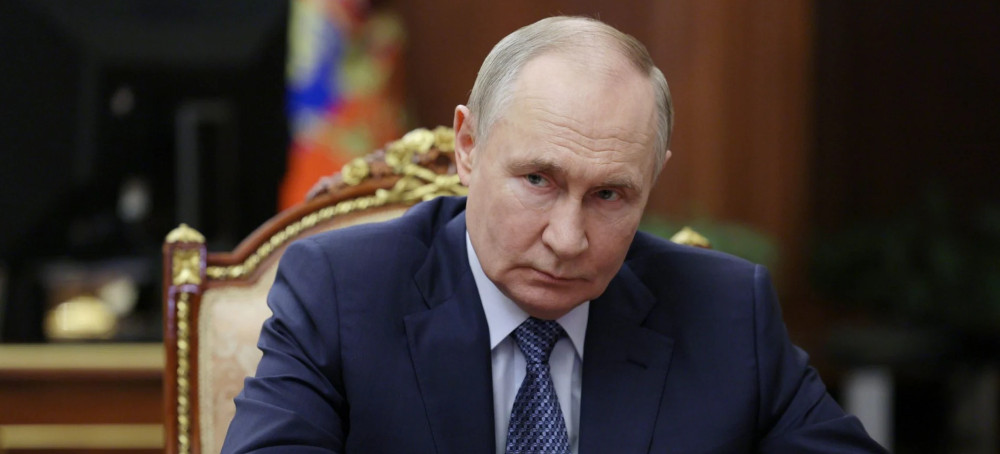 Vladimir Putin was given until Friday to agree to a ceasefire or face tariffs on Russia’s main trading partners. (photo: Shutterstock)
US president announces extra 25pc tariff on India in effort to isolate Moscow as reports claim he may meet Putin next week
The US president said that he would hit India with an additional 25 per cent trade tariff over its purchase of Russian oil, an important source of income for the Kremlin.
Later reports also claimed Mr Trump could meet Putin as soon as next week.
The so-called secondary tariff, which brings the total levy against India to 50 per cent, was announced in an executive order signed hours after envoy Steve Witkoff, Mr Trump’s top envoy, met Putin in the Kremlin for showdown talks.
Mr Trump gave Putin until Friday to agree to a ceasefire or face tariffs on Russia’s main trading partners.
“I have received additional information from various senior officials on, among other things, the actions of the government of the Russian Federation with respect to the situation in Ukraine,” Mr Trump said after Mr Witkoff’s meeting.
It is not clear what the “additional information” is but a top Russian presidential aide said after the talks in Moscow that “Russia had conveyed signals to the American side on the Ukrainian issue and received corresponding signals from Trump”.
The US president said this information meant that Moscow posed “an unusual and extraordinary threat to the national security and foreign policy of the United States”.
Volodymyr Zelensky, the Ukrainian president, who spoke to Mr Trump and European leaders including Sir Keir Starmer on a joint call after the Moscow talks, said that Russia now appeared “more inclined” to agreeing a ceasefire.
But in a significant sign of progress, The New York Times reported on Wednesday night that Mr Trump could meet Putin as soon as next week.
A one-on-one meeting between the two leaders would then be followed by three-way talks involving Mr Zelensky, the newspaper reported, citing two sources familiar with the plan.
Ukraine has long pushed for a direct meeting between Mr Zelensky and Putin, though the Kremlin has resisted, insisting progress must first be made during ceasefire talks.
Meanwhile, a senior Trump administration official said after Mr Witkoff’s meeting in Moscow that “secondary sanctions are still expected to be implemented on Friday”.
The official said: “The meeting with Russia and special envoy Witkoff went well. The Russians are eager to continue engaging with the United States. The secondary sanctions are still expected to be implemented on Friday.”
Mr Trump said on social media that the meeting in Moscow was “highly productive”, however, a sign that a deal is still possible.
The language is a significant shift in tone from earlier this year, when Mr Trump went out of his way to placate Putin in order to coax him to the negotiating table.
“I determine that it is necessary and appropriate to impose an additional ad valorem duty on imports of articles of India, which is directly or indirectly importing Russian Federation oil,” Mr Trump added.
Mr Trump had suggested that Mr Witkoff’s meeting with Putin would determine any decision for the US president to follow through on threats to impose tariffs on countries buying Russian energy.
India and China are among the countries buying the most Russian crude oil, which analysts say provides key revenues for Putin to fuel his war machine in Ukraine.
Reducing these revenue streams would make it harder for the Russian president to deliver his maximalist war aims in Ukraine.
The US could also move to ramp up sanctions against Russia’s so-called “shadow fleet”, which it uses to deliver oil to New Delhi and Beijing.
Mr Witkoff met with Putin in Moscow on Wednesday for the fifth time, in what were considered crunch talks ahead of potential tariffs and sanctions.
Russian officials had hoped to head off the economically crippling measures by offering a partial “air truce” by halting missile and drone attacks on Ukrainian cities.
But this fell short of Mr Trump’s demand for an unconditional, 30-day ceasefire, which would be used to pave the way for talks over a permanent peace.
A top Russian presidential aide had described the talks as “useful and constructive”.
“Russia had conveyed signals to the American side on the Ukrainian issue and received corresponding signals from Trump,” Yuri Ushakov told reporters after talks wrapped up.
He claimed that Mr Trump had yet to be “briefed” on the talks, which he claimed focused on the “crisis in Ukraine” and “strategic US-Russia cooperation”.
But the US president announced his executive order with the first economic measures in an attempt to end the war.
It comes after four European countries promised to buy $1bn in US weapons for Ukraine as part of a scheme set up by Mr Trump and Mark Rutte, Nato’s secretary-general.
Mr Trump appears to be rowing in behind Kyiv’s cause after growing frustrated with Putin’s refusal to come to the negotiating table in a serious manner.
Ushakov described the discussion between Putin and Mr Witkoff as an exchange of “signals” between Moscow and Washington, without elaborating on the content.
Putin has previously tabled unrealistic demands, such as an end to Western military aid to Kyiv or Ukraine’s withdrawal from regions partially occupied by Russian forces, as the price for any ceasefire.
Mr Trump’s use of the term “extraordinary threat” is notable.
At the start of his second term, the president was known to have blocked a series of international statements due to be signed by the US if they blamed Russia for the war in Ukraine.
It was thought by his team that this would prevent a deal being brokered with Putin to stop the fighting.
But in recent weeks, Mr Trump has given his blessing to a number of statements attributing the war to Russia, as well as criticising Putin’s “war machine” in his first warning that India would be targeted with tariffs.
India said the tariffs were “extremely unfortunate”.
The foreign affairs ministry said: “We reiterate that these actions are unfair, unjustified and unreasonable. India will take all actions necessary to protect its national interests.”