Trump Administration Moves to Cut Programs That Fight Child Labor Abroad
Lauren Kaori Gurley The Washington Post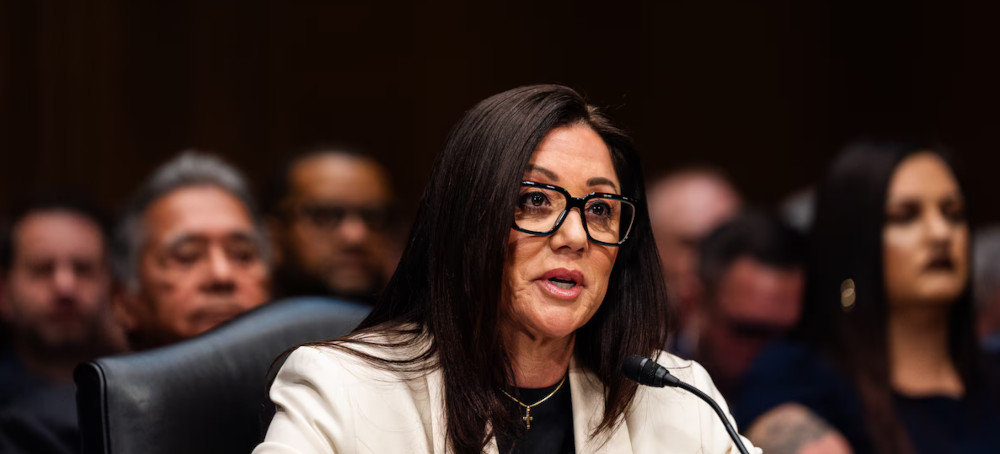 Lori Chavez-DeRemer testifies Feb. 19 during a confirmation hearing on her nomination to become labor secretary. (photo: The Washington Post)
The Labor Department is canceling $500 million allocated to programs that combat child labor, forced labor and human trafficking, and that enforce labor standards in more than 40 countries.
John Clark, a Trump-appointed Labor Department official, directed the agency’s Bureau of International Labor Affairs (ILAB) on Wednesday to end all of its grants due to a “lack of alignment with agency priorities and national interest,” according to an email obtained by The Washington Post.
A separate notice from leadership informed the office’s staff on Wednesday that the Labor Department had “taken a decision to immediately terminate all of ILAB’s existing grants,” and acknowledged that this would be a “difficult message to receive,” according to a copy reviewed by The Post.
The cuts are expected to end 69 programs that have allocated more than $500 million to combat child labor, forced labor and human trafficking, and to enforce labor standards in more than 40 countries.
Many of the programs provide support and resources to ensure foreign governments are complying with labor standards in U.S. trade agreements, including the United States-Mexico-Canada Agreement, as well as trade deals with countries in Central America, Africa, the Caribbean and the Middle East. Those standards are designed to protect U.S. jobs.
“Americans don’t want their hard-earned tax dollars bankrolling foreign handouts that put America last,” Courtney Parella, a spokesperson for the Labor Department, said in a statement. “That’s why we’re focused on improving oversight and accountability within this program — and across the entire department — while prioritizing investments in the American workforce.”
Among the terminated grants are congressionally authorized programs that allocate millions to nonprofits and nongovernmental organizations to combat child labor and forced labor in agriculture in Mexico, labor abuses in the garment industry in Southeast Asia, human rights abuses in fisheries along the coasts of South America, and mica-mining by children in Madagascar used to produce Chinese electronics and automobile parts sold in the United States.
The U.S. DOGE Service, the government cost-cutting initiative led by billionaire Elon Musk, touted the cuts in a post on X on Wednesday, praising Labor Secretary Lori Chavez-DeRemer and Deputy Labor Secretary Keith Sonderling for canceling “$577M in ‘America Last’ grants.”
Shawna Bader-Blau, executive director of the Solidarity Center, an international labor rights organization affiliated with the AFL-CIO, which has received 1o of these grants, said in a statement that cutting these programs would “abandon workers and roll back decades of progress combating forced and child labor.”
The termination reflects a broader effort by the Trump administration to shrink the federal government. The ongoing reductions have taken special aim at programs that provide assistance to the poorest foreign countries. This month, Secretary of State Marco Rubio announced that the vast majority of programs administered by the U.S. Agency for International Development were being eliminated, saying billions of dollars had been spent “in ways that did not serve … the core national interests of the United States.”
Defenders of ILAB note that the Labor Department grants, especially those directed to Mexico and Central America, were created in part to mitigate the root causes of unauthorized immigration to the United States — a focal point of the Trump administration.
In Honduras, one Labor Department grant has disbursed more than $13 million to fight child labor and other labor exploitation since 2014. That has resulted in more than 6,000 children and youths enrolling in educational programs, provided assistance to more than 1,800 families, and helped train some 500 inspectors on child labor exploitation and other labor laws, according to the Labor Department.
“These cuts mean that [more] children will be forced to work in extremely hazardous conditions in brick kilns, slave-like conditions in seafood processing centers and palm oil processing, and in forced online sex exploitation,” said a federal employee with knowledge of the grants, who spoke on the condition of anonymity because they feared retaliation. “These are conditions where they will die. This will affect some of the world’s most vulnerable children.”
ILAB — created under President Harry S. Truman in the aftermath of World War II — has been at the forefront of international efforts to root out child labor, forced labor and human trafficking around the world for decades, working hand-in-hand with the International Labor Organization, the U.N. agency that sets international labor standards. A core part of ILAB’s impact abroad has been achieved through its international grants programs, which began in the mid-1990s and make up the majority of the office’s budget.
“ILAB provides a very fundamental role in the issue of worker rights in the global economy,” said Mark Anner, dean of the Rutgers School of Management and Labor Relations. “It’s also about protecting worker rights within the U.S. If products are made elsewhere using forced labor and child labor, how are U.S. workers supposed compete?”