Trump Administration Faces Legal and Public Backlash Over Massive Offshore Drilling Expansion
Martina Igini Earth.org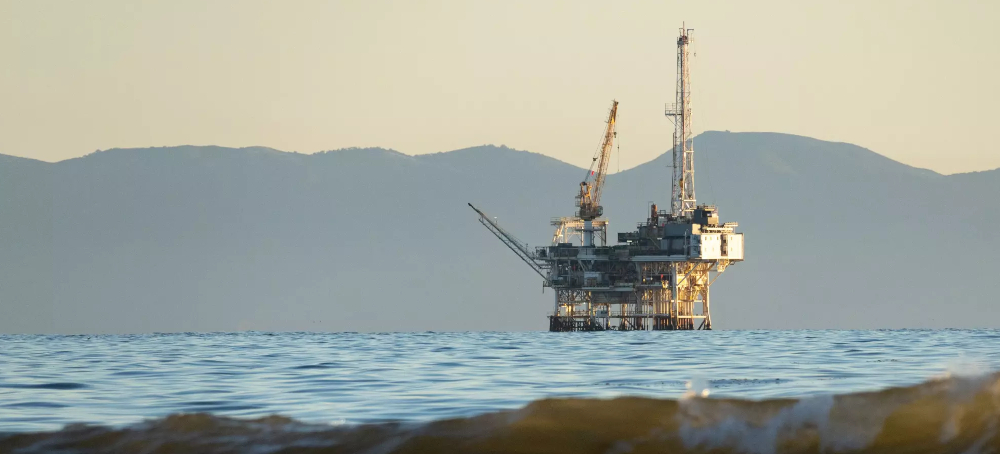 Offshore oil rig in Santa Barbara, CA. (photo: AP)
In late November, the US Department of the Interior announced a new offshore drilling plan that includes a five-year leasing program for outer continental shelf oil and gas drilling of roughly 1.3 billion acres. The area spans Alaska, California, and the Eastern Gulf near Florida.
It marked the latest push by the Trump administration to scale up US oil and gas production, despite heavy criticism and environmental concern.
Background
The Outer Continental Shelf (OCS) area is defined as “all submerged lands lying seaward of state coastal waters (3 miles offshore), which are under U.S. jurisdiction.” This geographic area has been plagued with a dark history of environmental disasters, primarily stemming from oil and gas extraction efforts. Throughout the country’s history of offshore oil drilling activities, there have been a plethora of devastating spills, resulting in massive detrimental effects to marine ecosystems and coastal economies.
In 1969, roughly 3 million gallons of oil spewed into the waters off of Santa Barbara, California due to a blowout on a Union Oil outrigger. Devastating and long-lasting marine ecosystem effects ensued, sparking widespread calls for a more robust environmental review process of such activities.
The spill served as a catalyst for the passing in 1969 of the National Environment Policy Act (NEPA), one of the country’s most comprehensive and prominent environmental laws to date. It requires federal agencies to assess potential social, economic, and environmental effects of proposed federal actions, and it requires federal agencies to provide a compulsory public comment period for major federal actions.
Heavy Opposition
The public comment period for Trump’s new offshore drilling plan lasted 60 days, from November 24, 2024 to January 23, 2025. The proposal was met with widespread opposition both from environmentalists and government officials.
“Time and again, President Trump has shown that his interest lies with his Big Oil friends profiting at the expense of our environment and public health,” California Attorney Rob Bonta wrote in a letter to the Department of the Interior’s Bureau of Ocean Energy Management (BOEM). “My office stands firmly opposed to this plan and will continue to push back against attacks on California’s natural resources and public health.”
The attorney general’s letter goes on to poke holes in the legality of the BOEM’s action, citing the rich history of oil spills and their subsequent environmental and economic impacts. “BOEM must consider the 1969 spill, along with the Exxon Valdez and Deepwater Horizon spills, as a relevant catastrophic spill for purposes of its oil spill analysis.” According to the California State Lands Commission, only 11 active offshore oil and gas drilling leases off the state’s coast remain, down from the original 60 leases issued prior to the 1969 Santa Barbara spill.
Opposition and concern for this proposal reached the far north as well. Erik Grafe, an Environmental Attorney for Earthjustice, expressed his concern for the plan’s proposed Arctic oil drilling activities. “Drilling anywhere in the Arctic Ocean is completely irresponsible. It is remote, ice-filled, stormy, home to irreplaceable wildlife and subsistence traditions. There is no way to clean up oil spills in this environment, and they are inevitable,” Grafe said.
According to the Sierra Club, the US’ largest grassroots organization, over a quarter million Americans submitted letters of disapproval to the BOEM over the 60-day comment period.
Despite this widespread criticism and pushback, oil industry leaders continue to believe that increased American oil and gas production is critical to the country’s economy and is the obvious choice towards energy independence. The Executive Director of the National Energy Dominance Council, Jarrod Agen, believes this new plan is a strong step towards achieving those goals. “By putting a real leasing plan back on track, we’re restoring energy security, protecting American jobs, and strengthening the nation’s ability to lead on energy for decades to come,” he said.
The Department of the Interior Secretary, Doug Bergum, echoed this sentiment: “We are ensuring that America’s offshore industry stays strong, our workers stay employed, and our nation remains energy dominant…”
What Happens Now?
Experts in the industry explained the feasibility for full implementation of the current administration’s bold plan. In a Politico article published in November, Glenn Schwartz, Director of Energy Policy for Rapidan Energy Group, said the lease sales off the California coast are unlikely due to the state’s ability to veto the construction of onshore infrastructure necessary to carry out oil production in the outer continental shelf region.
Similarly, the plan’s inclusion of oil lease sales off the Florida coast is being met with heavy opposition from both sides of the political aisle. An oil spill in Florida could indeed have devastating consequences in a state with a strong coastal tourism economy.
The Trump administration faces a long road fraught with political battles and public opposition before any oil drilling can take place. The BOEM is expected to submit a revised second draft of the plan in the coming months, which will again be open for public comment.