Trump Accelerated the Crisis
Prof Robert Pape Escalation Trap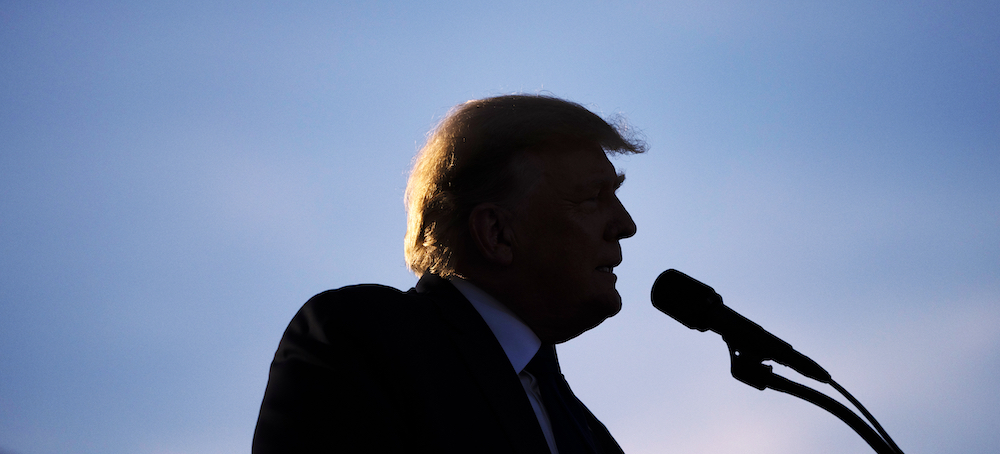 President Donald Trump. (photo: MSNBC)
ALSO SEE: Escalation Trap, Prof Robert Pape on Substack
No Plan for Hormuz, No Off-Ramp -- a New Phase has Begun
He offered no plan to restore reliable energy flows through the Strait of Hormuz, and made clear that escalation remains his primary tool.
The result is not resolution.
It is deepening instability.
The immediate consequence is not abstract. Roughly one-fifth of globally traded oil—nearly 20 million barrels per day—normally transits Hormuz. That system depends not just on physical passage, but on continuous insurance coverage, predictable routing, and tightly sequenced refinery deliveries across Asia and Europe. Those conditions are now breaking down. Tankers are delaying entry into the Gulf, war-risk insurance premiums have surged several-fold in days, and shipping schedules are slipping in ways that force buyers into volatile spot markets.
This is not a closure.
It is a loss of reliability.
This is the top-line structural shift. The full implications—and how to track them in real time—will be the focus of my live briefing on Saturday, April 4 at 4pm CT, 5pm ET.
What actually happened in Trump’s speech
1. The world now sees there is no plan to fix the problem
Not because of rhetoric—but behavior.
- No mechanism to reopen stable shipping
- No timeline for restoring normal energy flows
- No alignment between military operations and economic stability
In practical terms, this means that the actors who actually move the global economy—energy traders, insurers, shipping firms, and central banks—are repricing risk in real time and adjusting behavior accordingly. Gulf exporters are redirecting flows and storage strategies where possible. Asian importers are accelerating contingency purchases. European governments are coordinating in parallel rather than waiting for U.S. sequencing.
So actors are not waiting.
They are adjusting.
2. Escalation is now clearly the US default tool
The signal from the speech is simple:
When pressure rises → increase threats and expand targets.
That tells:
- Iran to prepare for continued confrontation
- Markets to price ongoing risk
- Allies to expect instability, not resolution
Historically, this pattern is not incidental—it is inherent to coercive campaigns. Limited strikes designed to compel adversaries expand when initial effects fall short of political expectations. The target set widens—from military assets to economic infrastructure—while timelines extend without formal acknowledgment. This is how short wars become coercive campaigns.
3. The war now has no defined endpoint
Not rhetorically—structurally.
You cannot end this war if the system it disrupted remains unstable.
Right now, there is:
- a military timeline measured in weeks
- an economic disruption with no clear end
- no constraint on Israeli military action
That gap means the war is not actually contained.
It also means something more dangerous:
The United States and its allies are falling deeper into an escalation trap—where each attempt to impose control through force increases the instability it is trying to resolve.
An escalation trap is a structural condition in which each effort to impose control through force increases the instability that makes control necessary. That is now the trajectory at Hormuz.
Securing Hormuz against asymmetric threats—mines, drones, missile strikes, and harassment of commercial shipping—is not a discrete task. It requires continuous presence and near-perfect performance. Iran, by contrast, does not need to stop the flow of oil. It only needs to demonstrate that the flow cannot be guaranteed.
There is no path back to stable energy flows under the current strategy. Only different levels of instability.
There are no clear military off-ramps from this position.
Only a pathway toward prolonged conflict and expanding economic damage.
4. What Matters for US military action
Three elements in the speech matter.
First, the timeline.
The war is now expected to continue for “two to three weeks”—but with no defined endpoint.
Second, the target set.
Trump signaled that attacks could expand to Iran’s broader infrastructure, including electric power.
Third, the justification.
He framed continued operations as necessary to “honor the dead by completing the mission.”
Each of these moves is individually defensible.
Together, they create a different kind of war.
Not a limited strike.
A coercive campaign.
For the US, the war is not de-escalating.
It is shifting to an effort at “controlled” escalation—and control is already slipping.
Consequences
1. Allies begin operating without U.S. direction
This shift is not tentative—it is structurally driven.
As U.S. strategy fails to stabilize the system, allies will increasingly act independently to protect their own economic and security interests.
This is already visible:
- European coordination increasing
- Less reliance on U.S. sequencing
- More independent hedging behavior
This mirrors the early phase of the Ukraine war, when European states began building parallel diplomatic and economic tracks alongside U.S. policy. The result was not immediate divergence, but gradual drift—measured in months, not days.
2. Markets are back in a precarious state
Not full panic—but an unstable equilibrium.
That is more dangerous.
It means:
- one additional shock → rapid escalation in prices and disruption
- insurance and shipping remain highly reactive
- volatility becomes the baseline
In tightly coupled energy markets, small disruptions necessarily cascade into larger systemic shocks. A marginal delay in shipping or spike in insurance costs propagates through pricing, supply chains, and financial systems.
Energy markets are structurally sensitive to these disruptions. In 1973, a supply reduction of roughly 5–7 percent produced a fourfold increase in oil prices and triggered years of inflation and economic stagnation. Today’s system is more financially integrated, meaning shocks transmit faster and more broadly.
This is how shocks compound.
And in this environment, they do not dissipate—they accumulate.
3. Iran’s power is increasing—and it doesn’t require physical control
This is the key shift.
Iran does not need to militarily seize global oil flows.
It only needs to make them vulnerable and unreliable.
That alone gives it power over:
- pricing
- timing
- global economic expectations
Every delayed tanker, every spike in insurance premiums, every rerouted shipment reinforces that power. It is exercised not continuously, but intermittently—just enough to ensure that markets must price risk into every transaction.
And as long as reliability is in question, that power persists.
4. The net effect: accumulating economic strain + U.S. power erosion
This is not a short disruption anymore.
As these current conditions persist:
- the global economy becomes progressively less able to absorb shocks
- allied behavior increasingly reflects independent risk management rather than coordinated strategy
- U.S. ability to shape outcomes narrows
Power is relative.
And under these conditions, it is shifting toward Iran, because Iran can shape whether the system functions.
This is the trajectory of the escalation trap: not a sudden collapse, but a steady movement toward a prolonged phase of global economic disruption with no clear point of reversal. It is a trap because the near-term incentives for doubling down intensify as the costs of failure mount.
Bottom line
Trump did not calm the system last night.
He made clear there is no plan to restore stability in the Strait of Hormuz and that escalation remains the primary lever.
That means the war is not approaching resolution.
It is moving deeper into an escalation trap—with no military off-ramps and a prolonged phase of global economic disruption.
And in this phase, the key variable is no longer who can strike.
It is whether the global energy system can function.
Right now, it cannot do so reliably.
And as long as that condition persists, power will continue to shift.
In the next 72 hours, these dynamics will become visible in real time. I will walk through exactly what to watch—and what it means—at Saturday’s live briefing.