‘Time Is Not on Russia’s Side’
David French The New York Times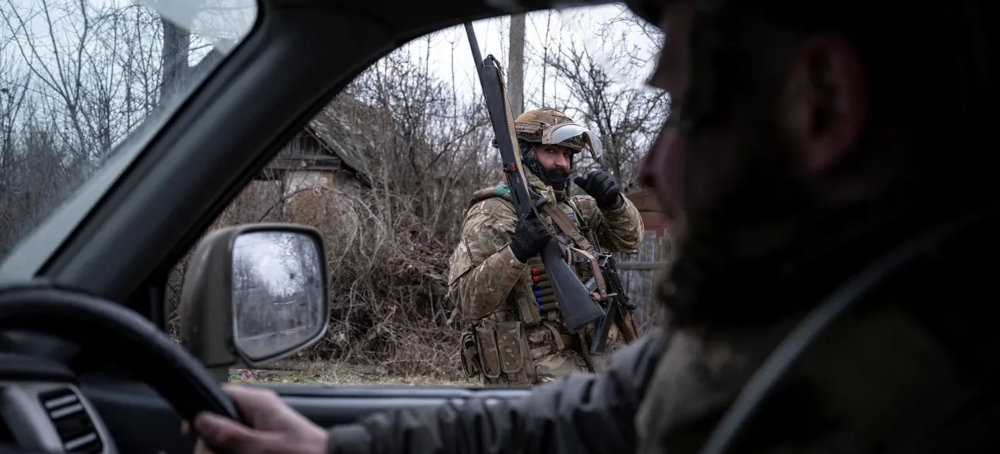 Ukrainian soldiers on the frontline in the Donetsk region, Ukraine, February 2026. (photo: Iryna Rybakova/Reuters)
The sheer scale and ferocity of the conflict is hard for us to comprehend. Russia has lost a staggering number of men. The Economist estimates that total Russian casualties number between 1.1 and 1.4 million. Between 230,000 and 430,000 Russians have died. That’s one in 25 Russian men between the ages of 18 and 49 who’ve probably been killed or seriously wounded since the war began.
Ukrainian losses have been far less severe in absolute numbers, but worse as a percentage of the population. The Center for Strategic and International Studies estimates that Ukraine has suffered 600,000 total casualties as of December, including between 100,000 and 140,000 dead. That’s a one-in-16 ratio of deaths, injuries and missing cases for men between 18 and 49.
It’s hard to grasp the scale of the losses, but it’s also hard to grasp the nature of this war. It’s a war unlike any other, where drones can sometimes outnumber people on the front lines, and even the concept of a true front line is fading away as both armies adapt to drone warfare.
On this fourth anniversary of the Russian attack, I reached out to one of the analysts of the war whom I respect the most — Michael Kofman, a senior fellow in the Russia and Eurasia Program at the Carnegie Endowment for International Peace. Kofman is that rare combination — a rigorous scholar and a courageous journalist, an expert who has spent a serious amount of time in the field.
The focus of our conversation is military, not political. There’s a good reason for that — once the battle is joined, military results tend to dictate political realities.
Normally, I’d say that I hope you enjoy our conversation, but “enjoy” is the wrong word here. The topic is too grim. I learned from our talk and I hope you will too. I gained greater appreciation for the nature of the war, the challenges both sides face, and why Russia isn’t ready to seek peace, but Ukraine is.
The bottom line, oddly enough, is both grim and hopeful. The grim part is clear. Russia is still pursuing maximal war aims. It is grinding away on the battlefield, advancing meter by meter and kilometer by kilometer.
But there is also reason for hope. There is very little chance of a Russian breakthrough, Ukrainian resolve remains and Russia might be losing more men than it can replace. As Kofman told me, “Time is not on Russia’s side.”
This conversation has been lightly edited and condensed.
Let me just start with the biggest picture question — how do you sum up the state of the war at the end of its fourth full year?
This war for the last two years had largely had a positional and attritional character. What I mean by that is that the fighting has been grinding. Both sides have found ways to adapt in technology and tactics, but have struggled to escape the prevailing dynamic on the battlefield.
The Russian military, while advantaged in manpower and matériel, has not been able to achieve significant gains or to convert those advantages into operationally relevant breakthroughs. The Ukrainian military has sought innovative ways to offset the Russian advantages and has largely held the Russian military to incremental gains. Russian forces have been advancing in a creeping offensive, seeking to grind their way through the front over the last two years. Although each year they’ve taken more territory, their casualties have increased over time and their combat efficiency hasn’t significantly improved.
And there’s a duality to the war. On the one hand, every three to four months, you see a great deal that changes at the front lines in terms of technology, tactics, and how the forces adapt to the fighting. But zooming out from that, you also see a dynamic that hasn’t changed nearly that much over the last few years. And ultimately Ukraine has proven resilient, despite the challenges they face, while Russia continues to see a mismatch between its political aims and its military means in this war.
To the extent there’s a kind of popular perception of the state of the war right now, I would say it goes something like this: that Ukrainian courage is unquestioned, but that there’s a feeling that there’s a clock that is ticking faster for Ukraine than Russia. That Russia can do this longer than Ukraine can do this. How do you see the concept of two ticking clocks here, one ticking faster for one side or the other?
So the truth is a lot more muddled. I would say that perception would be a fair assessment if we look at 2024 and early 2025. However, if we examine Russian combat performance last year, it was rather underwhelming.
Their battlefield results have been lackluster and increasingly they face economic strain. Now this picture may seem a bit optimistic for Ukraine, but it’s far from rosy. A big part of the challenge is that Ukraine is heavily dependent on external material support and the provision of capabilities and intelligence by Western countries. And so much depends on the continuation of that assistance, which is not easy to predict.
However, increasingly, it does look like time is not on Russia’s side for specific reasons. The Russian military is still struggling to achieve even Moscow’s minimal political objectives, which is the seizure of the remainder of the Donbas, and that could take another year or more, potentially, at the rate they’re going.
They were able to substantially reduce the effectiveness and advantage that drones provided to Ukraine last year, but they were still not able to convert that shift in relative advantage into any significant breakthroughs on the battlefield.
A fair amount of the challenge for them is the way they are fighting, whether it’s assaults with dismounted infantry, or infiltration through Ukrainian lines, is simply not conducive to achieving breakthroughs. And so absent major mistakes on the Ukrainian side, it’s difficult to see how Russian forces are going to advance much faster than they have in previous phases of the war.
Of course, wars are unstable systems. There are all sorts of gradual then sudden transitions that happen in war and it’s hard to extrapolate. We often are stuck because we’re extrapolating from the previous phase of the war to look into the future. And the future is in that respect a bit unknown. But the challenge that Russia has in particular is that they have the inherently tougher task of having to run offensive operations. The political goals and ambitions that Moscow has for this war are very difficult to achieve with the military means they have available. So increasingly the question is: Is time really on Russia’s side? Because as we head into 2026, if 2026 unfolds in a fashion similar to 2025, then we can already begin to say that the answer is no.
What about 2026? What are the factors that could make this year a tipping point?
First, if you look at manpower availability, which is an important indicator for the way the Russian military’s fighting, by 2025 they were barely breaking even looking at their recruitment rates versus their unrecoverable losses. And this does not bode well for 2026. It does not mean that the Russian military will be running out of men. It simply begins to question whether or not they’ll be able to sustain the offensive intensity this year that we saw last year. The Russian military attempts to maintain an offensive for almost the entirety of the year, running often from February to December.
The trade-off that the Russian military’s been making is that, on the one hand they can’t generate momentum and they can’t exploit a breach in Ukraine’s defensive lines the way they are fighting. On the other hand, their offensive is very difficult to exhaust because it runs year-round. Now, to sustain it, they have to maintain recruitment rates and replenishment rates at or above, ideally, their unrecoverable losses. And increasingly that looks in jeopardy heading into 2026, although we don’t know how this year will go for them.
This is the first issue. The second is that the Russian economy is increasingly under strain. If you look at the key indicators: economic stagnation, a growing deficit, regional budgetary crises, most importantly, very low oil prices and increasing pressure on Russian export capacity forcing them to offer steep discounts. Russia can continue funding the war, but there are increasingly questions about what things look like for Moscow in the latter part of 2026 and certainly if the war goes into 2027.
Let’s apply the same analysis on the Ukrainian side. So what are the strengths and weaknesses they have going into 2026?
If we look at Ukraine’s weaknesses through a similar lens, Ukraine continues to struggle with endemic manpower issues. The AWOL, absent without leave, problem significantly saps Ukrainian combat strength and their ability to replenish their forces. And Ukrainian effective combat strength at the front line has slowly been shrinking. Their manpower problems are worse and they’ve been compensating for them with more effective employment of drones and investment in drone units.
If we look at the other challenges that Ukraine has, many of them come down to force management. Ukraine lacks effective operational reserves and Ukrainian units have to run around the front firefighting to plug gaps where Russian forces advance, which then leaves other parts of the front line exposed.
And of course, Ukraine ultimately depends significantly on Western support.
The good news with that is that Europeans, at the 11th hour in December, agreed to issue 90 billion euros in loans, which by the way Hungary’s currently holding up because they want something regarding the Druzhba pipeline, but in general that funding should be sufficient for at least another one to two years to keep Ukraine in this war.
I think the challenge Ukraine has is that they too are trying to expand their strike campaign against Russia, but they are also pressed against time given growing exhaustion within the force and the Russian strike campaign, which has been particularly effective this year given how cold the winter is.
It’s driving people out of cities, it’s going to hamper Ukrainian defense production and you can see a great deal of tiredness and wear on the force which has been deployed for so long, often without any significant rotation for the units.
So the difference is that Ukraine has ultimately the easier task of defending its territory. And although the force may be tired, Ukraine’s situation isn’t so dire, that is to say the situation at the front line as best one can tell isn’t fragile. In some ways in 2025, Ukraine ended the year looking a bit better than they did around the same time in 2024 when the Russian military was making accelerated advances in the fall of that year.
The big challenge for Ukraine, of course, is the potential unpredictability of Western support, particularly US support. And the fact that it’s clear that in terms of financial assistance and material support, few things for Ukraine get better in this coming year. At best they can hope to maintain assistance at levels similar to 2025, and that’s likely the best-case scenario.
At this point in the war, although this is my bias on conventional wars in general, there are no silver bullets to be found or game-changers that will dramatically alter the situation on the battlefield. There are, however, interesting developments afoot that could have ripple effects.
For example, cutting Russian forces off of Starlink and forcing them to adapt to use other systems that are much, much less effective and more costly. But in general I think you can see the debate has long moved on past what is the next shiny object that can be provided to Ukraine that’s going to change the dynamic in this war, and the answer is there isn’t one.
I want you to describe for the readers — I’m looking for the right word — the weirdness of the Russian offensive tactics now. So could you describe how Russia’s offensive is unfolding?
I need to take a few moments just to explain how we got into the character of the fighting in 2025 and that is 2024. So what happened in 2024 is that the Russian military had switched primarily to attacking with infantry assault groups in increasingly smaller, smaller group numbers, eight men, six men or so.
Ukraine had also adapted to the way the Russian military was trying to press its way to the front by expanding drone units and substantially expanding drone production. The Russian advance began to stall as we got into the winter heading into 2025.
Russian forces then began to adapt to the Ukrainian approach in several ways. First, they deployed their own elite drone formations called Rubicon and started to organize a more cohesive approach to how they’re employing drones and engaged essentially in a tug of war with Ukrainian drone units for what both sides call the “kill zone.”
This is the drone engagement zone that’s somewhere around 20 kilometers from the front line in either direction. This was a significant contest that played out last year because the side that has superiority in the drone engagement zone has the initiative on the ground, greater freedom of action and can also inflict higher levels of losses and attrition on the opposing force.
And so even though it may seem last year as though not much changed, what really was taking place is that drone units, in supporting artillery and other fires, were focused on displacing and suppressing the drone units of the other side.
The locus of the contest switched from frontline infantry to supporting elements. And then increasingly what we saw is higher losses among those in support positions, drone units, logistics, than those actually in frontline infantry roles, which is unusual for a conventional war where most casualties stack among the infantry.
Now, the reason the Russian military began to use infiltration as the principal maneuver tactic by which they advanced last year is because Ukrainian forces were largely defending with drones. Drones were used in combination with minefields and artillery to essentially create defensive depth behind their forward positions.
However, Ukrainian forces did not have cohesive defensive lines. The image that is sometimes portrayed that this is like World War I with drones is very much incorrect. In reality, Ukrainian forward positions are small picket posts of men that are neither fighting positions or even observation posts.
They’re marking a line with large gaps in between them. And Russian forces were essentially trying to walk past them, then accumulate in depth.
On the front line, often you’ll see maybe nine men per kilometer in two-three man positions, just to give you a sense of what the numbers might be, you could picture, as this is a porous front line.
And since frontline formations often lack reserves, even if a few men got into the rear, they would begin to pose a problem because the forces were not available to counterattack them.
Now over in 2025, the Russian military started to use small groups and individual troops, guiding them by drone through Ukrainian lines, then accumulating them in the rear. And the challenge was that even if Ukrainian units were able to intercept, let’s say hypothetically 70 percent of an attack, a dispersed attack of this nature, if 30 percent of men got through, they would immediately face another attack and another attack. Eventually Russian forces would accumulate in their rear and start displacing their line.
The other tactic the Russian military used is lightly motorized attacks, motorcycles, dune buggies, often alongside traditional mechanized assaults and the concept was the same, to try to get past the initial contact layer, the engagement zone of Ukrainian drones, and then into the rear.
Often the Russian military made better gains using fewer men in these types of assaults than in more traditional attacks. But it came at significant cost, because in this way the Russian military preserved equipment but took much higher casualties when it comes to manpower. That’s why Russian unrecoverable losses have been climbing, those killed and seriously injured, because they’re mostly using people in these assaults and they’re using them in a rather expendable fashion.
What is your understanding of the posture of the Ukrainian people right now?
I think an honest assessment is that people are very tired. And obviously everyone wants the war to end, but the Ukrainian public is not of the mind that they’re willing to make any concessions or accede to onerous terms currently being proposed by Moscow in order to end the war.
And there’s a good reason for that: The Ukraine battlefield situation ultimately is not dire, they can still sustain the war, and Russia lacks the ability to pose a serious threat to the big Ukrainian cities or to take large territories.
As long as Ukraine has Western support, they still have a chance of achieving war termination, an end to this war on acceptable terms.
I don’t think that the Ukrainian public or the political establishment is in a place where they are willing to easily concede to Moscow’s demands. And they are largely negotiating from a position that is informed by the objective assessment of the prevailing military situation.
Russia consistently is making demands on the basis of aspirational military performance, but not actual military performance.
If you look at the extensive list of demands which go well beyond just taking the rest of the Donbas — people sometimes focus on that, but I think they miss the other national-level demands that Moscow has — these are the demands of a side that sees itself as a decisive victor in the war, but this position is unsubstantiated. In fact, Russian military performance has been relatively lackluster compared to what they’re asking.
How much do you think that Putin is receiving information that is based more on the aspirational than the actual?
Russian military leadership consistently briefs successes to the top that they haven’t actually made. That was quite visible last year. I think the challenge is more that Putin believes Russia can outlast the West in this war and that even though the war has long ago reached diminishing returns for Moscow and that increasingly it looks like Russia’s not going to get much more politically from continuing offensive operations this year, he doesn’t share this view.
He believes the two bets he made last year — first that through sustained pressure eventually parts of the front line will begin collapsing. And the second bet was that Russian diplomacy will effectively maneuver the United States out of the Western coalition supporting Ukraine and try to turn Washington against Kyiv.
The reality is neither bet came to fruition, but he’s likely to try to make them again this year. And this is not unusual. The pathology of decision making in wars like this is that leaders often fall into sunk cost fallacies. Wars tend to go on well beyond the point when either side can attain a decisive advantage. At a certain point leaders often want to believe that something will break their way simply if they persist, even though there’s no evidence of that happening.
I think another factor in looking at Russian decision making is that the Russian elite and the Russian economy has structurally adjusted to sustaining this war. The Russian elite now profits from it. And there is no impetus or imperative for Putin to end the war. On the contrary, he may face economic challenges and crises to try to then shift the economy back once the war is over. And much of the Russian system has already adapted to life under the conditions of this ongoing conflict. And consequently, the domestic incentives are very much not there.