This Is How Trump Is Already Threatening the Midterms
David Gilbert WIRED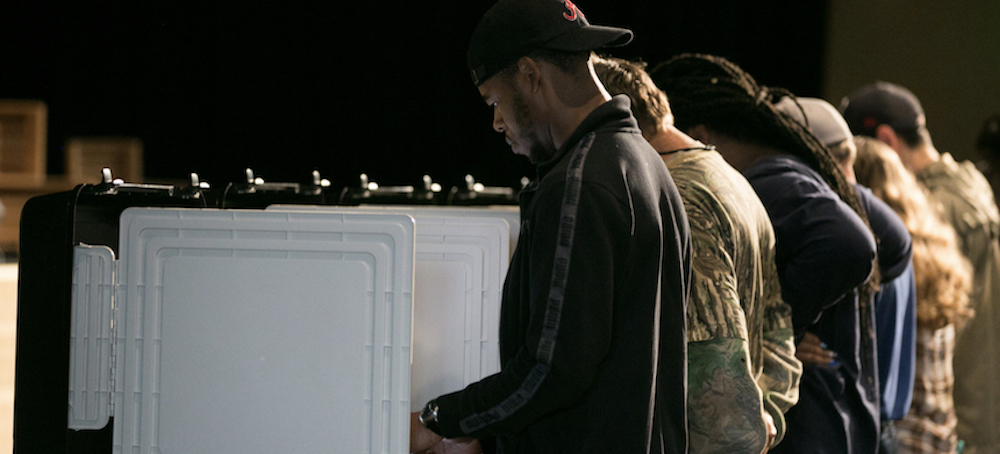 Voters at a polling precinct. (photo: Jessica McGowan)
WIRED surveyed the ways the Trump administration is working to manipulate this year’s midterm elections.
Over the past couple of months, he’s told podcaster turned FBI deputy director turned podcaster Dan Bongino that Republicans “should take over the voting” in 15 places and “ought to nationalize the voting.” He told Reuters that “when you think of it, we shouldn't even have an election.” And he told NBC he will only accept the midterm results “if the elections are honest.” On Truth Social, he slammed the Supreme Court because “they wouldn’t even call out The Rigged Presidential Election of 2020.”
Members of Trump’s administration and Republican lawmakers have quickly dismissed criticism. When Speaker of the House Mike Johnson was asked about Trump’s comment about nationalizing elections, he claimed without evidence that election results in “blue states” like California “just look on [their] face to be fraudulent.”
Now, with Trump laser-focused on an anti-voting bill called Safeguard American Voter Eligibility (SAVE) America, which would disenfranchise millions of Americans, what was already clear has become glaringly obvious: The Trump administration appears to be threatening the midterm elections. Trump isn’t even hiding the real reason why he wants the SAVE bill signed into law: “[Democrats] know if we get this, they probably won't win an election for 50 years, maybe longer.”
As polls show that the Republican party could lose the House and the Senate, Trump and his allies are quite openly engaged in a concerted and widespread effort to undermine trust in elections and, seemingly, to lay the foundations for baseless claims of rigged midterm elections in November.
Trump’s campaign has included the weaponization of the Department of Justice and the FBI, the undermining of laws designed to protect voters, the redrawing of voting maps to disenfranchise minorities, the installation of election deniers in key positions of power within the government, and the emboldening of election officials at all levels across the country to pursue an anti-voting agenda with impunity.
Here is a non-exhaustive list of the ways the Trump administration is already targeting this year’s midterm elections:
The SAVE America Act
Many of the ways the Trump administration is working to undermine trust in November’s elections have been distilled into a single piece of legislation.
The SAVE Act is the Republican response to the conspiracy theory that millions of noncitizens are flooding polling stations every election. Although that claim that immigrants were voting was shared widely ahead of the 2024 presidential election, all the available evidence suggests that noncitizen voting accounts for a vanishingly small fraction of a percent of the votes cast, with one estimate in 2017 from the Brennan Center of a dozen states putting the figure at 0.0001 percent. (Apply that figure to the number of people who voted in 2024 and you get just over 15,000 votes—orders of magnitude below what conspiracy theorists claim.)
The first effort to pass the SAVE Act failed last year due to widespread opposition, but Republicans returned in January with a new version, this time referred to as the SAVE America Act. House Republicans initially released a version of the act that would require all voters to produce specific documentary proof of citizenship when voting. That restrictive provision was ultimately removed in an update published earlier this month. However, the new bill would still require every state to introduce laws requiring voters to show certain photo IDs when voting—instantly disenfranchising millions.
The bill would also require those registering to vote to produce a passport or birth certificate, documents that over 20 million Americans of voting age do not have access to. It narrowly passed the House but, despite over 50 Republican senators signaling their support, Democrats can still block its passage in the Senate using the filibuster rule.
”We are going to have the Save America Act, one way or the other, after approval by Congress through the very proper use of the Filibuster or, at minimum, by a Talking Filibuster, à la ’Mr. Smith Goes to Washington,’” wrote Trump on Truth Social last month. More recently, he has connected the passage of the SAVE act with getting Transportation Security Administration workers paid during the current partial government shutdown.
There is, however, virtually no chance that the SAVE America Act will pass in its current form, and Senate Majority Leader John Thune has repeatedly ruled out changing filibuster rules in order to force it through.
Republicans are simultaneously pushing an even more extreme overhaul of election rules with the Make Elections Great Again (MEGA) Act, which would eradicate universal mail-in voting and would remove much of the control over election administration from states and put it in the hands of the federal government.
The SAVE America Act is ultimately an attempt by the GOP to turn Trump’s March 2025 executive order on elections into law. The order, titled “Preserving and Protecting the Integrity of American Elections,” contains many of the provisions now enshrined in the SAVE America Act but demands that every state give the so-called Department of Government Efficiency (DOGE) and the Department of Homeland Security access to unredacted voter rolls, the same data the Department of Justice is now suing states to obtain. Last October, a court signaled that Trump’s order was a massive overreach by partly blocking implementation and ruling that Trump lacks the authority to alter the election process.
While the SAVE America Act may not pass Congress, there are a large number of people inside the administration who are winning to undermine trust in elections from within.
Election Conspiracy Theorists Are in Government Now
Election deniers, who worked tirelessly to undermine trust in elections and spread baseless conspiracy theories about everything from ballot mules to noncitizen voting, have found a new home inside the Trump administration.
Kari Lake, a former TV presenter turned failed politician who unsuccessfully ran for governor and the senate in Arizona in recent years, was appointed by Trump to oversee the US Agency for Global Media. Lake has spent years boosting baseless election conspiracy theories and has not stopped spreading those lies since being appointed.
In August, Heather Honey, an activist whose research fueled election denial claims and who has worked closely with former Trump adviser Cleta Mitchell in recent years to promote election conspiracy theories, was appointed to a senior role at the Department of Homeland Security where she will be overseeing election integrity.
In December, Gregg Phillips, who cofounded election denial group True the Vote and helped produce the debunked election conspiracy theory film 2000 Mules, was appointed to help head up the Office of Response and Recovery at the Federal Emergency Management Agency.
The White House also appears to be relying on a cohort of prominent figures from within the election denial movement. In May of last year, Seth Keshel, a former Army intelligence captain who has become one of the superstars of the election denial world, claimed in a Substack post that he briefed “one of President Trump’s most critical staff members and his own key staff—someone who undoubtedly interfaces with the President daily.”
The White House did not respond to a request for comment about the meetings, but an official who was not authorized to speak on the record, told WIRED at the time: “The White House does not comment on mysterious meetings with unnamed staffers.”
Simultaneously, Trump has also sought to absolve officials of any wrongdoing in the wake of the 2020 election. Last year, Trump gave “full, complete and unconditional” pardons to a slate of people who had tried, and failed, to help him overturn the 2020 election results. In recent months, Trump has pressured Colorado governor Jared Polis to release Tina Peters, the former county clerk in Mesa County, Colorado, who became a hero for the right’s election deniers when she facilitated a security breach during a software update of her county’s election management system.
Peters was found guilty of four felonies, but Trump has been mounting a campaign in recent months to get her released, even going so far as to say he “pardoned” her, even though he has no power to do so given she was convicted on state charges.
Election Day Interference
While Trump has not announced specific plans to deploy troops to polling locations or seize voting machines, he and his administration have certainly been suggesting that such action is not off the table.
In January, Trump lamented not having the National Guard seize certain voting machines after the 2020 election. In early February, White House press secretary Karoline Leavitt told reporters that while she hasn’t specifically heard Trump discussing the possibility, she couldn’t “guarantee that an ICE agent won't be around a polling location in November.” (The question was in response to former White House adviser Steve Bannon stating: “We’re going to have ICE surround the polls come November. We’re not going to sit here and allow you to steal the country again … We will never again allow an election to be stolen.”)
Earlier this month, during his confirmation hearing to head up the Department of Homeland Security, Senator Markwayne Mullin said he would be willing to deploy ICE to polling locations to address “a specific threat.”
The result of the Trump administration’s drip feed of threats and dog whistles is that those who are running elections in states across the country are already war-gaming what happens if ICE or the National Guard show up at their voting locations.
Michael McNulty, the policy director at Issue One, a nonprofit that tracks the impact of money in politics, also points to the fact that the Department of Justice sent monitors to oversee elections in November in New Jersey and California, despite no federal elections being held. “The concern is that this could become a massive deployment of, quote unquote, observers by the DOJ in 2026 who might do something more, whether it's intimidation, whether it's interfering with local election officials, to get data to confirm conspiracy theories,” McNulty tells WIRED.
FBI Raids
On January 28, the FBI raided the election office in Fulton County, Georgia, executing a search warrant that allowed it to seize ballots, ballot images, tabulator tapes, and the voter rolls related to the 2020 election. The search warrant affidavit, unsealed a few weeks ago, shows that the FBI relied on the work of Kurt Olsen, a lawyer who was appointed by the administration to investigate election security in October and who has a long history of working with some of the country’s biggest election deniers, including Patrick Byrne, Mike Lindell, and Kari Lake. Olsen’s claims are based on debunked and previously investigated conspiracy theories about the 2020 election.
The raid was also notable for the presence of Tulsi Gabbard, the director of national intelligence, who is, according to The Guardian, running a parallel investigation into the 2020 election with the apparent tacit approval of Trump.
Despite having no idea why the FBI conducted the raid, election deniers were ecstatic about it. “You. Are. F*cked,” Kari Lake wrote on X to a Fulton County election commissioner after the raid. Lindell, the MyPillow CEO and Minnesota gubernatorial candidate, and a major funder of election-denial conspiracy groups, said he was “very excited,” while Trump-aligned attorney Sidney Powell said, “It’s about time.”
“This raid was based on long-debunked conspiracy theories about what happened in Fulton County,” Dax Goldstein, director of the election protection program at the nonpartisan election integrity group States United Democracy Center, tells WIRED. “But nonetheless, DOJ is continuing to use its immense power to advance tired lies. And that causes real harm, because DOJ has unique tools that run-of-the-mill conspiracy theorists don’t.”
The FBI’s focus on the 2020 election expanded on March 5 when the agency issued a grand jury subpoena seeking information as part of its investigation into the widely debunked Cyber Ninjas audit of the 2020 election in Maricopa County.
A Massive National Voter Database
Since May, the Trump administration, led by attorney general Pam Bondi, has been demanding unprecedented access to state voter rolls, without giving a clear explanation for how the information will be used or who it will be shared with.
So far the efforts have had limited success. Ten states—accounting for around 37 million citizens—have already handed over the data, which includes drivers licenses and partial Social Security numbers. When states have refused, the DOJ has sued; 24 lawsuits have been filed to date. In late January, just days after Alex Pretti was shot and killed by federal immigration agents, Pam Bondi used the situation to demand Minnesota hand over its data rolls—a request a lawyer representing the state described as a “ransom note.”
The states that have turned over their voter data were also forced to sign a ”confidential memorandum of understanding,” which outlines how the Trump admin was planning to “test, analyze, and assess” the data and direct states to remove specific voters—a complete inversion of how elections have typically been run in the US.
“Instead of taking a perspective of enforcing federal law and protecting individuals’ rights to vote, the [civil rights] division is really focusing on executing on the president's priorities, which are fueled by conspiracy theories and anti-voting groups' narratives,” Goldstein tells WIRED. “It's a 180-degree turn.”
States that signed the agreement are given just 45 days to remove voters identified by the government, even though doing so would likely be a breach of federal law under the National Voter Registration Act, which requires states to wait two federal election cycles before removing someone from their voter rolls.
A number of local election officials appear to be emboldened by these efforts: In September, the head of the Republican-controlled North Carolina election board wrote a letter to the head of the states’ DMV demanding access to people’s full Social Security numbers held by the agency.
In January, the board of elections outlined plans to label certain voters as “presumptive noncitizens” based on notoriously unreliable data held in federal databases, potentially purging them from the rolls. The board has also decided to remove early voting locations from three North Carolina universities, despite large protests against the decision.
The War on Mail-In Voting
Trump, who has relied on mail-in ballots to vote in the past and urged his own voters to use the system ahead of the 2024 election, has long boosted baseless conspiracy theories around the security of mail-in voting.
Last August, Trump signaled his aim to eradicate mail-in voting completely. ”We're going to start with an executive order that's being written right now by the best lawyers in the country to end mail-in ballots because they're corrupt," Trump told reporters in the Oval Office.
This week Trump once again called mail-in voting “cheating” just days after he himself voted by mail in a special election in Florida.
Like Johnson’s claim about ballots being “magically whittled away,” Trump’s assertion is based on conspiracy theories that mail-in ballots are used by Democrats to fix the vote. In reality, Republicans are less likely to use mail-in ballots, partly because of Trump’s repeated demonization of the process, and so when mail-in ballots get counted on or around election day, they are most likely to result in a major jump in votes for Democrats.
And earlier this week, the Supreme Court heard arguments in a case brought by the Republican National Committee asking that mail-in ballots that arrive after election day—even if they are postmarked as sent before election day—are not counted, a move that would impact hundreds of thousands of voters. The conservative justices who hold a majority on the court appeared ready to side with the RNC.
Redrawing the Maps
Administration officials have demanded Republican-controlled states redraw their congressional maps in order to prevent the Democrats from taking back control of Congress in the midterms.
Trump had hoped to gain a dozen or more seats with his redistricting push when it launched last June, but pushback from the courts and the Democrats’ response means any gains are likely to be much smaller—and extreme gerrymandering makes some incumbents more vulnerable.
But while states like Texas, North Carolina, and Missouri have complied with the administration’s demands, any gains made in those states could be wiped out by Democrat-led states like California which has conducted its own redistricting efforts.
The piece piece of legislation that prevents states from pursuing discriminatory redistricting efforts is the Voting Rights Act (VRA) introduced in 1965. The Supreme Court undermined the act’s power in 2013 by eradicating federal oversight of election rules, and appears set to once again diminish the protections it provides. The court, stacked with conservative justices appointed by Trump, appears ready to effectively abolish Section 2 of the VRA, which will dramatically weaken the voting power of minorities by allowing the GOP to redraw districts at will.
DOGE Working With “Voter Fraud” Group
In a court filing in January, the Social Security Administration admitted that an employee from DOGE had signed a “voter data agreement” with an unnamed “political advocacy group.” The agreement would allow the group access to SSA data, and the group aimed to find “evidence of voter fraud and to overturn election results in certain States.”
A number of news outlets speculated that the group in question was True the Vote, given it had at the time the agreement was signed in March 2025 appealed directly to DOGE employees to work with them on just such an effort. However, in a newsletter published earlier this year, True the Vote cofounder Catherine Engelbrecht denied her group was involved.
DOJ’s Voting Section Decimated
Within months of Trump taking office again, the voting section within the Department of Justice was given a new mandate: forget protecting voter access to the ballot, and instead focus on investigating alleged voter fraud.
The change reflected the priorities set out by Trump in his executive order and relies on conspiracy theories linked to the 2020 election to define the section’s new priorities, according to an internal memo obtained by AP.
In the months since, most of the attorneys who were working in the voting section have left. The departing attorneys, who all have decades of experience with federal election law, have been replaced by lawyers with no federal court experience, according to sources familiar with the situation who spoke to WIRED on the condition of anonymity.
Many of the new lawyers hired to work in the voting section have ties to election denial groups or have actively worked to overturn the 2020 election results on Trump’s behalf.
The current acting head of the section is Eric Neff, a former LA county prosecutor who led a case against the CEO of Konnech, a software company that many conspiracy theorists believed had ties to the Chinese government. Neff was placed on administrative leave in 2022 after bringing the case due to concerns about “irregularities” with “how this case was presented.” (Neff told the LA Times that he was cleared of any wrongdoing following an internal review.)