These Ukrainians Don’t Want to Be Traded to Russia for Peace
Andrew E. Kramer The New York Times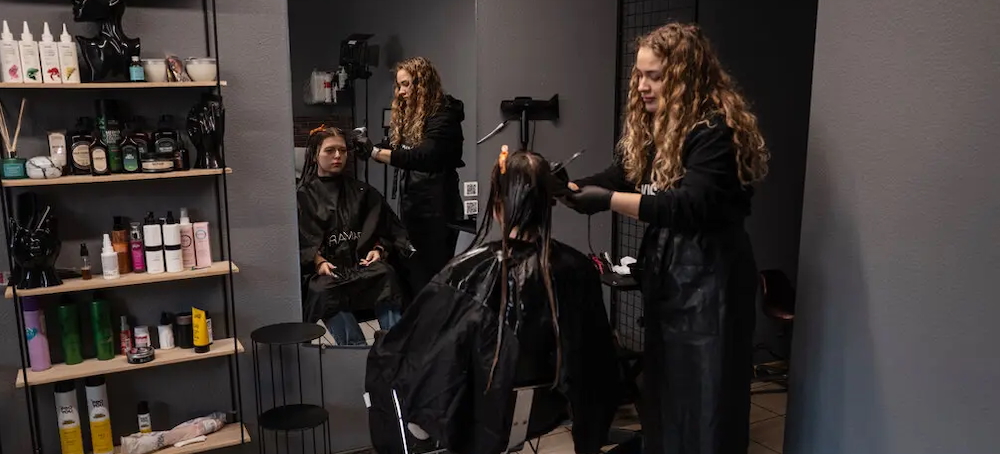 Daria Bondareva last month with a customer at her salon in Sloviansk, Ukraine, in the Donetsk region. (photo: Lynsey Addario/NYT)
Four years into the war, a major sticking point in talks is control of the eastern Donetsk region. Residents could face an agonizing choice if Ukraine gives up the territory.
And she does not want it handed over to Russia, along with the rest of the Donetsk region in eastern Ukraine, where she has lived her whole life. Four years into a war that Moscow began with a lightning invasion on Feb. 24, 2022, this is the essential trade being offered to Kyiv in talks brokered by the Trump administration. Surrender Donetsk, Ukraine has been told, and in exchange get a promise of peace in the rest of the country.
Ms. Bondareva, 28, has little faith that Russia would abide by any agreement. For her, that makes the idea of giving up territory that Moscow has demanded but failed to conquer an unfathomable risk.
“I don’t think Ukraine will ever agree to this,” she said. “I don’t know what will need to happen for Ukraine to agree to give us up.”
As fighting continues to rage along hundreds of miles of front line, Russia and Ukraine are engaging in near-weekly peace talks. Negotiators have narrowed their differences largely to two core issues: control of Donetsk and guarantees of Ukraine’s postwar security.
The talks about territory are driven by Russia’s slow but seemingly inevitable advances. The argument by those pushing Ukraine to relinquish the territory is that Kyiv will eventually lose it militarily anyway, so it should go ahead and cede the area and potentially end the killing.
President Volodymyr Zelensky has said that Ukraine will not unilaterally withdraw from Donetsk, a territory that thousands of Ukrainians have died defending. He has argued that doing so would violate the country’s Constitution and give Russia a springboard for future attacks. It could also cause a rupture in Ukrainian society and end his political career.
Mr. Zelensky has expressed openness to compromise, including a proposal for a demilitarized zone, though it is unclear if Russia would accept such a plan. Polls indicate that about 40 percent of Ukrainians would be willing to cede Donetsk if Kyiv’s allies were to offer sufficient protections against another Russian invasion.
With the possibility of peace now at least on the table, it is a moment of some hope for Ukraine — but less so for the roughly 190,000 people, including 12,000 children, who live in the area that would change hands if Ukraine were to surrender it in a settlement.
They would face an agonizing choice after enduring years of war. They could uproot themselves and move elsewhere in Ukraine. Or they could stay and potentially live under the rule of Russia, which has engaged in extrajudicial executions, arbitrary detentions and torture in other areas it has occupied, according to rights groups.
Ms. Bondareva, the owner of the beauty salon, said she would stay if the region were patrolled by an international peacekeeping force. But if the Russian police were to run a demilitarized zone there, she would leave, she said.
To flee would mean leaving behind a vibrant community. The city where she lives, Sloviansk, remains viable despite being about 12 miles from the front. While the road leading into the region through snowy fields is a forlorn sight, covered by miles of eerie green anti-drone netting, reaching Sloviansk is like finding an oasis in the battlefield.
Other cities in the region, like Bakhmut, Mariupol and Sievierodonetsk, lie in ruins after being captured by Russia. But Sloviansk is bustling from a boom spurred by the tens of thousands of soldiers quartering in apartments and houses there.
At Pittsburgh Pizza, mud-spattered pickup trucks pull in, and soldiers fresh from the front pile out for meals. A bowling alley is open for business. Coffee shops abound, as do shops selling flowers and balloons for soldiers to buy for visiting wives or girlfriends. Dance and Pilates classes are also on offer.
One recent evening at Sirius Sport Studio, about a dozen women, including soldiers on leave, stamped, twirled and kicked up their heels in a routine set to Paris Hilton’s “Turn You On.” The instructor yelled “One, two, three!” and set the group in motion.
The studio had relocated after a bomb blew out the windows at a previous site.
“I love Sloviansk,” said Yulia Lypach, a military medic attending the class on her downtime while away from the front.
Both civilians and soldiers in Donetsk reject the premise that Ukraine will inevitably lose the region, after watching years of failed Russian efforts to seize this land.
Ukraine began heavily fortifying Donetsk after Russia sent troops into the region in 2014 and fomented an uprising. Kyiv refers to frontline cities — Sloviansk, Kramatorsk, Druzhkivka, Kostiantynivka and Dobropillia, along with smaller settlements — as a “fortress belt.”
President Vladimir V. Putin of Russia has leaned on imperial-era history to argue that Donetsk and other parts of a broader Ukrainian region known as the Donbas are culturally and ethnically inseparable from Russia. Seizing Donetsk could allow him to claim some measure of victory even as he has fallen far short of his goal of subjugating all of Ukraine.
At the Russian military’s current pace, it would take about two years to seize the Ukrainian-held territory in Donetsk, according to DeepState, a group with ties to the Ukrainian military that maps the war.
As drones saturate the front lines, Russia now sends no more than a single soldier or a small group forward at a time, lest a larger group be spotted quickly by drones and attacked. The small units probe defenses and find weak points, Ukrainian commanders say.
Capturing territory this way comes at a high cost. In January, 225 Russian soldiers were wounded or killed for each square mile of territory seized, according to the Institute for the Study of War.
Overall, 1.2 million Russian soldiers have been killed or wounded since 2022 or were missing in action, according to a study by the Center for Strategic and International Studies. The equivalent number for Ukraine, the study said, is 600,000.
“The only reason they succeed is that they don’t count their people,” Col. Volodymyr Poteshkin, commander of Ukraine’s 10th Brigade, said of the Russians. His brigade is defending an area of rolling hills east of Sloviansk, a portion of the front that has not shifted since 2023.
“The question is, How much time to do they have?” he added. “How many men are they willing to lose?”
To slow or halt advances, Ukraine has widened the defensive zone along the front with mines, razor wire and trenches while filling the skies with drones. These strips are now up to 12 miles wide.
“Russian advances are not inevitable,” said Lt. Col. Shamil Krutkov, the commander of the 93rd Brigade. “We can stop them.”
Rafila Mirzayeva, 68, a retired nurse, said that after all that people in Donetsk had been through, they could not be expected to live under Russian rule.
She narrowly survived a bombing last month. The explosion sprayed glass and other debris into the bedroom of her 17-year-old granddaughter, Sabrina, who is autistic.
The girl, who was unharmed, had collected stuffed animals and calendars of dachshunds. All were coated in dust and broken glass. Sabrina moved to a temporary shelter without her stuffed animals.
“They should not hand us over like cattle,” Ms. Mirzayeva said of the notion of relinquishing Donetsk. “That would be a mistake.”
Olena Ogorodnikova, 33, a volunteer instructor at a children’s center in Sloviansk, said she had faith in the Ukrainian Army to hold the line. She has heard the explosions from the largely stationary front for four years.
“You hear less of it in the winter,” she said. “It’s noisier in the summer because the windows are open.”
Some in the region want a Russian victory, said Olha Chernikova, a humanitarian aid worker in Sloviansk. Those biding their time for a Russian takeover are known as “waiters.”
More often, Ms. Chernikova said, people remain in the Ukrainian-controlled parts of Donetsk because they have no other place to go. Monthly stipends for internally displaced people are insufficient for them to rent an apartment elsewhere.
“People are very tired,” she said, and can do little but “hope we will not be given to Russia.”