The White House Wrecking Ball
Jess Bidgood The New York Times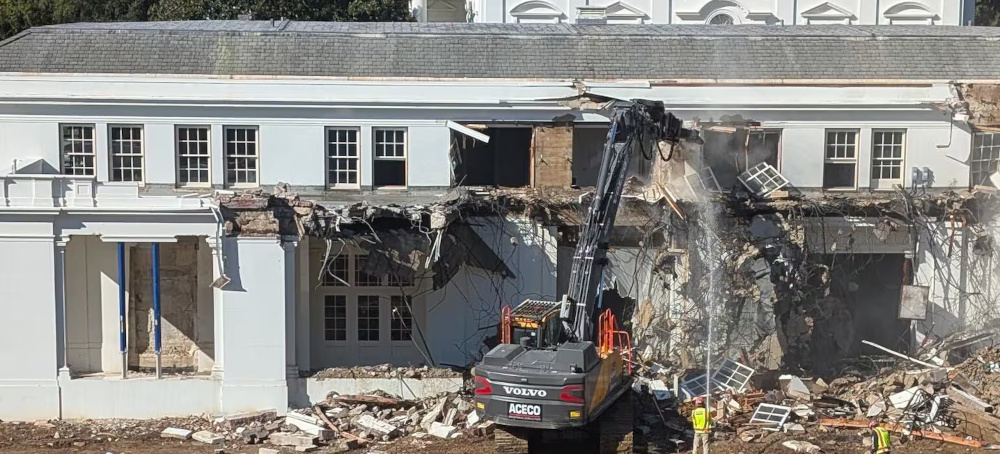 A construction crew demolishes part of the East Wing of the White House on Monday. (photo: The Washington Post)
ALSO SEE: Trump’s Ballroom Blitz Sparks Chorus of Disgust: ‘The Perfect Symbol’
President Trump’s demolition of the East Wing has struck a nerve in Washington and beyond.
I heard it before I saw it: the thrum of construction equipment and a loud rat-tat-tat that could have been digging or drilling. As I weaved through a group of schoolchildren posing for photographs in front of the main residence, I could see the arms of two excavators bobbing around, too tall to be hidden by the thick white fence erected around the fresh construction site. Behind them, a cloud of dust obscured the clear air.
It wasn’t so long ago that Trump was promising his plan to build a 90,000-square-foot ballroom on the grounds “won’t interfere with the current building.” In fact, my colleague Luke Broadwater reported today that the entire wing, which is historically the domain of the first lady, will be razed in the project, and the price tag would increase to $300 million, $100 million more than initially estimated.
Images of the demolition, which began on Monday, have rocketed around the globe, swiftly becoming political fodder and a perfect Rorschach test for a deeply polarizing presidency.
“This is Trump’s presidency in a single photo,” wrote Senator Elizabeth Warren, the Massachusetts Democrat, on X, above a picture showing roof tiles and windowpanes cascading from the facade of the wing, having fallen victim to the excavators’ jaws. “Illegal, destructive, and not helping you.”
The project has left historians and architects deeply alarmed. The National Trust for Historic Preservation on Wednesday urged officials to pause until it could go through the “legally required public review process.” Last week, Trump seemed to suggest to donors that “no approvals” were required for the project.
Trump’s allies insist that the images show a president shaking up Washington, just like he promised. In a sign of awareness that they could not entirely ignore the criticism of the project, though, administration officials called the uproar “manufactured outrage” in a release that detailed other renovations on the building over the years.
“He’s the builder-in-chief,” the press secretary, Karoline Leavitt, said brightly on Fox News on Tuesday. “In large part, he was re-elected back to this People’s House because he is good at building things.”
Leave it better than you found it?
Trump, ever the developer, has certainly spent a lot of time building things at the White House. He paved over the lawn in the Rose Garden to create a patio. He has added gold filigree to the Oval Office and ornate chandeliers to the Cabinet Room, remaking the White House with an indelible imprint of Mar-a-Lago maximalism that is all but certain to outlast his presidency.
“Thank you for having us at your home,” John Thune, the Republican Senate majority leader, told Trump on Tuesday, even though the White House does not actually belong to him, while thanking him “for everything you’re doing to make this such a beautiful place.”
Trump is also, arguably, pretty good at tearing things down, like longstanding alliances — something the secretary general of NATO sought to bolster on Wednesday in Washington — or the guardrails intended to hem in his impulses as he seeks revenge on his enemies.
“He seems to be upending all the norms that are associated with the presidency,” Matt Smith, a tourist from Lexington, N.C., observed this afternoon after riding up to the White House on a Lime scooter. Smith, an independent voter who did not back Trump, had hoped to spend his trip to Washington visiting Smithsonian art museums; with those museums closed by the government shutdown, he settled for this particular spectacle instead.
“This is him physically doing it to us,” Smith said, “just to show that he can.”
When busted norms collide
White House officials have repeatedly said that the ballroom will be paid for privately; Trump last week hosted a private dinner for donors who may see a donation to the project as a way to curry favor with the president.
But yesterday, one busted norm seemed to collide with another as Trump suggested that he might use funds from a settlement with his own government to pay for the ballroom.
After my colleague Devlin Barrett reported that Trump is demanding the Justice Department pay him $230 million to compensate him for the federal investigations into him — a situation with no parallel in American history in which the officials reviewing Trump’s claims are his own allies — Trump said he might use those funds to pay for his ballroom.
“If I get money from our country, I’ll do something nice with it, like give it to charity or give it to the White House while we restore the White House,” he said. “We’re doing a great job with the White House. As you know the ballroom is under construction.”
The source of such compensation would typically be taxpayer dollars.