The Transitive Strongman, a Bit of Hockey Philosophy
Timothy Snyder Thinking About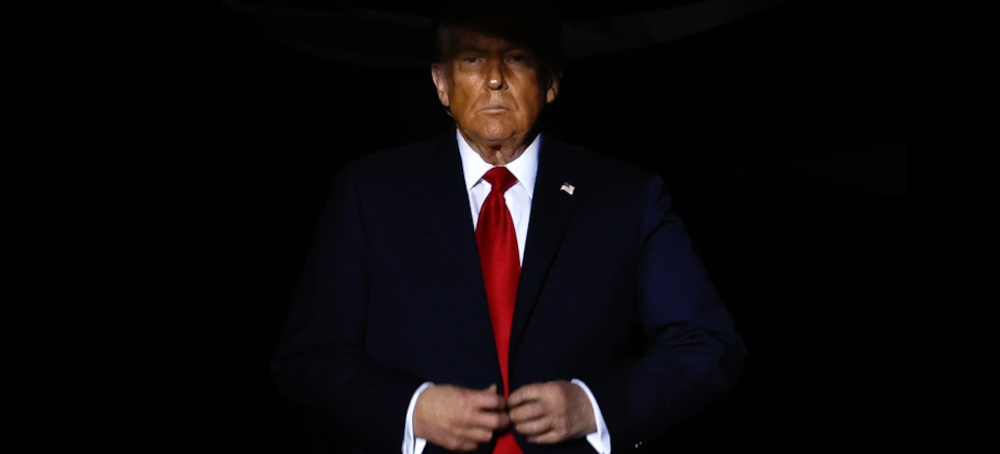 The strongman is strong because he is seen as stronger than the person who sees him as strong. (photo: Getty)
What is a strongman? This is a crucial political question. Democratic systems are being undone by strongmen around the world. But how?
This is mysterious, in general, because it has to do with a certain kind of charisma. It is mysterious in particular for those on whom the charisma does not work.
When I look at Donald Trump as a person, I see a failed real estate guy from Queens with a lot of natural showman talent, whose obviously poor physical condition is covered by terrible, ill-fitting suits and a lot of makeup. When I listen to him I hear incoherent bluster and self-absorbed whining. None of this makes me experience him as strong.
I do experience him as the president of the United States, because I identify strongly with my country, and accept the legitimacy of its (flawed) institutions, through which he was duly elected. For the very same reasons I am troubled when he abuses the power of the office, breaks the law, and seeks to replace our constitutional structure with a cult of personality.
For the strongman it is not the office and the law that matter. They can help him to attain a certain position, but they are essentially a backdrop, an element of dramaturgy. He attains official authority with a performance of strength and then he instrumentalizes it for further performances of strength.
It seems to be the performance that matters, not strength in any objective sense. The strongman is strong insofar as he is seen to be strong, accepted as being strong. His strength is conferred, not innate. And so his actions are right, on his terms, when they allow his followers to join him in a performance of strength.
We are at war now, a war that is transparently one of a series of masculinity contests. Our American strongman is strong because he is stronger than the other strongmen. He can abduct Maduro. He can assassinate Khamenei. He is performing relative strength, at huge cost to others.
It’s another question, of course, as to whether any of this makes the United States stronger. The use of force in this way is obviously illegal in terms of both international and domestic law. Breaking international and domestic institutions will tend to make the United States as a country weaker rather than stronger.
But the people who support the war in Iran seem to be those who already believed that the president is strong. They accept the performance of strength, even as it is humiliating to them, because it goes against what the president himself had promised them -- no more wars, nor more wars in the Middle East, no more forever wars.
Why do they do so? I think the mystery can be broken down into two parts.
The first is relativity: the strongman is strong because he is seen as stronger than the person who sees him as strong. The second is a kind of anthropological gift: at a certain moment, the attribute of strength is accorded to the strongman, as a reward for a kind of performance.
The strongman is strong, in other words, because of the law of transitivity. If you accept at a certain point that he is stronger than you, then you are accepting that you are weaker than him. You are joining in the collective creation of the strongman. But you are also scripting your future behavior. In any confrontation with the strongman you must be weak. You must serve his strength and, if confronted directly by it, accept ritual humiliation.
Having made the initial attribution of strength, it is hard to go back, because doing so is not simply acknowledging a mistake, but acknowledging a choice to be weak oneself.
It’s maybe in other areas of life, seemingly distant from grand politics, where we best see this kind of submission. This whole line of thought descended upon me when I was watching Olympic hockey in Ukraine, and then watching the men’s hockey team be both celebrated and humiliated by the White House.
The central figure was Brady Tkachuk. A year ago, when Trump was talking about annexing Canada and initiating a trade war, he and his brother politicized the Four Nations Face-Off hockey tournament, staging fights with Canadian players in the first few seconds of the game. There was no hockey background for the fights. There was a Trumpy political background. The Americans won hat game; Canada beat them in the final and won the tournament.
This year Tkachuk played on the US Olympic team, which rode the excellent play of its goalkeeper to win the final against a Canadian team that looked to be the stronger side. Trump treated this as an occasion to mock both women and Canada itself, bringing along Tkachuk for the ride. The White House distributed an AI video which falsely and unfairly portrayed Tkachuk making a demeaning remark about Canadians. It has at least ten million views.
This is where it gets interesting, at least for me. Tkachuk was clearly troubled by the video. He plays in Canada, as left wing for the Ottawa Senators. He is the captain of the team that plays in the Canadian capital and is named after a chamber of the Canadian parliament. It is awkward for him to be associated with hatred of Canada.
And yet Tkachuk cannot seem to bring himself to say that the president of the United States did something wrong. And Trump obviously did do something wrong. He spread a lie about Tkachuk that has changed Tkachuk’s life for the worse, at the very moment when he was supposed to be celebrating Tkachuk.
Trump ritually humiliated Tkachuk, as he does to all who acknowledge his strength. And all Tkachuk had to do is state the obvious: that this was improper. But he can’t seem (at least in his published remarks) to be able to do that. He is angry, but somehow at a general situation. In his circumlocutions he blames the video itself and comes close to blaming himself. He defines his interactions with the president as something over which he has no power, something that he cannot change. The aura of the president, he suggests, made all of this inevitable, and there is really nothing one can do.
It’s in these little encounters, I think, that we see how the cult of strength works. Once you accept that Trump is strong, you are accepting that you are weaker than Trump. And once you accept the strongman form of politics, you no longer have recourse to laws, or norms, or even basic ideas of decency. When the strongman dishes it out, you have to just take it. And when the person who just takes it is a public figure, secure in every way, a rich athlete with a gold medal, say, it normalizes the submissive behavior for everyone else.
On such small examples we see the clash between the performative, charismatic strength of the strongman and the actual prosperity of those around him. Tkachuk’s gold will be associated with Trump’s behavior, and with Tkachuk’s inability to respond to it. Tkachuk now faces hostility in Ottawa that he need not have faced. More broadly: the artificial tensions between the United States and its northern neighbor serve the citizens of neither country; they serve only the cult of the strongman.
To be sure, the cult of the strong man works on some women, as well. Frozen in my mind is a televised interview of a group in Cincinnati, Ohio, in autumn 2016, in which a woman said that Trump “sets the standard.” This baffled me: how so? In what domain? And then I understood what was meant: that no matter what he does, she had accepted that as the standard. She had conferred upon him the power to define her own ethics. Canvassing in Ohio then and later I heard similar things from women.
That said, the strongman schtick seems to work less often, and less well. The American women’s hockey team also won the gold, and was also baited by Trump with the combination of a sexist joke and an invitation to the White House. But they did not take the bait, and declined the invitation to attend Trump’s State of the Union. The strongman aura was not irresistible, at least not to them.
The category of the strongman has been on my mind these last few days as I have been looking forward to speaking live with Professor Ruth Ben-Ghiat, the author of Strongmen, a major political text of our time.
Professor Ben-Ghiat has been very prescient and very active these past few years, and I am delighted to have the chance to speak to her about masculinity in politics -- as well as the war in Iran and the means of resistance — in a couple of hours. Tune in to Thinking Live... for my conversation with Ruth Ben-Ghiat this Wednesday, March 4th, at 12:30pm (North American eastern time). If you are a subscriber to Thinking about... you will be automatically alerted by email when the conversation starts.
PS No doubt the title of this essay owes something to Karen Elizabeth Gordon’s The Transitive Vampire, an excellent guide to grammar that I read when I was much younger.