The ‘Third Gulf War’ And Its Aftermath
Hassan Hassan and Kamran Bokhari New Lines Magazine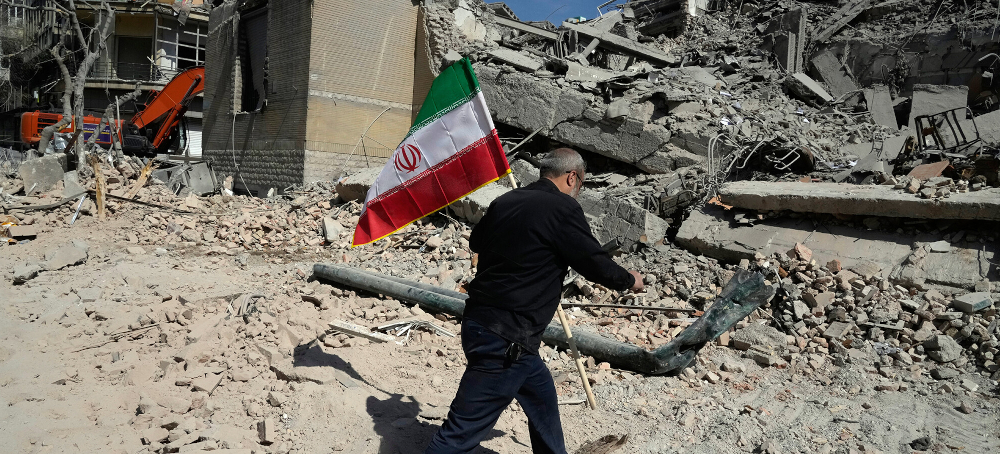 The rubble of a police facility struck during the U.S.–Israeli military campaign in Tehran. (photo: Vahid Salemi/AP)
Tehran built a doctrine of resistance designed for export, not for local consumption, but then Washington broke a quarter-century taboo about striking Iran
The balance sheet of the war that just paused is striking in both directions. Israel killed more than 250 Iranian officials, including Supreme Leader Ali Khamenei and almost all of Iran’s senior military leadership, and thousands of Islamic Revolutionary Guard Corps (IRGC) personnel were reportedly killed or wounded. The Pentagon also claims it has sunk over 90% of Iran’s navy. Yet the regime remains intact, with a functioning leadership structure. Iran has also done something it spent decades only threatening, closing the Strait of Hormuz and turning the world’s most critical energy choke point into a tollbooth. Iran’s strategy has been to endure and impose costs, and by that measure it has achieved meaningful success. A regime that lost its supreme leader in the opening strikes and 90% of its navy in five weeks nonetheless forced the most powerful military in the world to negotiate through Pakistani intermediaries rather than deliver a knockout blow. That is not victory, but it is not the collapse the strikes were designed to produce.
Yet the mixed record of this war obscures the broader reality of what Iran has lost. That is why it is more useful to widen the aperture and to frame what is unfolding as the Third Gulf War. The first began with Saddam Hussein’s invasion of Kuwait in 1990, with American campaigns formally codenamed Operation Desert Shield and Operation Desert Storm, and ended with a coalition victory that left the Iraqi regime intact but severely degraded. The second, launched as Operation Iraqi Freedom in 2003, toppled that regime in three weeks, a speed that masked the fact that the conditions for the collapse had been building for 12 years. The third is playing out now, and the pattern will likely be more visible in the years to come.
We use this framing because it serves an analytical function. This conflict has a wider context, going back to at least 2020, that can tell us even more about the future of Iran’s regional standing than this war’s balance sheet. It reveals this conflict as belonging to a type that leaves regimes intact on the surface while hollowing them out from within. Framing the current war as the third in a series of Gulf wars shifts attention from the current show of force to what comes after the dust settles. In almost every consequential event of the past decade, immediate commentary inflated the resilience of pro-Iranian forces — and was proven wrong as time went by.
The Islamic Republic is unlikely to collapse in the near term, but both the United States and Israel will adapt to a new norm of maintaining pressure, which President Donald Trump suggested in recent statements, even before announcing the ceasefire. The new norm involves periodic precision strikes against Iran, deployed not for the purpose of regime change but for containment. Tehran, in turn, will be forced to internalize a posture of resistance it has spent decades exporting and leading from the rear. Resistance, a tool originally designed for export to battlefields hundreds of miles from its borders, is now applied to its own territory.
The critical and lasting change for Iran is that the war broke a taboo in Washington that had stood for a quarter of a century. Successive American administrations, Republican and Democratic alike, ruled out direct strikes against Iran, calculating that the costs of escalation outweighed the benefits of degrading Tehran’s capabilities. Iran built its entire strategic posture on that predictability. The Islamic Republic could threaten and bleed adversaries and bankroll proxies across four countries because everyone understood there was a ceiling to what Washington would do about it.
In 2007, a formal capture mission to detain Qassem Soleimani, the IRGC Quds Force commander, was rejected at the senior leadership level in the George Bush administration, as documented in the U.S. Army’s official history of the Iraq War. That same year, as Gen. Stanley McChrystal revealed in a 2019 Foreign Policy essay, a convoy carrying Soleimani crossed from Iran into northern Iraq, and the Americans chose to monitor rather than strike. CIA officers in Baghdad who pushed for authorization were repeatedly told to stand down because he was “untouchable,” according to a Yahoo investigation in 2020. “I was told, ‘No, these are Iranians,’” John Maguire, a former senior CIA official stationed in Baghdad in the mid-2000s, told Yahoo’s reporters. “There was no appetite for it.”
President Barack Obama retained the same posture toward Iran. He wished that America’s Sunni Gulf allies had something militarily equivalent to the IRGC, and wanted to respect Iranian “equities” in Syria, as he put it. Iran’s equities ended up taking over aspects of Syria’s security and began to fortify Iran’s land corridor to Lebanon and the Mediterranean, including through engineering demographic shifts near Damascus.
It was at that moment, with Iran reaching something close to its regional peak strength in 2018, that Trump withdrew from the Joint Comprehensive Plan of Action (JCPOA) agreement with Iran, launched the “maximum pressure” campaign against Tehran and its proxies and, on Jan. 3, 2020, ordered the killing of Soleimani. The strike demonstrated that Washington’s long-standing hesitation had been a political choice rather than a strategic or tactical limitation, and may be remembered by future historians as the beginning of the end of Iranian hegemony in the region.
Trump began dismantling that ceiling and, with it, predictability. Significantly, barely three months before the Soleimani strike, Iran’s regional position seemed unassailable. Iranian-linked attacks on oil facilities at Abqaiq and Khurais in eastern Saudi Arabia had prompted Riyadh to seek diplomatic rapprochement with Tehran rather than escalate against it. A 40-year rivalry between the Sunni and Shiite powerhouses seemed to have settled in Iran’s favor. Riyadh shrank inward, focusing on economic prosperity at home and accommodation with Tehran and its allies, including Bashar al-Assad in Syria. (This trend culminated with a formal China-brokered rapprochement between Riyadh and Tehran in March 2023.)
Washington’s old playbook did not hold because it was riddled with contradictions, most of them made clear by the war against the Islamic State group, which involved indirect American alignment with Iran and Russia in that region and direct alliance with the Kurds in predominantly Arab areas, to the dismay of NATO ally Turkey. These contradictions erupted in a series of skirmishes between U.S. forces and those adversaries, which climaxed under the Trump administration and as the Islamic State’s caliphate crumbled. In February 2018, American warplanes decimated 200-300 Russian Wagner Group mercenaries and Syrian and Iranian militia members in the desert near the Iraqi border in Deir ez-Zor. IRGC-run militias, especially Kataib Hezbollah, routinely rocketed or attacked the fortified U.S. garrison in Iraq. Trump also allowed Turkey to invade northeastern Syria to establish a buffer zone against America’s main counterterrorism proxy, Syria’s Kurdish militias. He was only kept from withdrawing all U.S. forces in Syria by the deceptive “shell games” his own Cabinet and advisers played to conceal troop numbers.
The old restraint in Washington extended to Israel’s operations as well. For years, Israeli Prime Minister Benjamin Netanyahu reportedly sought authorization to kill Hezbollah chief Hassan Nasrallah, only to be restrained by American pressure amid concern about regional blowback. When Israel finally struck at Nasrallah on Sept. 27, 2024, dropping more than 80 heavy bombs on Hezbollah’s underground headquarters in Beirut’s Dahiyeh suburb, the Americans, who were blindsided by the operation, had been in the middle of brokering a ceasefire. Netanyahu was in New York when he approved the strike, and deliberately withheld notice from the Joe Biden administration to avoid attempts to block it.
The series of high-level assassinations began earlier in April 2024, when Israel struck the Iranian Consulate in Damascus and killed Brig. Gen. Mohammad Reza Zahedi, the top commander of the IRGC’s Quds Force in the Levant. The assassination of former Hamas chief Ismail Haniyeh in Tehran on July 31, 2024, was crucial because it happened on Iranian soil. The “pager and walkie-talkie attacks” against Hezbollah in mid-September 2024 established a chilling Israeli edge in technological and intelligence warfare.
These attacks continued something that Soleimani’s killing had started. The ceiling is gone, and a generation of American strategic caution has been replaced by a demonstrated willingness to strike. Significantly, the decimation of the Iranian axis took place during the Biden administration, at a time when Washington was seeking to return to an earlier policy toward Tehran.
It is true that Biden took a different approach from Trump, pursuing a revised nuclear deal and quietly shelving the maximum pressure posture. This was not the same as when President Bill Clinton continued the pressure campaign against Iraq in the wake of the First Gulf War. Yet the fact that the Biden administration did not try to restore the JCPOA shows that it is unlikely there would be any significant shift in how a future administration will deal with Iran — assuming the regime itself does not undergo significant behavioral change. At that point, however, current U.S. policy stops being the determining factor. Iran could not simply rebuild its regional dominance even if such a shift took place, because it would have to replicate the crises that enabled its rise over a quarter century — events akin to the U.S. invasion of Iraq and the several conflicts that allowed it to fill a vacuum.
Even after the current cycle of escalations has subsided, the U.S. and Israel are likely to strike Iran whenever Tehran is assessed to be reconstituting threatening capabilities or directing hostile activity. With an Iranian surrender being out of the question, and even if Washington returns to old policies, Israel sees no scenario in which it voluntarily returns to the old prohibition against striking Iran directly.
A bigger challenge for Iran is not surviving the current campaign, as it has so far, but contending with the fact that a pattern has been broken, and the old costs that deterred American and Israeli action no longer apply. Indeed, restoring the older pattern is precisely what the Iranian regime is trying to achieve with its current attacks. These give Iran an advantage in terms of raising the cost of war, but offer fleeting value in the long term. They may even be counterproductive in terms of restoring the status quo ante that existed before the weakening of Iran’s allies in the region and before the current open war. Until recently, the scenario of Iranian strikes targeting Gulf Arab states was a theoretical one. Every Iranian attack on Gulf Arab states hardens the resolve of Washington’s regional partners, making a return to the pre-2024 status quo not more but less likely, a fact currently clouded by continuing Gulf diplomatic statements and efforts to mediate an end to the war.
This is already the pattern both American and Israeli wars have followed elsewhere. After the 1991 Gulf War, the U.S. and Britain maintained no-fly zones over Iraq for 12 years, enforced by routine air patrols and punctuated by strikes, including Operation Desert Fox in December 1998, which targeted suspected weapons sites with four days of sustained bombardment. Iraq absorbed those strikes, and yet each one deepened structural damage that would not be fully apparent until 2003.
Israel applied a variation of the same logic to Syria for years, both before and after Assad’s fall, conducting hundreds of strikes against Hezbollah weapons transfers and Iranian military infrastructure inside Syrian territory. The strikes became so routine that they barely registered in international coverage, although Syria also never meaningfully retaliated. The cumulative effect was to hollow out the Syrian state’s military capacity and deepen its dependence on external support to an extent that was not visible until the regime finally collapsed on Dec. 8, 2024.
Post-Soleimani Iran had been losing regional influence, almost steadily, even before Israel’s direct war on its proxies after October 2023. This was discernible first in Iraq and Syria, with Iran’s waning ability to determine the direction of Iraqi politics or replicate in Assad’s Syria the success it had had in Iraq since 2003. Soleimani did not leave a well-oiled machine that could continue attempts to strengthen Tehran’s regional project, as analysts contended at the time. That machine’s erosion was almost immediately felt under his less effective successor Brig. Gen. Esmail Qaani, especially in Iraq and Syria, and in the changing reality around Iran. In this sense, the blows against Hezbollah and Assad’s Syria in 2024 could be seen as a symptom of that prior vacuum left by Soleimani in 2020, as well as the changing playbook in the U.S. and Israel. Hezbollah, Iran’s premier proxy, was dismantled by the Israelis. The Iranians failed to anticipate Israel’s intelligence penetration of both Hezbollah and Iran itself. And the collapse in the Levant also made the current war possible.
In Iran, the regime absorbed sustained military strikes, but the question of what a surviving but severely weakened regime in Iran will look like after the shooting ends, both in the region and inside its own borders, remains.
Regionally, the weakening of Iran’s forward-defense architecture is likely irreversible. Hezbollah, the crown jewel of the so-called axis of resistance, has lost its leadership and suffered catastrophic attrition.
The Houthis have absorbed sustained American strikes, and they serve as independent contractors of the Iranian regime rather than corporate-controlled franchises like Hezbollah and the Iraqi Shiite militias. The Houthis also see that the Iranian regime is facing an existential threat and do not wish to go down with it. Their strategic calculus in joining the axis of resistance was always to strengthen their dominant position in Yemen. If that is not being served, and joining the war could lead them to weaken domestically, then they will avoid entanglement, which they have demonstrated by taking limited action against Israel, and that, too, after a month of only issuing statements in support of the Iranian regime.
Meanwhile, the Iraqi militias and political forces are also likely watching their patron with great trepidation over what its situation could mean for them. An Iran struggling on the home front cannot offer much support to the Iraqi Shiite factions whose fragile intracommunal dynamics have been held together by the IRGC’s Quds Force. A weakened Iran will not be able to maintain its influence in Iraq, leading to intra-Shiite power struggles that could weaken the dominant Shiite position at the intercommunal level. The Kurdistan Regional Government in Erbil has long been hoping for a weaker Baghdad.
The weakening of Iran and, by extension, Shiite allies, is a historic opportunity for the Sunni minority, which has long been marginalized and caught between Shiite Islamism and Sunni jihadism. They also have strategic depth in Syria with the new Sunni-dominated regime backed by Turkey, Saudi Arabia and the U.S.
In other words, what Iran built over four decades as a deterrent network capable of threatening Israel from multiple directions has been substantially degraded or disrupted. The proxies that were supposed to prevent a direct strike on Iran failed in their primary mission. Their reconstruction, if it happens at all, will take years and require resources Iran may not have.
Domestically, the picture is equally fragmented. The latest wave of public unrest, brutally suppressed in early January, did not resolve the underlying grievances that produced it. If anything, a war that cost tens of thousands of lives and inflicted widespread damage could intensify those grievances rather than extinguish them.
None of this is likely to bring the regime down in the near term. Its capacity for repression remains formidable, as January demonstrated. But war and protracted pressure will likely determine the shape of the new Iranian regime, reinforcing a change that was a few years in the making before the post-Oct. 7 Middle East made it a pressing domestic challenge.
The most structurally significant damage may not be to Iran’s conventional military at all, but to the institutional hold of the IRGC. The corps was never just a military organization. Over four decades, it has become a parallel state, controlling large portions of Iran’s economy through affiliated foundations and commercial enterprises, extending its influence through the telecommunications and media sectors, overseeing defense production and running the nuclear program. Estimates of its direct and indirect economic footprint range from a quarter to nearly half of the country’s GDP.
The systematic elimination of multiple layers of IRGC leadership does not simply disrupt military command chains. It disrupts the patronage networks through which they have maintained internal cohesion, rewarded loyalty and extended their reach into civilian life. Those networks, once broken, are not easily reconstructed. The consequence could be internal fragmentation and a slow crumbling of the cohesion that has held Iran’s security apparatus together, although not a coup or a clean transfer of authority.
In theory, the regular armed forces, the Artesh, represent a more institutionally cohesive alternative. In practice, they have historically exercised little influence over the domains in which the IRGC is most deeply entrenched. It is difficult to envision how the Artesh, even in partnership with pragmatic elements from among the Revolutionary Guards, could spearhead a stabilization effort across a country whose security architecture has been so thoroughly merged with the IRGC. Without that kind of orderly reconfiguration, the regime is more likely to experience continuing institutional decay than a reconsolidation of power.
Hard-liners in Tehran may draw the wrong lesson from surviving the current war, concluding that their resilience vindicates continued confrontation. An invasion is unlikely, and a regime collapse is not feasible. But the regime that emerges will be drastically different and will operate in a different regional environment. The new regime will be a far cry from the evolution toward pragmatism that many had hoped for, and from the hegemonic power that was uncontested five years ago.
The trajectory of postwar Iraq offers one instructive precedent. Saddam Hussein’s survival of the 1991 Gulf War was initially read as regime resilience, proof that he had withstood a superpower-led coalition and endured. It was followed by 12 years of incremental damage. The no-fly zones that partitioned a third of Iraqi territory north and south created de facto Kurdish autonomy in the north and Iranian influence among Shiite populations in the south. A decade of sanctions compressed the economy and eroded the middle class that had once provided the regime’s technocratic base. Persistent strikes, including Desert Fox’s four days of sustained bombardment in 1998, degraded military infrastructure that sanctions prevented from being rebuilt.
By 2003, when U.S. and coalition forces crossed the border, they encountered a state that had been hollowing out for over a decade. The three-week collapse was due to how thoroughly the regime had been degraded before the first strikes fell on central Baghdad.
The analogy may seem imperfect at face value. Iran is larger, more populous and more ethnically complex, and it faces no imminent ground invasion designed for regime change. The Islamic Republic has demonstrated greater ideological resilience than Baathist Iraq. But the underlying logic remains that wars weaken embattled regimes in ways that only fully manifest over time, and immediate postwar survival can obscure deep vulnerabilities.
The postwar period will likely be marked by a particular kind of persistent instability. The regime will find itself having to manage at least four simultaneous crises, but without the old tools: a security apparatus fraying or transforming at the top, an economy strangled from the outside, Israeli strikes becoming the new norm and a severely degraded proxy network.
The Third Gulf War has no clear ending and may simply, like its predecessors, hollow out what it cannot topple.