The Supreme Court Weighs How Much Google Surveillance Can Be Used Against You in Court
Robyn Nicole Sanders Slate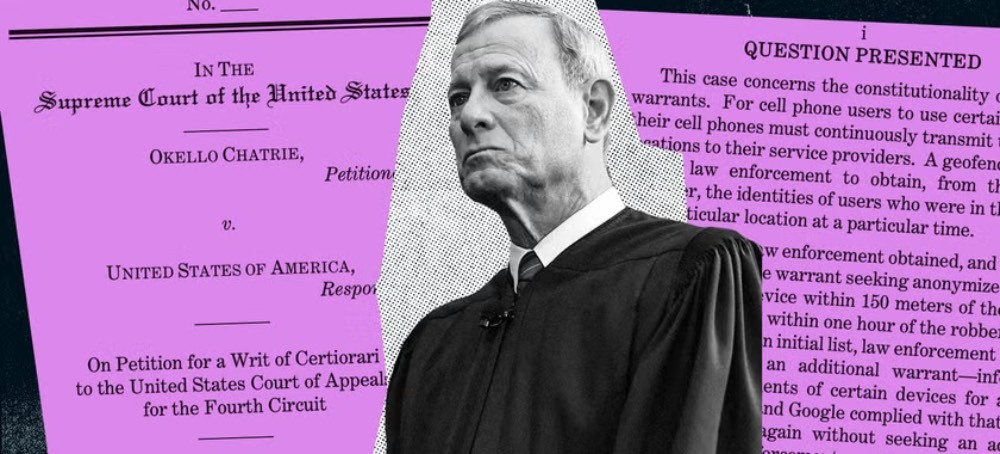 Chief Justice John Roberts. (photo: Getty)
The facts in Chatrie arrive wrapped in the familiar language of a violent crime. In 2019, a man entered a credit union outside Richmond, Virginia, carrying a cellphone and a gun. He handed a teller a note threatening violence against employees and their families. He forced workers onto the floor, escorted employees to the safe, and fled with nearly $200,000. Surveillance footage showed him holding a phone to his ear shortly before the robbery. Witnesses described him. Detectives ran down leads. When the investigation stalled, detectives obtained what is known as a geofence warrant, directing Google to identify devices located within roughly 150 meters of the bank during the relevant hour. Google searched its location history database and produced anonymized information tied to devices inside that perimeter. Police reviewed the movement patterns, requested expanded data for selected users, and eventually sought identifying information connected to several accounts. One belonged to Okello Chatrie.
The mechanics sound technical right up until you say plainly what happened. The government searched through the historical movements of multiple innocent people in order to identify a suspect it did not yet know. That inversion of constitutional order hovered over the entire oral argument late last month. Traditionally, police develop suspicion first and search second. Geofence warrants reverse the sequence, where the search becomes the mechanism through which suspicion is generated. While the government insists the process remains narrow because the warrant involved a specific place and time, geography is not particularity, and a warrant authorizing police to search everyone who happened to occupy a given space is still breathtakingly broad even if the map around that space is carefully drawn. The phrase “geofence warrant” disguises the extraordinary nature of what the government actually requested. Police effectively asked Google to look through a vast archive of human movement and identify which lives intersected with a particular patch of pavement at a particular moment in time.
A generation ago, that would have been impossible. Police could canvass neighborhoods, interview witnesses, check traffic cameras, maybe pull hotel records or receipts. But they could not reconstruct with retrospective precision who stood near a location hours earlier. Smartphones changed that. More accurately, the business model surrounding smartphones changed that. Devices became continuous producers of information, and technology companies realized that information itself possessed enormous economic value.
For years, Google maintained a database known internally as Sensorvault, an immense repository of detailed location information associated with users who enabled the company’s location history feature. Using this database, Google quietly stored detailed records of where millions of people traveled, often minute by minute, day after day. As the Supreme Court eight years ago in Carpenter v. United States acknowledged, location data is especially revealing because movement forms narrative and human beings tell stories through where they go. A device that spends every weekday morning at one address and every evening at another says something about work and home. A phone that regularly appears outside an oncology clinic tells another story. So does a device that repeatedly travels to a church, a mosque, a union office, a bar at 1 a.m., a political protest, an addiction treatment center, or someone else’s apartment late at night. None of this requires the government to be physically present or to listen to a single conversation that may have occurred in such locations. That realization haunted the majority in Carpenter. Chief Justice John Roberts acknowledged there that historical location data provided an “intimate window into a person’s life.” But Carpenter still involved surveillance directed at a known suspect. Police had someone in mind already. Chatrie broadens the constitutional problem considerably because geofence warrants are built around collective searching. Their entire value lies in the ability to sweep up innocent people’s information and sort through it later.
That feature of the technology surfaced repeatedly during argument. Adam Unikowsky, representing Chatrie, kept trying to force the Supreme Court to see Google’s databases in human rather than technological terms. He described individual accounts as “virtual safety deposit boxes.” The government, he argued, compelled Google to open them and identify which users happened to be near the bank. The metaphor worked because Fourth Amendment law still relies heavily on physical intuition. Once the justices can imagine the same search occurring in the physical world, the constitutional discomfort sharpens considerably. Imagine police responding to a robbery by obtaining judicial permission to open every safety deposit box in a neighborhood bank, briefly inspect the contents, and determine afterward which customers seem suspicious. The search would still violate the rights of innocent box-holders even if officers looked quickly and moved on. Digital surveillance changes scale and visibility, but it does not eliminate intrusion. It simply makes intrusion easier to normalize because machines rather than officers perform the searching.
That distinction became central during the oral argument. Several justices seemed drawn to the idea that the process was somehow less constitutionally troubling because the initial search involved automated filtering rather than human eyes manually reviewing every account. Justice Sonia Sotomayor pressed directly on that point, asking whether the search really occurred only once information was exposed to the government. But automation does not eliminate the constitutional problem. If anything, it intensifies it by removing the practical friction that once constrained broad searches. Historically, dragnet surveillance was difficult because searching large numbers of people required enormous time and labor. Technology collapses those limitations. An algorithm can now perform in seconds what would once have required weeks of officers riffling through papers and records. That efficiency creates temptation.
The Fourth Amendment exists largely because governments predictably exploit opportunities to search broadly whenever those searches become easy. The Fmers understood that instinct intimately. General warrants and writs of assistance enraged the colonies precisely because they allowed British officials to rummage through homes and businesses without individualized suspicion. The evil was not merely that searches occurred but that the government treated entire populations as searchable first and innocent later. Geofence warrants threaten to re-create that logic in digital form.
Several conservative justices seemed resistant to that framing because they viewed the case primarily through the lens of consent. Roberts returned repeatedly to the idea that users voluntarily enabled Google’s location history feature. Justice Samuel Alito emphasized that users took affirmative steps to activate it. Their questioning reflected a deeper tension running through modern Fourth Amendment doctrine. How voluntary is digital participation really?
During argument, Sotomayor pointed to findings that Google’s interfaces themselves were confusing and opaque. More fundamentally, the “just turn it off” logic begins collapsing once you think seriously about what modern life requires. Smartphones are no longer optional accessories. Employers expect them. Schools expect them. Banks expect them. Hospitals expect them. Transportation systems, workplaces, familial and social relationships, and government services increasingly assume continuous digital participation. Suggesting Americans remain free from surveillance because they could abandon smartphones entirely feels a little like saying citizens remain free from public monitoring because they could stop leaving their homes. At some point constitutional rights have to govern ordinary participation in society rather than hypothetical withdrawal from it.
That underlying conflict explains why Chatrie matters far beyond one robbery investigation or even Google itself. Justice Neil Gorsuch seemed particularly aware of how expansive the government’s theory could become. If voluntarily storing information with Google destroys Fourth Amendment protection, he suggested, why would the same logic not apply to email, documents, cloud photographs, or calendars? That question may ultimately define the future of digital privacy law more than the court’s eventual holding about geofence warrants themselves. Modern people no longer store the substance of their lives in desk drawers or filing cabinets. They store it on remote servers owned by corporations. Cloud storage has become memory infrastructure. If the Constitution treats all of that information as voluntarily exposed merely because third parties mediate it technologically, then the Fourth Amendment contracts dramatically without anyone ever formally rewriting it.
The timing of the case matters because surveillance capacity is only accelerating. Phones already generate enormous streams of location data. Cars increasingly do the same. Smart watches monitor bodies continuously. Apps track movement constantly. Artificial intelligence will make those information systems easier to aggregate, analyze, and weaponize. The constitutional question raised by Chatrie is not simply whether one warrant went too far, but whether the government may use mass reservoirs of innocent people’s data as searchable terrain for criminal investigation.
Traditional searches announced themselves physically. Digital surveillance lacks that drama because it happens silently, bureaucratically, and invisibly. Indeed, most people never know the search occurred at all. And yet invisibility makes that power easier to expand because citizens stop feeling the intrusion even while the state acquires increasingly intimate access to ordinary life.
Near the close of argument, the justices sounded less like judges debating doctrine and more like people trying to decide whether constitutional language forged in an analog century still possesses enough force for a digital one. What counts as a search now? What counts as consent? What counts as exposure when modern existence itself requires constant technological disclosure?
Those questions do not have clean answers. But the instinct underlying the Fourth Amendment remains surprisingly stable across centuries. Governments should not be permitted to search broad groups of innocent people merely because technology makes doing so efficient. The Framers feared officers rummaging through homes and papers because they understood something permanent about institutional power. If governments gain the ability to search widely, cheaply, and invisibly, eventually they will do so. Chatrie asks whether the Constitution still remembers that lesson once the rummaging happens through data instead of drawers.