The Supreme Court Has Found Its True Enemy: Multiracial Democracy
Dahlia Lithwick Slate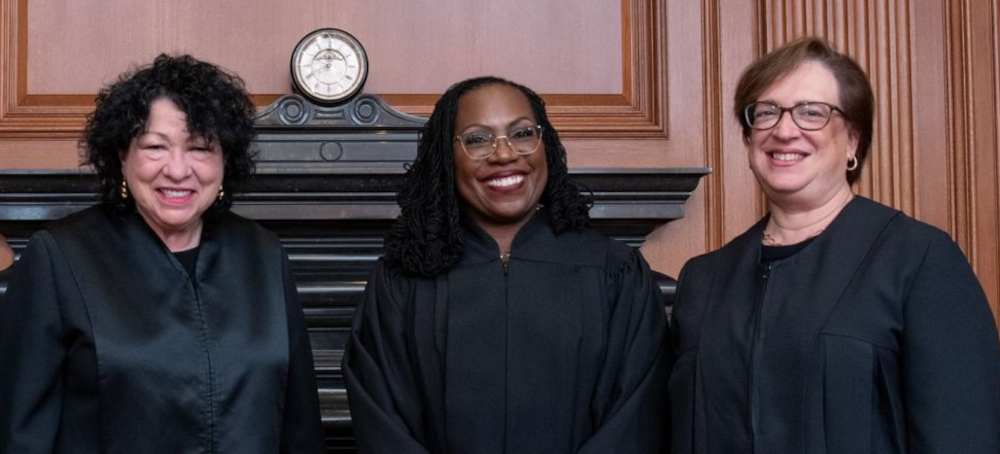 Supreme Court Justices Sonia Sotomayor, Ketanji Brown Jackson and Elena Kagan. (photo: Getty)
Dahlia Lithwick: Election law expert Rick Hasen just described this as “one of the most pernicious and damaging Supreme Court decisions of the past century.” Can you describe the significance of this case and the stakes?
Janai Nelson: I said at oral argument that it would be catastrophic for the Supreme Court to in any way narrow or shrink Section 2 of the Voting Rights Act. And it has done far more than that. It has effectively debilitated us from being able to enforce it in most contexts we’ve used it in in the past. This is a day of infamy for the court. It is a day of devastation for our democracy. And it is also a call to action for every American who hopes to continue to live in a functioning democracy, and one that is multiracial and multiethnic, and whose representatives reflect that.
Can we talk about the Louisiana map that’s at issue? African Americans make up approximately 33 percent of the state’s population. And despite this, the 2022 congressional map included one majority-Black district out of six. Can you talk about how we got to a place where the objection to mass disenfranchisement of Black voters in Louisiana turns into a conversation about how this is racism against white voters?
We get here, quite predictably, when we look at how race has been handled in this country from the very beginning. The VRA was challenged right after it was passed, even though we know that Black people had the right to vote in name only. They were intimidated with violence, with voter suppression tactics and tools, with tests and devices that kept us from the ballot box and from realizing our political power until the VRA was passed in 1965.
We get here when you think about the challenges to affirmative action. Dating back to the Bakke decision in 1978, in which a white medical applicant is able to claim he’s discriminated against because a few seats are going to qualified Black applicants who are woefully underrepresented. The litigants in the Callais case who challenged the map that we won, based on an overwhelming, voluminous record of evidence, that six federal judges agreed proved racial discrimination. This ruling was somehow overcome by white residents of a new district drawn to remedy that discrimination saying that they thought it was unfair.
So what the Supreme Court did today was rubber-stamp this concept of white grievance. It rubber-stamped this false notion that you can just will race away by ignoring it. And it rubber-stamped so much of what has really eroded our civil rights framework.
Can you talk for a minute about the ways in which Justice Samuel Alito in the majority opinion keeps insisting he’s not overturning the framework laid out in the 1986 case Thornburg v. Gingles. He also says he’s not overturning Congress when it reauthorized the Voting Rights Act. He says he’s doing nothing other than correcting or updating the many cases and the acts of Congress that have had a pretty long-standing history until today. And I guess I’m curious about why this is done in the language of We’re tweaking, we’re doing tiny fixes, we’re restoring us to the status quo ex ante. And the follow-on question to that is: What, if anything, survives the Section 2 regime after this?
I think what we can glean from the acrobatics in the Alito majority opinion is a degree of cowardice to admit that what they are doing is gutting what this same court, with a different constellation of justices, once called the crown jewel of civil rights legislation, and what this very court, in its current configuration, upheld in a 5–4 majority opinion just three years ago authored by Chief Justice John Roberts in Allen v. Milligan. So in order for the justices to even come up with any sort of logical or seemingly logical veneer of rationality for this opinion, they had to engage in that twister effort to reconcile past decisions.
But what they did was effectively resurrect an intent requirement to Section 2. The court had already tried to do [that] in an opinion Congress had rejected in 1982. And so what the majority opinion does is it tramples on Congress’ enforcement powers, elevates partisan politics over the principle of fair maps and the right to vote, and rejects stare decisis by distancing itself from a decision that it made a mere three years ago on nearly identical facts. This decision is truly an abomination, not just because we don’t like the outcome, but because of all the principles the court had to violate to get to that outcome, and to get to that outcome against the backdrop of a hyperpartisan midcycle redistricting landscape that was set in motion by its equally egregious decision in Rucho v. Common Cause. So this is a project by this court, and it’s becoming more and more transparent. And I fear that the court has lost all credibility, and deservedly so.
There may be some theoretical academic application, but the reality on the ground is that we have lost the most important tool to protect our democracy from race discrimination in voting outside of the 15th Amendment. And the 15th Amendment, in Roberts’ words from the Allen v. Milligan decision, is now a mere “parchment promise.” It is lost on me how he could square those poetic words with the decision he endorses in Callais.
Can you give me one more second on Allen v. Milligan? I want to note for the record that Brett Kavanaugh and Roberts, who joined with the court’s liberals in that case, were silent on Wednesday. Is there any theory here that asserts that this is anything other than just pure political partisanship and ideology and an effort to suppress the vote? I’m trying to square this with Milligan because I actually thought that stood for something. Does Alito even attempt to distinguish this?
You know, I haven’t found it. I will continue to look for something redeemable about how the court got from Milligan to Callais. But from what I’ve seen thus far, there is no path. There is nothing that reconciles those two decisions through any logic or law.
Justice Elena Kagan, in her dissent, is as angry as we’ve seen her. She starts by noting that the Voting Rights Act is, or was. one of the most consequential, efficacious, amply justified exercises of federal legislative power in the nation’s history. Its [history] was born, she writes, “of the literal blood of Union soldiers and civil rights marchers.” And she essentially says that this has been a set of cases that ended Wednesday with what she describes as a kind of dead letter, a ghost of whatever Section 2 was. And I just want to give you a moment to remind us what this history is.
Section 2 comes out of one of the most poignant exemplars of patriotism and love of country I can point to in our history. Everyday Americans sacrificed their lives, were fearless in their resolve to demonstrate the need for greater protections for Black people to actually be able to go into a ballot booth safely and securely. This is a betrayal of those individuals who put everything on the line for this democracy. And so we will now be relying on people again to use their people power, to use their power of protest, their power of persuasion, their power of agitation and mobilization, to make this country do what this court was not brave enough to do today. And really, that’s what we’re left with.
I want to ask the pragmatic, going-forward question about the immediate effects on the midterms. We know there’s going to be huge impacts at the most local level. on city councils and school boards. The stakes are vast, but it sounds to me as if we still don’t quite know what’s going to happen. But what we do know is that there is this one lingering power left to us, which is to get out and vote.
That’s right. There will likely be near-term effects, but certainly there will be medium- or long-term impacts as a result of Callais. So any drastic changes in maps before the midterm elections remain to be seen. We know that many states are already champing at the bit to do that. We know that by 2028, if we don’t have a Congress that is elected and passes legislation to protect voting rights, our 2028 elections will be drastically undermined, if they exist at all. And so we’ve got some real work to do, and we don’t have a lot of time to do it. The Supreme Court has just told us that it’s game on, that there’s no holds barred, and we need to accept that challenge and meet it.