The Stunning Corruption In The White House
Adam Kinzinger Substack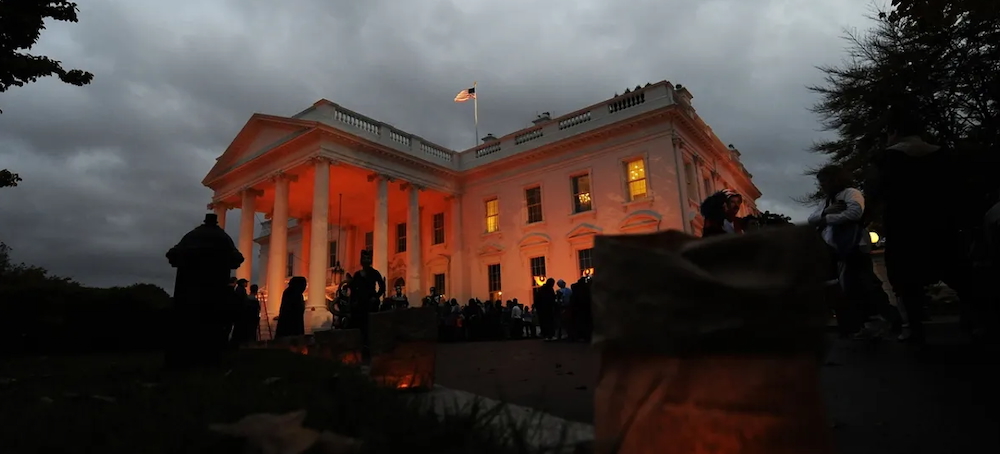 The White House at night. (photo: Jewel Samad/AFP/Getty Images)
ALSO SEE: Adam Kinzinger (Substack)
As president, Trump has been able to turn the publicity dial up to eleven, using press conferences, speeches (such as they are), media interviews and nonstop social media posts to keep the name in our faces. Meanwhile his clan is out there exploiting the brand for all its worth.
The most recent family member to exploit the man, and therefore the presidency, is his granddaughter, Kai Trump. She’s an 18-year-old high schooler whose Wikipedia page notes her profession as “social media influencer.” Indeed, she’s got 6.8 million followers on various platforms, where she posts about her family, politics, golf (she is a champion player), and her encounters with celebrities. Most recently, she has begun hawking $130 sweatshirts with her initial -- KT -- emblazoned on the front. It’s expected to be just the first item in an entire clothing line.
Kai’s big social media sales pitch was filmed and recorded at the White House. (No conflict of interest there!) and she wore one of the shirts while accompanying her grandfather to the recent Ryder Cup golf tournament. With the Secret Service and other security officials clearing the way, the two strolled the course with press photographers snapping away.
As the daughter of Donald Trump Jr. and his first wife Vanessa, who is now dating Tiger Woods, young Kai is coming early to a party her father has attended for many years. Most recently, he and a partner opened a private club called Executive Branch at 1070 Wisconsin Avenue in Washington, which is less than a mile and a half from the White House. It boasts a $500,000 initiation fee for “founding” members.
Though it’s located in the basement of a less-than-posh shopping mall dominated by TJ Maxx and a Department of Motor Vehicles service center, the club does have a private entrance, making it possible for members to come and go without being observed.
“It’s a place for members to come and enjoy the best food and finest wine that DC has to offer in a private and relaxing environment,” explains Omeer Malik, a venture capitalist who is one of the partners in the club. It’s also a place where the superrich (who else can afford it?) will socialize together and almost certainly host Trump administration officials.
During the first Trump administration, the family profited in less splashy ways as foreign governments and others paid top dollar to stay at the Trump International Hotel in D.C., and the Secret Service was forced to rent rooms at Trump resorts during the President’s many visits. With the president standing to benefit directly, these deals and others raised immediate ethical concerns. This time around, the money-grubbing is more open and brazen.
Three days before the 2025 inauguration, Trump companies launched a form of cryptocurrency called a “meme coin,” which jumped to just over $75 as bidders competed for the 200 million that were available. (The companies retained 800 million.) The coins are digital collector’s pieces, whose value rises and falls based on demand. In this case, the “$TRUMP” coin’s price has fluctuated significantly. At one point, the price jumped 50 percent when it was announced that the top 220 investors would get dinner with Trump and the top 25 would be rewarded with special tours of the White House. One dinner attendee said he would use the event to promote his business. Another big purchaser said he would try to talk with Trump about lowering tariffs.
Some $TRUMP investors who decided to forego the dinner/tour opportunity and sold during the special promotion made handsome profits. (A person who went by the alias “Noah” made almost $1 million on a $2.2 million investment.) However, buyers who held on to their coins saw their value tank as the price settled to around $7.50. Of course, as issuers, the Trump companies couldn’t lose. Estimates of their actual profits ranged from $93 million to almost $400 million. A second meme coin, this one named for the First Lady -- $MELANIA -- peaked at $13.69 on inauguration day and steadily declined to the point where it bounced around between five and 25 cents. Visitors to the websites devoted to both coins were notified that they were not intended to be investments or securities.
While the coins garnered a lot of publicity, other Trump family exploits generated far less attention but should produce revenue for many years to come. In May, Donald Trump Jr. went on a paid speaking tour of Central Europe, where he met with political leaders and presented an investment pitch called “Trump Business Vision 2025.” Meanwhile, his brother Eric went on a tour of new ventures, including several in countries where leaders are eager for good relations with the United States. Among them were the United Arab Emirates, Saudi Arabia, and Qatar.
The Saudis, who depend on the U.S. for defense, have long been interested in doing business with the Trumps. In the years between the first and second administrations, the country’s sovereign wealth fund pumped $2 billion into an investment firm founded by Trump’s son-in-law, Jared Kushner. Thanks largely to this money, Kushner, who got to know the Saudis when he worked in the first Trump White House, has seen his personal fortune soar past $1 billion. Most recently, his fund has become involved in the largest leveraged buyout in history: the $55 billion takeover of the video game maker Electronic Arts.
Kushner, ever the diplomat, has rarely commented on his venture with the Saudis. When he does, he stresses the work they have done backing a handful of Israeli firms. “If we can get Israelis and Muslims in the region to do business together,” he has said, “it will focus people on shared interests and shared values.” He added, “We kicked off historic regional change, which needs to be reinforced and nurtured to achieve its potential.
In contrast, the Trump brothers have grown testy when asked about their activities. In typical fashion, Donald Trump Jr. pointed to President Joe Biden’s son Hunter, who appears to have suggested he could provide access to his father back when he was vice president. Others have pointed out that President Jimmy Carter’s brother Billy traded on the family name to sell a brand called “Billy Beer,” and the first President Bush’s son Neil may have used the family name as he developed an energy business.
Billy Carter’s beer biz was a short-lived embarrassment to his elder brother. And it generated peanuts compared with the Trump business. Likewise, Neil Bush was never accused of suggesting he could get any special favors done for his business associates. The issue heated up briefly during the 1992 presidential campaign and quickly dissipated because there was no “there” there.
Indeed, in the history of the presidency, no First Family has cashed in like the Trumps. As his meme coin promotion shows, Trump has involved himself directly in the cash grab and there’s no question that his personal wealth is climbing as Trump companies, old and new, do business. If it ever seems like the growth is slowing, he can always talk about his businesses at public events or on social media. He has done this more than 60 times so far this year.
The ethical questions that arise from all the Trump business deals begin with the fact that Trump’s kids enjoy direct access to him, and everyone knows it. Do you think that he doesn’t know who has plunked down $500,000 for a membership in his son’s private club in Georgetown? For that matter, do you think that anyone will pay half a million for access to a basement in Georgetown without expecting preferential treatment from the administration? If you think so, then let me tell you about the bridge for sale in Brooklyn.
The meme coins scheme is so corrupt that it’s hard to know where to begin. Let’s start, anyway, with the fact that the President of the United States essentially sold VIP tours to the White House to the top 25 meme coin buyers. In what universe would anyone think that such a blatant pitch didn’t represent a pay-to-play arrangement? Yes, I know, big-time party donors, Democrat and Republican, have been invited to sleepovers at 1600 Pennsylvania Avenue. But this is a far cry from developing a family business worth billions of dollars and then giving White House access to its customers.
You might ask if there are laws against the president’s family using the White House and the presidency to build its brand. The Constitution does prohibit the commander-in-chief from accepting “emoluments” (money or substantial gifts) from foreign sources. Also, federal laws against bribery and ethics rules forbid accepting payments for official acts. However, both the emoluments clause and the bribery laws are virtually unenforceable. What about ethics rules? Well, here the president is a special case. The office is basically exempt from these rules.
With the formal rules providing no real guardrails, the system has always left openings for Presidents (and family members) who would monetize the office. Prior to now, we have depended on and assumed that they would constrain themselves as a matter of integrity. President Carter, the peanut farmer, didn’t put out a new brand of peanut butter called “Jimmy’s.” Instead, he sold the farm. Other presidents have acted in the same way, selling assets and using blind trusts to avoid even the appearance of a conflict of interest.
Though Trump claims to have stepped away from the family business, he continues to play the role of salesman, talking up the brand. In the meantime, his sons leverage the name in every conceivable way. The most peculiar may be a Trump cellphone service, which will offer a special gold-colored phone for $499.
Not to be outdone, Melania Trump has cashed in by making a $40 million deal with Amazon’s streaming service, which is making a documentary about her life. If you wonder why Amazon would send her such a big check, consider that the company’s web services division has federal contracts worth more than $10 billion, AND that as a behemoth in consumer sales, Amazon is always engaged with federal regulators. If the $40 million greases the wheels, it will be a bargain
In the spirit of Christmas, Melania is also selling patriotic Christmas tree ornaments. At $75 to $90 a pop, these baubles will include, among others, replicas of Mount Rushmore, the American flag, and the Statue of Liberty. In choosing that last one, Melania honors the symbol of America’s tradition of welcoming immigrants. Do you see the irony there?
I have no doubt that the First Lady will make millions as she uses her position to dash for cash. Like the others in her family, from young Kai to high-flying Jared, Melania is telling us that she doesn’t care about appearances. The money is there. She’s going to grab it. Integrity is for chumps.