The Revolutionary Guards Are Taking Over Iran
The Economist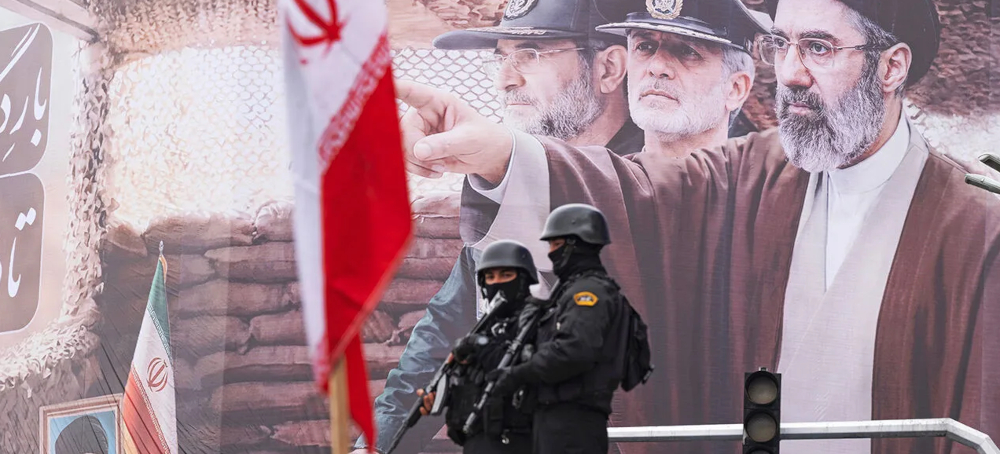 IRGC soldiers in Tehran. (photo: Getty)
They now appear to run both the state and the war
The supposed supreme leader, Mojtaba Khamenei, has not been seen or heard since his predecessor and father was killed at the outset of the war on February 28th. Senior advisers and commanders, including Ali Larijani, the secretary of the National Security Council, have also been killed. Their place has been taken by an opaque, decentralised web of institutions designed to insulate the regime from decapitation strikes. At its core is the Islamic Revolutionary Guard Corps (IRGC), the Islamic Republic’s 190,000-strong paramilitary force that now appears to run both the state and the war. “This war for the IRGC is a blessing,” says an Iranian in exile with high-level regime contacts. “It has sealed their place at the helm.”
People close to the regime describe a system that has shifted from theocracy to something resembling a military junta, akin to Algeria, Egypt or Pakistan. “We’ve gone from divine power to hard power,” says one. Under the constitution, Iran’s supreme leader should be a senior cleric. But Mr Khamenei’s elevation owed less to religious credentials than to the IRGC’s desire for continuity. Clerics were strong-armed to endorse him. Yet he remains conspicuously absent—officially for his safety. Rumours abound that the supreme leader is in a coma, in a Moscow hospital or dead. “It’s not clear he’s capable of significant decisions,” says Raz Zimmt, an Israeli analyst. If he resurfaces, it will probably be as a figurehead. “It’s now the military that pulls the strings,” says Mohamed Amersi, a British businessman with regime contacts.
In practice, authority has passed to the IRGC. The National Security Council, dominated by military figures, sets overall strategy. On March 24th it replaced Larijani, a former philosophy professor, with Muhammad Zulghadr, an IRGC apparatchik. Other members include Muhammad Bagher Qalibaf, the powerful parliamentary speaker who rose through the ranks of the Guards, and a slew of IRGC generals. A revived defence council functions as a war room, selecting targets and directing strikes. Its members are anonymous, but are thought to be former or serving IRGC generals hiding in bunkers. Operational control rests with Khatam al-Anbiya, the IRGC’s battlefield headquarters. Iran-watchers believe the corps retains firm control over Iran’s most advanced and longest-range missiles.
For would-be American negotiators, this presents a problem. For all its command-and-control, the IRGC is not monolithic. Some leaders, such as Hossein Alaei, a retired general who once likened the late Khamenei’s despotism to that of the shah, are openly reformist. Mr Qalibaf heads a group of pragmatists, swinging between radicalism and moderation as the moment demands. Both these camps might be open to talks. Yet there are plenty of hardliners who are deeply hostile to compromise. Their leader is Saeed Jalili, another former Guardsman who won 13.5m votes at the last presidential election. It is uncertain whether all factions would obey an order to end hostilities with America, or stick to an agreement to halt nuclear development.
Iran-watchers also question the extent of the central command’s authority across the country. One reason for the IRGC’s resilience, despite heavy bombardment, appears to have been decentralisation. To guard against a repeat of the mass assassinations in last summer’s war, former IRGC members say the corps was divided into 31 sub-districts. Each received its own weapons stockpile (including missiles and drones) and target banks, along with the autonomy to use them, should communications or central command fail.
The Basij, the IRGC’s internal security affiliate, has likewise been broken into tens of thousands of small, mobile cells. After Israel began pummelling their bases, they fanned out across mosques, schools or encampments under bridges. That is bad news for America and Israel, because decentralised IRGC cells could go rogue and form the nucleus of a guerrilla force that could keep fighting and continue to block the Strait of Hormuz indefinitely.
By contrast, external threats to the IRGC seem less immediate than a few weeks ago. Early in the war, Kurdish opposition groups in Iraq threatened to march across the border and spark ethnic uprisings in Iranian Kurdistan and other provinces with ethnic minorities, including Azeris, Arabs and Baluchis. But IRGC reinforcements and a wave of drone and missile attacks have forced them to reconsider for the time being.
Anticipation of a popular uprising has faded, too. Some Iranians in the cities cheered the death of Khamenei and celebrated on their balconies as Israel whacked regime bases. But the bombing of civilian targets has dulled their enthusiasm, as has the IRGC’s perceived success at resistance. An emboldened IRGC now brands critics enemy collaborators and threatens to confiscate their property. “We used to talk about the end of the regime when the war stopped,” says a teacher in Mashhad, a city in north-eastern Iran. “Now we fear what to do with a regime that is stronger and more powerful than ever.”