The National Security Trial of Hong Kong Media Tycoon Jimmy Lai
Adolfo Arranz, Han Huang, Jessie Pang and James Pomfret Reuters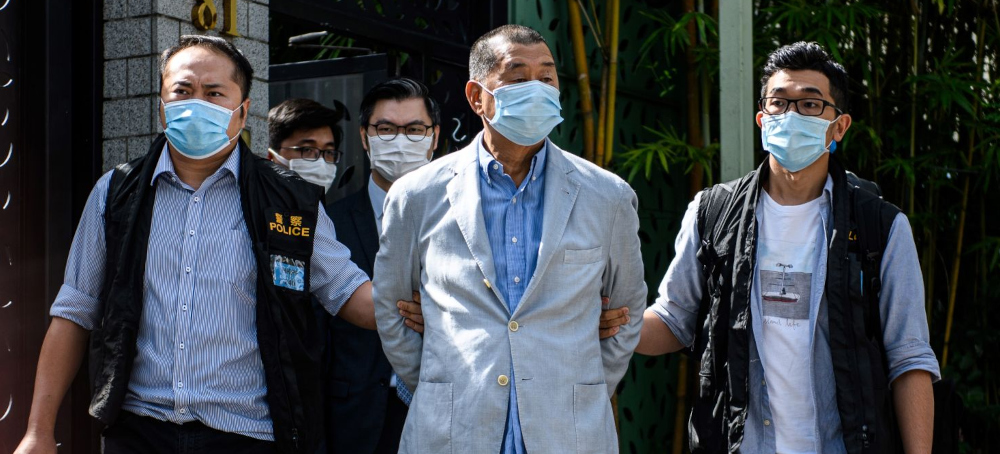 Police lead Hong kong pro-democracy media mogul Jimmy Lai away from his home after he was arrested under the new national security law in Hong kong on August 10, 2020. (photo: Vernon Yuen/AFP)
ALSO SEE: Claire Lai | My Dad Is Shrinking to Nothing. If China Fails to Act, He’ll Be a Martyr.
U.S. President Donald Trump raised Lai’s plight in an October meeting with Chinese leader Xi Jinping, and has said he would do everything in his power to “save” the businessman.
Hong Kong prosecutors allege that Lai and individuals including former Apple Daily staff, overseas politicians and activists, worked together to “commit collusion with a foreign country or with external elements” to endanger China’s national security, including calling for “sanctions, blockades or other hostile activity” (SBHA).
Meetings with foreign officials have long been commonplace in the global financial hub. But under a national security law imposed by China on Hong Kong in 2020, any person who requests a foreign entity, including countries or organisations, to impose sanctions is guilty of an offence.
The prosecution alleged that “all these foreign connections and foreign collaborations show (Lai’s) unwavering intent to solicit SBHA from foreign countries,” adding that “these collaborations are long-term and persistent”.
The 78-year-old, who faces a possible life sentence, has diabetes and suffers from heart palpitations. He has spent more than 1,800 days in solitary confinement.
Lai founded the now-shuttered pro-democracy newspaper Apple Daily, and is the most high-profile figure to face prosecution under the national security law. The law was implemented in response to mass pro-democracy protests the year before.
What is the case about?
Prosecutors accused Lai of using Apple Daily to conspire with three subsidiaries, six former executives, and others to publish seditious materials between April 2019 and June 2021; and to collude with foreign forces between July 2020 and June 2021.
Some 161 articles published in Apple Daily were deemed seditious under Hong Kong’s colonial-era sedition law, including 33 opinion columns written by Lai.
Prosecutors also accused Lai of conspiring with his longtime personal assistant Mark Simon, paralegal Chan Tsz-wah, activist Andy Li, exiled activist Finn Lau, and others to commit collusion with foreign forces between July 2020 and February 2021.
Lai was deemed to be the “mastermind and financial supporter” of an advocacy group, “Stand With Hong Kong, Fight For Freedom” (SWHK), which prosecutors said lobbied countries for sanctions on China and Hong Kong. He is also alleged to have encouraged them to continue their lobbying efforts after the national security law came into force.
Jimmy Lai and other defendants
Apart from Lai, all other defendants have pleaded guilty. Five of them have become prosecution witnesses.
Since August 2020, the U.S. has sanctioned dozens of Hong Kong and Chinese officials including the city leader and police chief for cracking down on freedoms under the security law.
Simon was alleged to have carried out Lai’s instructions and vetted requests for financial support. Chan was alleged to be a middleman who received instructions from Lai or through Simon, and then delivered those instructions to Li and Lau, whom the prosecution alleged to be core members of SWHK.
However, Li, a key prosecution witness, said he had never met or contacted Lai, nor received money from him.
In his testimony, Lai said all the allegations were “totally rubbish”.
Lai told the court the Apple Daily’s editorial policy reflected the core values of Hong Kongers who cherished greater freedom and democracy. He denied asking former Apple Daily editor Chan Pui-man to compile a “shitlist” of officials who should be sanctioned.
Lai said he never called for sanctions after the national security law took effect, as “it would be suicidal to do so”.
The national security law cannot be applied retroactively.
Defence lawyer Robert Pang said the articles did not amount to sedition as they pointed out government mistakes and fell under legal exemptions of sedition offences.
Another defence lawyer, Marc Corlett, said there was no evidence that Lai directed or agreed with any of his alleged co-conspirators to take actions against Hong Kong and China after the security law took effect.
What are Lai’s alleged foreign links?
The prosecution listed Lai’s connections with activists and politicians in the U.S., Britain, Taiwan, Japan, and Israel, accusing Lai of meeting them face-to-face, contacting them via email, WhatsApp and Signal, or chatting with them online.
He is alleged to have sought to solicit, either directly or indirectly, foreign sanctions against Hong Kong and China.
Lai did confirm in court that he had met Mike Pence, then U.S. Vice President, and former Secretary of State Mike Pompeo in July 2019, but only to ask them “to voice out support for Hong Kong”.
Lai also said he had connected three former U.S. officials, with then Taiwan President Tsai Ing-wen, and an intermediary. He said, however, he was not acting as a middleman nor seeking to endanger China’s national security.
Lai told the court he did not call for the U.S. to engage in acts against China. “It’s not hostile activities. I was concerned about Hong Kong’s freedom and human rights,” he said.
The prosecutors also named Luke de Pulford, the British founder of the Inter-Parliamentary Alliance on China (IPAC), a group critical of Beijing; Japanese politician Shiori Kanno and U.S. financier Bill Browder as co-conspirators. Prosecutors said these co-conspirators contacted officials in the U.S., Britain, Japan, Australia, New Zealand, Ireland, the Czech Republic and Portugal, urging them to impose SBHA.
Several overseas activists, rights campaigners, and politicians named in the trial have rejected the prosecution’s claims.