The Supreme Court of Chief Justice
Roger B. Taney, (1836-1864) is generally considered if not the worst
certainly the most problematic for American democracy in United States
history. Taney etched his name in American judicial history with the now
unfathomable ruling in the Dred Scott v. Sanford case and the quote which
haunts the Judicial Branch to this day. Speaking of Dred Scott and African
Americans in general Taney said that, [African Americans] had
"No Rights Which the White Man was Bound to Respect."
The Taney court's tenure culminated with the election of ardent
abolitionist Abraham Lincoln and shortly thereafter all-out civil war. Would
it be fair to say the court of John Roberts is dangerous as Taney's?
The jury is still out, but the intent is clearly there.
The Roberts Court like the Taney Court seems willing to take any risk to
protect even promote the interests those who appear to long for a return to
pre Civil War America. These are not just conservative rulings on cases
taken up by the Roberts Court based on their merit but rulings carefully
selected and delivered like torpedoes to the hull of American Democracy.
These people have an agenda and they are executing that game plan
meticulously. This isn't an activist court or even a radical court,
this is a seditionist, an anarchist court and more specifically a monarchist
court.
The members of the Roberts court are daring anyone to challenge their
authority as they deliberately pave/show the way the for Donald Trump's fascist revolution to gather steam.
Is there still legal recourse? There is an old axiom in martial arts and
self defense, your opponent is most vulnerable when they attack. To achieve
what the members of the Roberts court are trying to accomplish they
necessarily have to take risks, legal risks but risks nonetheless. The
Trump v. CASA (birthright citizenship) ruling while celebrated in the
Trump camp also opens up the door unbridled red-state legal and legislative
adventurism.
The sword they cut with will necessarily be double edged. They will not be
able to kill what hate without killing what they love. The assault on
birthright citizenship, now joined by the Roberts court is a perfect
example. Trump v. CASA if taken to its logical conclusion would
infer that only Native Americans would qualify for citizenship. Which is on
it's face laughable because Native Americans were denied U.S.
citizenship until the Indian Citizenship Act of 1924 was passed. Trump
v. CASA is more likely to create a tsunami of litigation than mass
purging of illegal aliens.
A serious discussion on court reform must begin now and it's not
likely that will happen in congress. It has to be a civil and academic
discourse in its early stages in preparation for an opportunity to implement
a legislative solution. Ideas that have been floated include, term limits
and court expansion. Another idea would be to move away from political
appointments and use a system of rotating judges at random from the appeals
courts to the Supreme Court for a fixed term. In any case waiting for
control of Congress and the White House to occur before crafting a plan
would significantly diminish the chances for success. The time for planning
is now.
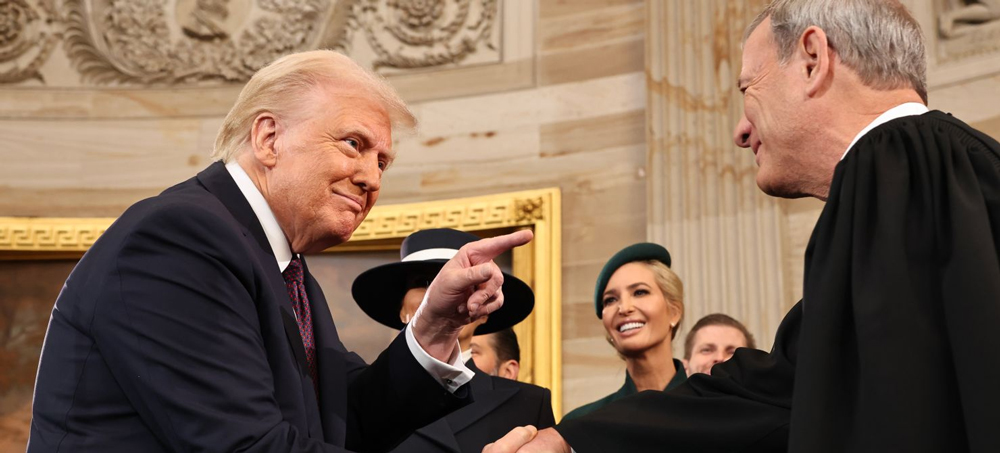 20 January 2025: Donald Trump and John Roberts greet one another in the Rotunda of the Capitol immediately following Trump's second inauguration. (photo: CNN)