The Moment the World Realized Iran Is a Global Power
Prof Robert Pape Substack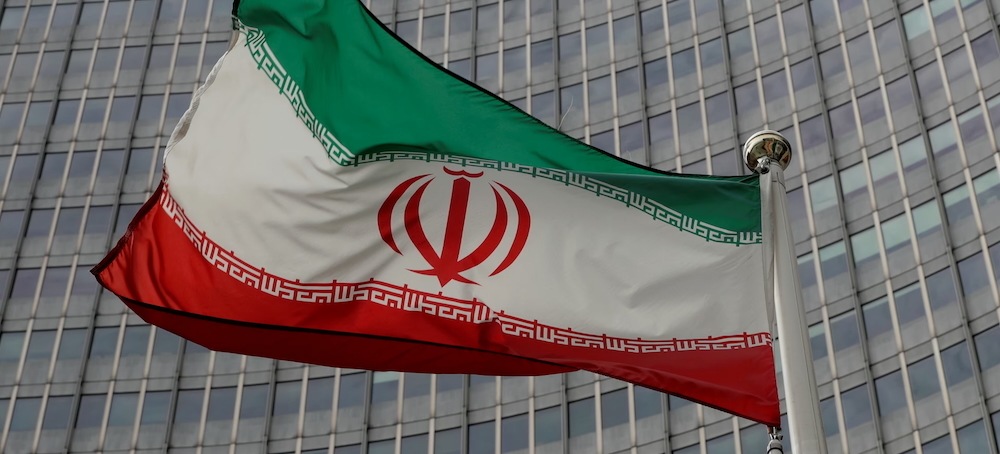 "Iran now possesses a form of strong leverage that cannot be eliminated at acceptable cost." (photo: Leonhard Foeger/Reuters)
ALSO SEE: Escalation Trap, Prof Robert Pape on Substack
For nearly an hour, the discussion did not revolve around whether Iran had been weakened. It revolved around something else entirely: control of the Strait of Hormuz, the inevitability of negotiations, and what a negotiated outcome would look like in a world where Iran cannot be ignored.
That is not a tactical shift. It is a conceptual one.
The world is beginning to treat Iran not as a problem to be solved, but as a power to be reckoned with.
That distinction marks the emergence of something rare in international politics: a new center of world power.
Two weeks ago, in an op-ed in The New York Times, I argued that Iran was not collapsing under pressure, but instead moving toward a new form of durable power rooted in its ability to influence the global economy through the Strait of Hormuz. At the time, that claim ran against the dominant narrative.
Events over the past two weeks have moved sharply in the opposite direction.
What was controversial is now becoming conventional.
This essay builds on that argument—and shows why the implications are even larger than initially understood.
Today, only three states exert sustained influence across multiple regions of the international system: the United States, China, and Russia. Each possesses the ability to shape outcomes far beyond its immediate neighborhood—militarily, economically, and politically.
Iran is not yet fully in that category. But it is moving toward it with surprising speed.
And the direction is becoming difficult to deny.
I. The Recognition Moment
Three ideas now dominate elite discussion:
--Hormuz traffic will continue only with Iran’s acquiescence.
--Negotiations with Iran are not optional.
--Any negotiated outcome will leave Iran with enduring power.
Taken together, these are not policy preferences. They are acknowledgments of the structure of power.
They imply that Iran now possesses a form of strong leverage that cannot be eliminated at acceptable cost.
In classical terms, power is the ability to use resources to influence the behavior of others.
What has changed is not simply Iran’s behavior. It is the nature of the resource it can now wield—and the scale at which it can apply it.
II. The Resource: Control Over a System-Level Chokepoint
Roughly one-fifth of the world’s oil passes through the Strait of Hormuz—about 20 million barrels per day, representing roughly 25 percent of global seaborne oil trade.
That figure alone understates the magnitude of the leverage.
The majority of this flow—approximately 80 to 85 percent—moves toward Asian markets. China alone imports roughly 5.4 million barrels per day through the Strait, while India takes in over 2 million barrels per day, making both deeply exposed to any disruption.
Countries such as Japan and South Korea are even more structurally dependent: Japan sources roughly 95 percent of its crude oil from the Middle East, while South Korea relies on the region for around 70 percent of its imports.
At the same time, the vulnerability extends beyond importers.
The economies of key Gulf exporters are structurally tied to uninterrupted oil flows. Saudi Arabia alone accounts for roughly 37 percent of all crude moving through Hormuz, with Iraq contributing about 23 percent and the United Arab Emirates nearly 13 percent.
Together, just five countries—Saudi Arabia, Iraq, the UAE, Iran, and Kuwait—account for over 90 percent of all oil transiting the Strait, creating an extraordinary concentration of global supply in a single corridor.
This creates a dual dependency:
— Importers depend on access to energy.
— Exporters depend on access to markets.
The Strait of Hormuz sits at the intersection of both.
Control over such a chokepoint is not simply regional leverage. It is system-level power.
III. The Mechanism: Technology Meets Geography
Geography has always mattered in the Persian Gulf. At its narrowest point, the Strait is only 29 nautical miles wide, with shipping lanes just two miles across in each direction, compressing global energy flows into a highly constrained space.
What is new is the technological layer Iran has built on top of that geography.
Over the past decade, Iran has developed a dense network of capabilities: anti-ship missiles, naval mines, drones, fast-attack craft, and distributed surveillance systems. Individually, none of these systems would be decisive against a superior naval power such as the United States Navy.
Together, they form something different: a “denial” architecture (the concept of “denial” is developed extensively in my book, Bombing to Win).
This architecture does not need to permanently close the Strait. It only needs to introduce persistent, selective risk—enough to disrupt traffic, spike insurance costs, and force global actors to recalculate. Even short disruptions have already caused shipping suspensions and forced countries to draw on emergency reserves and seek alternative supply routes.
The result is a form of control that is not absolute, but is nevertheless effective.
Even the most capable air and naval forces cannot guarantee uninterrupted passage without escalating to a broader and far more costly conflict.
That is the innovation.
Iran has combined modest technologies with advantageous geography to create a lever over a critical artery of the global economy.
IV. Power in Action
The effects are already visible across multiple regions.
In Asia, major energy importers are acting with caution. South Korea, for instance, has scrambled to secure hundreds of millions of barrels of alternative supply and build reserves covering several months of consumption—an extraordinary peacetime adjustment driven by Hormuz risk alone.
States such as Japan and Australia are not aligning their policies around confrontation, but around stability. The priority is continued access to energy flows, not strategic signaling.
In Eurasia, Iran’s position is attracting deeper engagement from Russia and China, both of which see value in a partner that can complicate U.S. power projection and reshape global energy dynamics.
In the Middle East and Indian Ocean, regional actors are adjusting. India, Iraq, and Oman are recalibrating their positions. Qatar and others are hedging toward neutrality.
This is what influence looks like when it begins to scale.
It is not expressed through declarations. It is revealed through alignment.
V. The Fateful Choice
This trajectory creates a structural dilemma.
Iran is unlikely to relinquish this source of power. No state voluntarily abandons a position that yields systemic influence.
The United States is unlikely to accept it. Iran’s gain translates directly into diminished U.S. freedom of action in a region long central to its strategy.
That leaves two broad paths.
The first is accommodation: accepting Iran’s emergence as a fourth center of world power. Under this path, Iran would consolidate its position atop a chokepoint that carries roughly one-quarter of global seaborne oil and nearly one-fifth of global LNG trade, converting geographic leverage into sustained economic and political power.
The second is escalation: attempting to wrest control of the Strait through sustained military operations. Given that only 3.5 to 5.5 million barrels per day can be rerouted through alternative pipelines—far short of total flows—any serious attempt to neutralize Iran’s leverage would require not just maritime operations, but physical control over the territory from which that leverage is exercised.
That is not a limited intervention. It is the opening phase of a much larger war.
This is the core of the Escalation Trap.
A new form of power has emerged. It cannot be easily neutralized. It cannot be easily accepted.
And as recognition spreads—as it did, quietly but unmistakably, this morning—the pressure to resolve that contradiction will only grow.
The world is adjusting to Iran’s rise faster than policymakers are prepared to respond.
That gap is where the next phase of this conflict will unfold.
If this analysis is correct, the next 30 days will follow a predictable escalation pattern—one that will determine whether the United States accepts Iran’s rise or is pulled into a far larger war. I’ll be tracking those indicators in real time.