The Legal Consequences of Pete Hegseth’s “Kill Them All” Order
Isaac Chotiner The New Yorker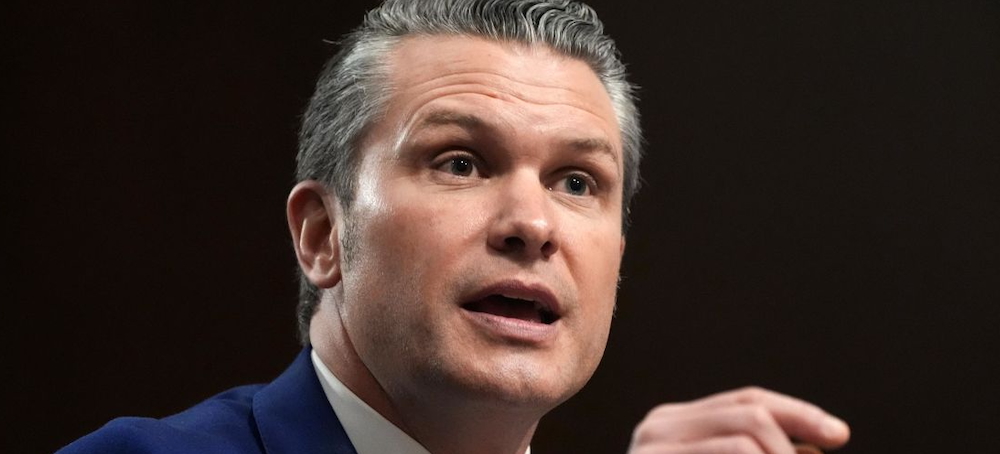 Defense Secretary Pete Hegseth. (photo: Jacquelyn Martin/AP)
A former military judge on the Trump Administration’s contradictory—and likely unlawful—justifications for its Caribbean bombing campaign.
To talk about the Trump Administration’s strikes, I called Todd Huntley, the director of the National Security Law program at Georgetown University Law Center. Huntley previously served as a judge advocate in the Navy for more than two decades. During our conversation, which has been edited for length and clarity, we discussed the apparent illegality of what has been reported about this attack, the similarities and differences between this strike and the worst parts of America’s drone wars, and, more broadly, what the Trump Administration wants to do to the culture of the U.S. military.
If the Washington Post’s reporting is accurate, why exactly was this strike illegal?
Basically, this is the one strike that we know about where even if you accept the Administration’s position that the United States is in an armed conflict with these drug cartels, this would still be unlawful under the laws of armed conflict, because the individuals were out of the fight and shipwrecked, and thus owed protection.
So it is essentially the same as if you storm the beaches at Normandy and a German puts his hands up and you shoot him anyway?
It’s kind of the same, but it is the law of the sea, and the law of naval warfare has developed separately from the law of land warfare and the law of armed conflict. And long-standing tradition around the law of the sea has come to take on a legal status. But in general it is the same.
When you say it would potentially be a violation of the law, are we talking about international law? Are we talking about domestic law?
It’s a violation of customary international law. And, again, this is accepting the Administration’s position that we are in armed conflict with drug cartels. [In October, the Administration notified Congress that it was in a so-called non-international armed conflict, which refers to a conflict with non-state actors.] So it’s a violation of customary international law and the law of armed conflict. Those provisions have also been incorporated into American domestic law. And so under domestic law it would be murder and it would constitute a war crime.
You’re saying that all of these things would be true even if we take as a given the Administration’s position that we are in an armed military conflict with drug cartels, correct?
Right.
What has the Administration been saying about this so-called conflict? I sense from your tone of voice that you don’t find their arguments particularly compelling, but what is the Administration claiming, and why do you think what they’re claiming is problematic?
Their claims have contradicted each other. Initially, the claim was that the United States was using force against these boats and members of the drug cartels as an act of self-defense, and they equated the importation of drugs to an armed attack against the United States. Then, in one of the notices to Congress, they claim that we are in a non-international armed conflict with the drug cartels. The factors that determine whether you’re in such a conflict with a non-state group are: You look at the level of organization of the group—it has to reach a certain level of organization, and have some sort of command-and-control structure, be able to resupply itself, be able to plan and carry out operations, those types of things. And then the violence has to reach a certain level of intensity, because if it doesn’t meet those factors, what you have is basically just unlawful violent action, which is a law-enforcement matter. And so the advantage, if you will, of triggering a non-international armed conflict is that you can use force against members of that group as a matter of first resort. It’s not like law enforcement, where you have to use the minimal amount of force. If you’ve identified a member of the group, you can kill him no matter where he is, and no matter what he’s doing.
So that would be the legal basis under international law. The domestic legal basis comes from a line of several Office of Legal Counsel (O.L.C.) opinions. These O.L.C. opinions have stated that the President, as the Commander-in-Chief under Article II, has authority to use military force if it is in the U.S. national interest, and if it’s for a limited duration, scope, and intensity. The idea is that when the President has to respond to an attack on the United States, you shouldn’t require him to get congressional authorization before he does. But here, if they say we’re in a non-international armed conflict, an ongoing armed conflict, that contradicts the fact that this is of limited scope and duration. The domestic legal basis seems to conflict with the international legal basis.
Aside from the fact that those two bases conflict, what do you make of them separately as arguments?
Could we be in a non-international armed conflict with drug cartels? Yes, I think theoretically we could be, or the facts could support that. But I just don’t see the facts here. The level of violence, at least as directed against the United States, isn’t so great unless you’re going to count the effects of the drugs and the drug use itself. That is what the Administration is doing, but I think it is too indirect to be legitimate. The groups certainly are not organized at the level that we saw with Al Qaeda, for instance, and the Administration seems to lump all these drug cartels in together, when they’re really, in fact, rivals. They are not acting in concert. So I just don’t think that the Administration has shown the facts that support their legal analysis.
What they have done is they’ve said all the magic words. They have laid out the correct legal framework, but they just haven’t brought forth the facts that support it. I guess if you believe that the President just has the discretion to do this, that basically nobody can question the President’s assessment of the facts—that is kind of problematic.
If you consider some of the U.S.’s worst acts in the war on terror, such as the bombing of a wedding party in Yemen, in 2013, or the strike on a Doctors Without Borders Hospital in the Afghan city of Kunduz, in 2015, what makes this different? Is it in fact different?
I think it’s the intentional nature of it. In most of those other situations where U.S. attacks have killed civilians, the deaths were due to either faulty intelligence, a faulty assessment of the facts, or an accident. This one seems to have been very clearly intentional. I think that is one thing that makes it much different, and on some level worse, because if you’re looking at the use of force in an armed conflict and you have violations, not everything rises to the level of a war crime. This is a war crime.
My understanding of international law is that you can be relying on faulty intelligence, but if faulty intelligence happens enough times, at a certain point, if you are not taking proper precautions that could be a war crime.
You are right. If it happens enough where basically it can be imputed to the commander that he or she is not exercising the level of command that is required to control the forces, then, yes, that could rise to the level of a war crime.
During the war on terror, either in the fight against Al Qaeda or the fight against ISIS, civilian deaths were much, much higher than they are in this Caribbean campaign so far. But you don’t feel that those campaigns involved the same level of intent, or a lack of precautions to make sure the intelligence was correct?
As you said, there were many more civilian deaths and injuries during Afghanistan and Iraq, but legally speaking, if you’re looking at intent and culpability, this is worse. The Administration intentionally targeted people who they knew or should have known had a protected status at the time they were attacked.
This would probably be akin to some events we’ve read about in which U.S. soldiers killed Afghans or Iraqis. Trump has even pardoned some of those perpetrators.
That’s exactly right. We certainly had instances where we had soldiers commit similar violations. And, again, what makes this different is it seems to have come from a direct order from the Secretary of Defense and the Joint Special Operations Commander, Admiral Frank (Mitch) Bradley.
I think there’s viscerally something quite obviously different about this, despite some of the horrible things that happened in the War on Terror. But when you read about some of the war-on-terror incidents, like the wedding party that was bombed in Yemen, it does seem that they were not really properly investigated. The least that any democratic country that cares about not committing war crimes should do is investigate potential violations to the best of their abilities.
I don’t disagree with you that there were certainly times when investigations sometimes didn’t happen, and others when they did but weren’t really serious investigations. I was involved in several civilian-casualty investigations myself, and we were hampered at times due to the inability to gain access to the area. A lot of these casualties are from drone strikes, and we don’t have U.S. forces in the area. Some of them probably were done without sufficient care. Others I think were taken seriously and were done at a fairly complex level.
Let’s say that you’re right about the boat strike and that this is murder. What should happen next?
Well, it needs to be investigated by Congress. And, again, depending on what the investigation uncovers, there should be prosecutions if there is sufficient evidence to indicate that this was, in fact, a violation.
What would an investigation look like, in an ideal world?
The military would probably get assistance from the F.B.I. due to the level and the seriousness of the inquiry that would have to take place. Plus, I would think that you would want somebody from outside of the Department of Defense involved in the investigation. And if Hegseth is involved, and if, in fact, he gave the order and there’s evidence that he did it intentionally, he can’t be tried by a court martial: because he’s a civilian, he is not subject to the Uniform Code of Military Justice. It would have to go to a U.S. Attorney’s office, probably in the Eastern District of Virginia. Admiral Bradley, on the other hand, is certainly subject to the U.C.M.J. It might be difficult to prosecute him in a court martial just because you would have to find enough officers who are senior to him, and he’s a four-star, but you could do it. In a court martial, officers serve as the jury and have to be senior in rank to the defendant. But my guess is that, if an Administration wanted to look into this—and it won’t happen until there’s a new one—they would decide to do this through the D.O.J. and the U.S. Attorney’s office. Bradley could be prosecuted that way.
Broadly speaking, do you feel that the message that was sent to the military in the pre-Trump era was essentially that people who did illegal things would be punished to the full extent of the law? Or did you feel that it was something between that and the “anything goes” we see in the Trump Administration? I want to acknowledge that I think something has changed without saying that things were ideal in the first place.
I think you’re spot-on. As far as I can remember, and in terms of what I’ve read about, we have always been hesitant to hold our soldiers accountable for crimes that happened during a conflict. I think back to Lieutenant William Calley in My Lai. Even though he ended up being convicted, it took a lot to get there. [Calley was convicted by court martial on twenty-two counts of murder, but ended up serving just three years of house arrest.] And then President Nixon commuted his sentence. And so I think that, as a society, we have had the view: Who are we to judge? We send these people into a very difficult situation. We can’t place ourselves in their shoes, and therefore maybe we should give them a break. But I think you’re right that things have basically gone way beyond that. I mean, who’s advising Hegseth right now? One of his special advisers is Tim Parlatore, who is Eddie Gallagher’s defense counsel. Eddie Gallagher was the Navy SEAL whom his own team members turned in when they returned from a deployment to Iraq; they accused him of shooting civilians. And, in the end, he went to court martial for allegedly stabbing a teen-age wounded ISIS member in the neck and killing him, and then taking pictures.
And we should say Parlatore wasn’t the defense counsel because he was assigned to this. He chose this case.
Right. Because he was not a military attorney. He had served in the military as a surface-warfare officer, had left the service, went to law school, had a very successful criminal-defense practice. And when Secretary Hegseth came into office, he gave Parlatore a commission as a commander, even though he had never been a JAG, and made him a special adviser.
There’s also the broader question of how we know that these boats are smuggling drugs—we’re just taking the Administration’s word for that. I guess that’s always the case to some degree when the government is waging war. But I’ve just been struck by the lack of public accounting for that.
Yeah. I don’t understand it. In any other time, you would have Congress demanding to be shown some of the evidence or the intel, and I don’t understand why they haven’t been more forceful in that. And, of course, the Administration’s line is going to be “Well, this is all based on classified information. We can’t share it, we can’t disclose it.” But when the government is killing people in our name, I think they owe it at least to our representatives to make their case at some level. And, if you go back to the Cuban missile crisis, even Kennedy released classified spy photos to show why his Administration was taking the steps it was going to take.
The last time we were under as much threat as we are from these drug cartels.
Yeah, nuclear annihilation. Or drug smugglers. You didn’t ask, but one thing I’d like to add is just that I am really torn because I served with some of these people and I had a lot of respect for them. I’m talking about in the Pentagon, but I also served in Afghanistan with Mitch Bradley, who’s the commander in this, and I thought the world of him. And so it’s really—I don’t know. It’s hard to process for me.