The Largest Force of US Warships and Aircraft in Decades Is Heading to the Middle East
Konstantin Toropin and Ben Finley Associated Press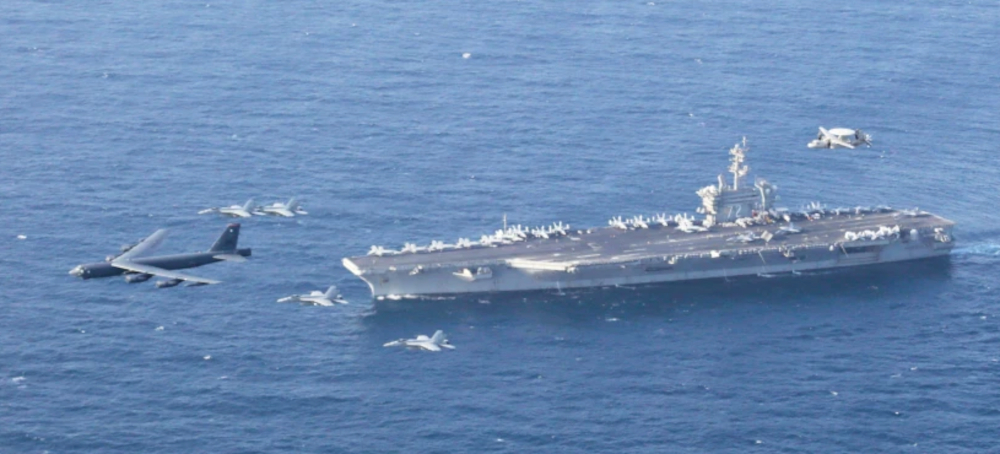 The USS Abraham Lincoln carrier and a U.S. Air Force B-52H Stratofortress, conduct joint exercises in the U.S. Central Command area of responsibility in Arabian Sea June 1, 2019. (photo: US Navy)
ALSO SEE: Trump Warns Iran of 'Bad Things' if No Deal Made, Sets Deadline of 10-15 Days
“It’s proven to be, over the years, not easy to make a meaningful deal with Iran, and we have to make a meaningful deal,” Trump said Thursday. “Otherwise bad things happen.”
Trump likely will have a host of military options, which could include surgical attacks on Iran’s air defenses or strikes focused on Supreme Leader Ayatollah Ali Khamenei, experts say. But they warn that Iran could retaliate in ways it hadn’t following attacks last year by the U.S. or Israel, potentially risking American lives and sparking a regional war.
“It will be very hard for the Trump administration to do a one-and-done kind of attack in Iran this time around,” said Ali Vaez, an Iran expert at the International Crisis Group. “Because the Iranians would respond in a way that would make all-out conflict inevitable.”
Trump has repeatedly threatened to use force to compel Iran to agree to constrain its nuclear program and earlier over Tehran’s bloody crackdown on nationwide protests.
Trump also said last week that a change in power in Iran “would be the best thing that could happen.”
Aircraft carriers bolster US presence in the Middle East
The aircraft carrier USS Abraham Lincoln and three guided-missile destroyers have been in the Arabian Sea since the end of January after being redirected from the South China Sea.
The strike group, which brought roughly 5,700 additional service members to the region, bolstered the smaller force of a few destroyers and three littoral combat ships that were already in the region.
Two weeks later, Trump ordered the world’s largest aircraft carrier, the USS Gerald R. Ford, along with three destroyers and more than 5,000 more service members to head to the region.
This will bring the Navy’s presence in the region to 14 ships and it will dwarf the 11-ship fleet that was, until the Ford’s departure, stationed in the Caribbean Sea.
More aircraft have arrived
Numerous additional U.S. fighter jets and support aircraft also have touched down in the Middle East.
Dozens of fighter jets, including F-35s, F-22s, F-15s and F-16s, left bases in the U.S. and Europe and were spotted heading to the Middle East by the Military Air Tracking Alliance, a team of about 30 open-source analysts that routinely analyzes military and government flight activity.
The team says it’s also tracked more than 85 fuel tankers and over 170 cargo planes heading into the region in mid-February.
Steffan Watkins, a researcher based in Canada and a member of the MATA, said he also has tracked support aircraft, like six of the military’s early-warning E-3 aircraft, head to a base in Saudi Arabia.
Those aircraft are key for coordinating operations with a large number of aircraft.
The massive wave was preceded weeks prior by the arrival of Air Force F-15E Strike Eagles. U.S. Central Command said on social media that the fighter jet “enhances combat readiness and promotes regional security and stability.”
At the time, analysts of flight-tracking data also noticed dozens of U.S. military cargo planes heading to the region.
The activity is similar to last year when the U.S. moved in air defense hardware, like a Patriot missile system, in anticipation of an Iranian counterattack following the June bombing of three key nuclear sites.
Iran launched over a dozen missiles at Al Udeid Air Base in Qatar days after the strikes.
Expectations of retaliation
Seth Jones, a defense expert at the Center for Strategic and International Studies, said it’s important to note that the U.S. is not deploying a major ground force.
The U.S. deployed more than 500,000 troops during Operation Desert Storm in the early 1990s and roughly 250,0000 American forces in Iraq in 2003.
“So there are substantial limits to the force package,” he said of the current military assets in the region.
The U.S. military buildup is technically the region’s largest since the 2003 invasion of Iraq, even though the resources moved for the war dwarfed current assets, said Michael O’Hanlon, a defense and foreign policy analyst at the Brookings Institution.
O’Hanlon said the U.S. could simply use long-range B-2 bombers, as it had in June, if it wanted only to strike what’s left of Iran’s nuclear program. The forces in place now are clearly designed for attacking targets in Iran and defending against retaliation.
Many likely expect Iran to “just keep firing drones and cruise missiles back at Israel and American bases in regard to almost anything we might do,” O’Hanlon said. But he said Iran could go bigger and broader, especially if its leadership feels targeted.
Vaez, the Iran expert at the International Crisis Group, said Iran is unlikely to limit its response as it did after the U.S. struck its nuclear facilities in June. Iran had signaled when and how it would retaliate with the attack on the military base in Qatar, allowing American and Qatari air defense to be ready and doing little damage.
“They have now come to the conclusion that the only way that they can stop this cycle is to draw blood and to inflict significant harm on the U.S. and Israel, even if that comes at a very high price for themselves,” Vaez said.
Behnam Ben Taleblu, an analyst at the Washington-based Foundation for Defense of Democracies, said Iran is still believed to have ballistic missiles that can strike its enemies in the region.
“The Islamic Republic may think that would be a deterrent to Trump, whereas in reality, that might be an inducement to move the president from a limited operation to a larger one,” said Taleblu, whose think tank has long been critical of Iran and has been sanctioned by Tehran.