The Grave Risk of Trump’s Kennedy Center Shutdown
Philip Kennicott The Washington Post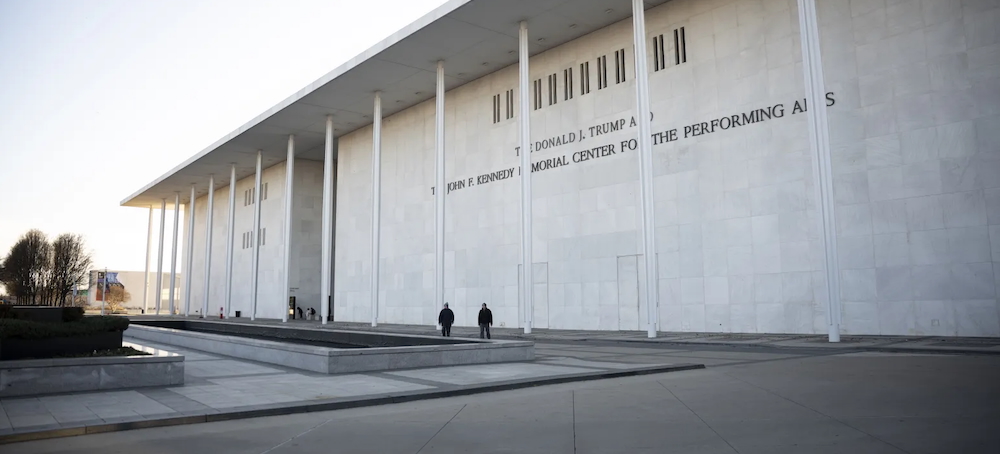 The John F. Kennedy Center for the Performing Arts in Washington, D.C. (photo: Celal Gunes/Anadolu/Getty Images)
Even in the best-case scenario, the president’s plan will only strain the performing arts ecosystem required for the center to thrive.
It was a seemingly small intervention from a man who fancies himself a connoisseur of architecture, but of course, it made no architectural or visual sense. Now, the all-white columns disappear against the building’s white marble cladding, and so too the lovely symbolism of the narrow, modernist metal supports, which look more like the strings of a musical instrument than the traditional, heavy stone supports of a classical structure.
Now there is grave concern from artists and patrons that the institution itself may disappear. Sunday night, Trump announced a two-year closure for renovation beginning in July, which sounds ominously like a complete rebuild of the structure. Trump added Monday that he wasn’t “ripping it down” but then went on to describe a process that could tear the structure down to its steel framing.
Given Trump’s sudden demolition of the White House’s East Wing in October, and the mix of vague promises and bombastic language in his social media post, which promises “a new and spectacular Entertainment Complex,” it certainly seems possible that the 1971 building, designed by architect Edward Durrell Stone, could be partially or completely erased. And with it, the center’s basic function, as a venue for the arts, along with its history, its distinguished legacy and its last remaining audience.
The center’s ambition, articulated by John F. Kennedy and emblazoned on the wall of the building, was to symbolize a nation “which commands respect throughout the world not only for its strength but for its civilization as well.” Now, it seems likely that the center will suffer yet more chaos, perhaps even deliberate destruction, as the 47th President mixes it into his larger agenda to remake the monumental and symbolic core of Washington after his own tinseled image.
A two-year closure suggests either that Trump doesn’t know how to sustain a viable performing arts center — which requires regular engagement, assembly and communion with its patrons, donors and artists — or he has plans to remake it into something unrecognizable. It might have been hyperbolic a few months ago to speculate that Trump would repurpose the center as a party palace or venue for popular entertainment and sporting events, but all of those possibilities have shifted from the unthinkable to the plausible.
Painting the steel columns was a minor detail in the proposed 2026 Capital Repair and Restoration Budget justification that the center submitted to Congress. That document focused on necessary repairs and upgrades, which are substantial, but not so substantial that the building would have to be closed for two full years. Like many mid-20th-century modernist buildings, the Kennedy Center has a flat roof, which, along with its terraces, creates drainage issues. It also requires routine asbestos abatement, elevator repairs and infrastructure upgrades.
Hardly any structure in the government’s real estate portfolio doesn’t suffer from some degree of deferred maintenance — democracies tend to be penny-wise and pound foolish when it comes to their investments. The Kennedy Center has the added challenge of staying up-to-date as a performance venue, which means upgrading things such as lighting and sound equipment. No one who has been there recently would deny the need for superficial refurbishment of the rugs and seating.
The Opera House also needs to address the outdated system that controls the elevation of its orchestra pit. Until Sunday night, the plan was to “minimize shutdowns to the theater and maximize the work that can be performed,” during a planned maintenance closure of the Opera House in 2027, according to the budget document.
Now, the goal seems not to minimize but maximize the disruption. Trump’s social media post suggested that complete closure was necessary to ensure quality work and move things along quickly. “If we don’t close, the quality of Construction will not be nearly as good, and the time to completion, because of interruptions with Audiences from the many Events using the Facility, will be much longer,” he wrote on Truth Social.
But previous large-scale renovations, including a major $175 million addition known as the Reach that opened in 2019 after four years of construction, were done strategically, without shutting down the entire center. The goal wasn’t to minimize “interruptions” to construction by the audience, but to preserve the audience with minimal disruption to the performance schedule.
If there is money for upgrading the center, there is a long list of reasonable improvements that would make the venue more popular with audiences. The Reach has never lived up to its potential, and it needs more staff to program it with diverse and engaging events that appeal to local and niche audiences. The food and beverage concessions have always been dismal. Ideally, the center would find a way to deck over the highway lanes that keep it disconnected from the city and public transportation. But these things do not seem to be on the agenda of a president who is big on vague promises and short on real details.
Even the best-case but highly unlikely scenario — a completely refurbished Kennedy Center with the concert hall, opera house and the Eisenhower and Terrace theaters intact, opening on time in July 2028 — will still present an existential danger to the center as a performing arts institution. The National Symphony Orchestra will be homeless for two years, and it can’t simply relocate to another theater or concert hall. It often gives three concerts a week, which requires a regular schedule of rehearsals, for which it needs an acoustically adequate environment. A letter sent Monday from NSO leaders to the group’s board members, musicians and staff, which The Washington Post obtained, said that the orchestra would continue to be funded and that the center would help it find a suitable location. But finding that space in the Washington area will be extraordinarily difficult.
Audiences will also be without a regular gathering place, and one lesson of the covid pandemic is that it can be very difficult to get patrons back into the habit of attending events once those habits have been disrupted. Booking artists, including soloists for the NSO, will also be difficult, given the uncertainty of what will be built, when it will be finished and who will be willing to pay money for tickets. Trump has effectively branded the Kennedy Center as his personal entertainment hall — as a place to premiere movies like the hagiographic “Melania” documentary — and that makes it toxic to many of its longtime patrons.
So, even if none of this happens, even if Trump’s Sunday evening bombshell was just another idle brain-dropping from the president, the Truth Social posting is already part of the chaos engulfing the center and cultural life in the nation’s capital. Artists, donors and staff who stuck with the center after Trump’s takeover a year ago and stayed committed even after he put his name on the building’s marble facade are tired of this nonsense, and likely to despair of the center if it remains closed for two years.
Sunday night, on social media and in conversations around the city among longtime patrons and audience members, there was a sense of profound grief. Conjecture that might once have seemed like wild speculation now feels like a grim assessment of likely reality. Audiences are boycotting the center, ticket sales have plummeted, and despite claims from the center’s leadership that they have secured some large donations, there is concern that the daily finances may be so bad that a two-year closure is more about saving face than making necessary repairs.
“How could this have happened?” I heard that question from several deeply committed arts patrons who believe, fundamentally, that a national capital without a viable arts center is a telltale sign of a new Iron Age, hard, cold and calculating. Was this a deliberate strategy of destruction, or just more reckless incompetence?
Stone, the center’s original architect, first used thin, gold anodized aluminum columns for his design of the United States Embassy in New Delhi, at a time when the United States actively sought to present itself to the world as an open, modern democracy and an ally to all who aspired to the same form of governance. The columns were stately but delicate, and they seemed not just to hold up the roof but to tie the building to the ground, as if it were, like the country it represented, in a state of natural ascendance.
The once-gold columns of the Kennedy Center did the same work: They read like columns but also like powerful cables that restrain the building’s exuberance. At sunset, as you approached for an evening performance, they also looked a bit like the strings of some great, wind-powered Aeolian harp that might produce (as in Coleridge’s poem) “a soft floating witchery of sound/As twilight Elfins make.” In a light wind, the building seemed like it might hum.
And for more than 50 years, it has hummed, inside, to the delight of millions. Now, it will go silent, perhaps for two years, possibly forever, if someone doesn’t intervene and stop this madness.