The Goodbye Stephen Colbert Wanted to Say
David Sims The Atlantic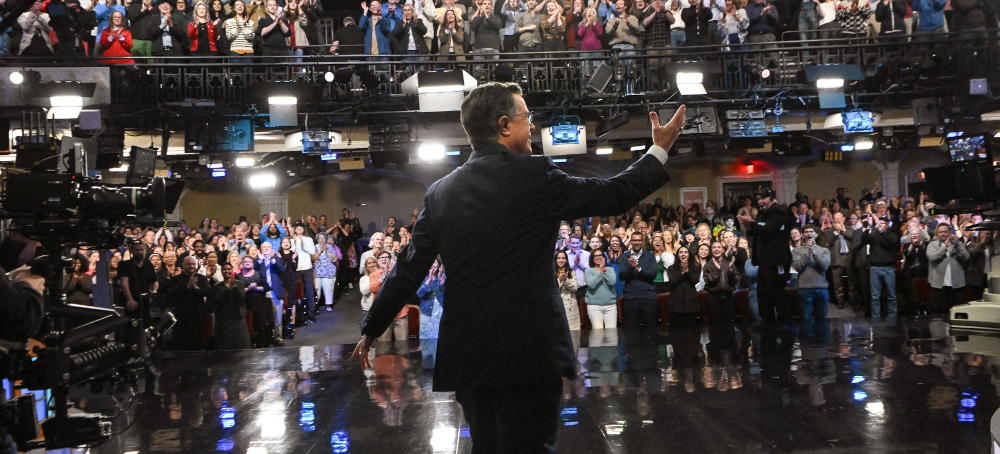 Late Show host Stephen Colbert. (photo: Scott Kowalchyk/Getty)
The late-night host ended his talk show the way he started it—with empathy, and an eye for entertainment.
In the case of hosts such as David Letterman and Johnny Carson, who picked the date and manner of their retirements, the send-offs were upbeat. Stephen Colbert, Letterman’s successor as host of CBS’s The Late Show for the past 11 years, is leaving his job under more forced, awkward circumstances. The network announced in July that it had canceled Colbert’s often politically sharp program for what it claimed were financial reasons; critics, and the host himself, questioned whether the move was in fact motivated by the CBS corporate owner Paramount’s desire to avoid further conflict with the Trump administration. Colbert has spent the intervening months doing the same show that put him atop the late-night ratings heap, and Thursday night’s series finale was, in many ways, an ordinary installment. And despite the circumstances, the host kept things bright, roping in a cavalcade of celebrities to send things out happily.
The marquee name for Colbert’s final interview (and musical performance) was Paul McCartney, though Colbert did jokingly nod to the rumors that Pope Leo XIV would be joining him, referring to McCartney as “infallible.” But the idea that the Pope would appear spoke to the overall image of Colbert’s Late Show as a thoughtful, more philosophical hour of comedy than its competitors—an ethos that will be hard to replace, now that CBS is putting him out to pasture. Colbert spent his final week on the air adhering to that tone: He waxed nostalgic with his friend and former The Daily Show collaborator Jon Stewart; invited Bruce Springsteen on to perform his anti-ICE protest anthem, “Streets of Minneapolis;” and put himself in the hot seat to complete his own “Colbert Questionert,” designed to eke out more intimate answers than usual from his celebrity guests.
Thursday’s program opened with him addressing the audience, reflecting upon the “reciprocal emotional relationship” he had developed with Late Show viewers over time. In that speech, he also laid out the energy he wanted to say goodbye with—cheerful, but still deeply empathetic. “We call this show the joy machine,” he said during his kickoff, “because to do this many shows, it has to be a machine. But if you choose to do it with joy, it doesn’t hurt as much when your fingers get caught in the gears.” He continued by referencing The Colbert Report, the satirical Comedy Central program that launched him to this job. On that show’s premiere episode in 2005, he recalled explaining that “anyone can read the news to you—I promise to feel the news at you. I realized pretty soon that our job over here was different. We’re here to feel the news with you. And I don’t know about you, but I sure have felt it.”
After his introduction, the episode proceeded normally for the most part. Bigshot guests popped up in the studio audience (including the actors Bryan Cranston, Paul Rudd, and Ryan Reynolds to do some bits and patter about the host going off-air, as Colbert moved through the usual jokes about the day’s news. After the monologue, he shifted to his desk for the show’s recurring “Meanwhile” segment, which echoes his slightly more pugilistic style of comedy on The Colbert Report. Then, he welcomed McCartney, whose appearance gave Colbert one last affable mega-celeb to chat with and evoked the history of the Ed Sullivan Theater, where The Late Show had been filmed since it premiered more than 30 years ago—The Beatles, of course, made their American TV debut in the studio back in 1964.
McCartney, ruminating on his first visit to America, recalled the band’s impression of the country as the place “where all the music we loved came from.” “So that’s what we thought—America was just the land of the free, the greatest democracy,” he said. “Still is,” he added with a bit of a wink. That comment was about as pointed as the humor got, though McCartney was likely a far livelier guest than the Pope might have been. After a final pre-taped segment that involved Colbert’s fellow hosts in the field—Stewart, Jimmy Kimmel, Jimmy Fallon, Seth Meyers, John Oliver—Colbert performed a song with Louis Cato of The Late Show’s house band, alongside the former bandleader Jon Batiste and Elvis Costello, before joining McCartney on stage to sing “Hello Goodbye.”
It was all pleasant, light, and bouncy—very much in line with the “joyous wake” version of late-night farewells; the entire crew of the show even took to the stage to dance with Colbert and McCartney as the night closed out. For all the awkward optics of his exit, and the iffy political implications that come with the loss of The Late Show, Colbert clearly wanted to remind everyone that he was an entertainer first and foremost. He may not have picked the timing of his departure, but after a proud run of more than 1,800 episodes, Colbert chose to leave with his head held high.