The FBI Seizure of Georgia 2020 Election Ballots Relies on Debunked Claims
Stephen Fowler NPR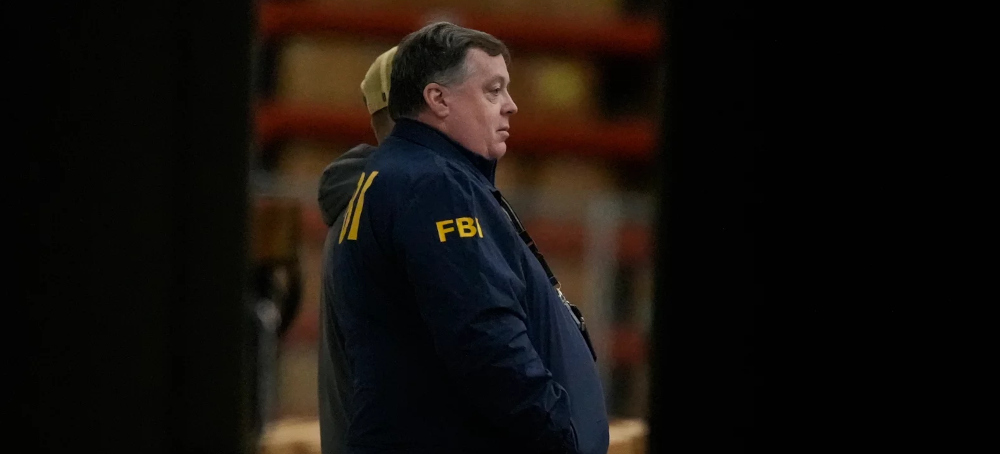 An FBI employee stands inside the Fulton County election hub, near Atlanta, as the FBI executes a search warrant for 2020 election materials, on Jan. 28. (photo: AP)
President Trump and his allies sought unsuccessfully to overturn that election, pushing baseless claims of widespread fraud. Fulton County's 2020 ballots were counted three separate times, with the results affirmed.
The affidavit — written by FBI Special Agent Hugh Raymond Evans and unsealed Tuesday — led to a judge signing off on a search warrant of Fulton County's elections hub, just outside Atlanta. The FBI executed that search warrant on Jan. 28, seizing more than 650 boxes of ballots and other 2020 election materials.
Yet the FBI's justification for seizing materials from more than five years ago relies on misleading claims of wrongdoing that were already investigated in detail by state law enforcement.
The claims largely align with allegations found in three cases presented to the Georgia State Election Board. Reports obtained by NPR show that investigators with the Georgia secretary of state's office found isolated examples of Fulton County election workers violating rules and procedures, but ultimately those errors did not affect the county's accurate tally.
The FBI did not reach out to state investigators for copies of prior investigations, two sources familiar with the ongoing probe who were not authorized to speak publicly tell NPR.
The affidavit mentions some of the state's investigations, and that one case resulted in a letter of reprimand for the county, but omitted key details from the investigations, such as one conclusion that their "findings do not affect the accuracy of the results of the 2020 General Election in Fulton County."
Republican Brad Raffensperger, the Georgia secretary of state who resisted Trump's efforts to overturn his 2020 election loss in the state, was critical of the probe. Raffensperger is now running for governor.
"As Secretary of State, I've made Georgia the safest and most secure place to vote," he said in a statement. "Instead of wasting time and tax dollars trying to change the past with baseless and repackaged claims, let's focus our efforts on building a safer, more affordable future for all hardworking Georgians."
State investigators already debunked claims of "defects"
The FBI investigation, according to the affidavit, is focused on five alleged "deficiencies or defects" with the election and the subsequent tabulation: missing images of ballots, ballots that were scanned multiple times, inconsistent vote counts during a hand-count audit, ballots that could have been improperly inserted into the totals and changing vote totals during a machine recount.
Of the five, NPR's review of state investigative files found only one claim that was "partially substantiated" by law enforcement who are trained election investigators — that some batches of ballots were scanned twice during a Trump-requested recount.
But ultimately, a 2024 report reads, "These investigative findings do not affect the accuracy of the results of the 2020 General Election in Fulton County, which were confirmed as accurate by both the [Risk-Limiting Audit] and the Recount."
In that same case, investigators found that the individuals who filed the complaint — Joe Rossi and Kevin Moncla — used incorrect calculations and records not involved in tallying results to make claims about missing images and tabulator tapes and changing vote totals.
Rossi's complaint matches the description of a redacted Witness 1 in the affidavit, which highlights the fact that investigations were opened, but not the conclusion that almost all of the claims were unfounded.
State law at the time also did not require counties to maintain ballot images as records. A 2021 omnibus bill that made numerous changes to Georgia elections added a requirement that ballot images be made publicly available.
The Georgia State Election Board voted to issue a letter of reprimand to Fulton County in 2024 as a result of that state investigation.
Another report that investigated the hand count of Fulton County's election found that complaints about mismatched tallies of ballots misunderstood the purpose of the risk-limiting audit, which is to confirm the winner of the election, rather than an exact count of votes.
"A precise count of over 5 million ballots by human beings in 159 jurisdictions is impossible," the 2022 report reads. "Humans counting will always produce errors. In Georgia, the difference was only 0.1053% in the number of votes cast and 0.0099% in the margin. These differences are well within the expected variances in a computer count vs. a hand count and further support the overall conclusion of the hand audit — that the initial reported result in the presidential contest in Georgia was correct."
Investigators with the Georgia secretary of state's office wrote that "these allegations, like so many, are well intentioned. That said, in nearly all of our investigations we are seeing the expected and normal degree of issues that occur due to human error in nearly every election."
Fulton County officials entered into a 2023 consent order with the State Election Board as a result of that case, in which the county promised to improve its audit process and both the state and county acknowledged there was no intentional misconduct and that errors did not affect the 2020 election result.
A final complaint was dismissed unanimously by the State Election Board in 2024 after an investigation found no evidence to support the claim that fraudulent ballots were found and counted in Fulton County — a claim that is included in last month's FBI affidavit."After interviewing all identified witnesses and reviewing identified batches of ballots, investigators could not substantiate the allegations of 'pristine" ballots being counted during the risk-limiting audit," that report reads.
In a statement, David Becker, a former Justice Department official who's now executive director of the Center for Election Information … Research, called the affidavit "much weaker than I suspected."
"After more than five years, dozens of court cases, and over a year in total control of the federal government, this is all they've got?" he said. "If taken at its word, this entire affidavit at most alleges human error after a late night during a global pandemic, all of which had no impact on the outcome of the race."
Trump-aligned lawyer behind FBI investigation
Additionally, the affidavit reveals that the FBI investigation was initiated by a lawyer working for the Trump administration who also aided Trump's efforts to try to overturn that election years ago.
"This warrant application is part of an FBI criminal investigation into whether any of the improprieties were intentional acts that violated federal criminal laws," the affidavit reads. "The FBI criminal investigation originated from a referral sent by Kurt Olsen, Presidentially appointed Director of Election Security and Integrity."
Olsen played an integral role in Trump's failed efforts to overturn his narrow 2020 election defeat by challenging the results in Georgia and other swing states.
The White House did not respond to NPR's questions Tuesday about Olsen's role in the administration.
The affidavit does not mention any evidence or suspicion of foreign election interference, raising more questions about the presence of Director of National Intelligence Tulsi Gabbard at the site of the raid.
In a letter to Democratic lawmakers last week, after the search, Gabbard defended her role in investigating election security. She also confirmed that she "facilitated a brief phone call for the President to thank the [Atlanta-area FBI] agents personally for their work." The call was first reported by the New York Times. Gabbard said Trump "did not ask any questions, nor did he or I issue any directives."
Trump and his allies have continued to focus on the 2020 election and falsely claim he was victorious while also taking extraordinary steps to exert federal control over future voting, including suing states to try to obtain unredacted voter rolls and suggesting that Republicans "nationalize" elections.